Kovacevic Sanjin, Ivanov Milan, Zivotic Maja, Brkic Predrag, Miloradovic Zoran, Jeremic Rada, Mihailovic-Stanojevic Nevena, Vajic Una Jovana, Karanovic Danijela, Jovovic Djurdjica, Nesovic Ostojic Jelena
Department of Pathophysiology, Medical Faculty, University of Belgrade, 11000 Belgrade, Serbia.
Department of Cardiovascular Physiology, Institute for Medical Research, University of Belgrade, 11129 Belgrade, Serbia.
Antioxidants (Basel). 2021 Jul 22;10(8):1163. doi: 10.3390/antiox10081163.
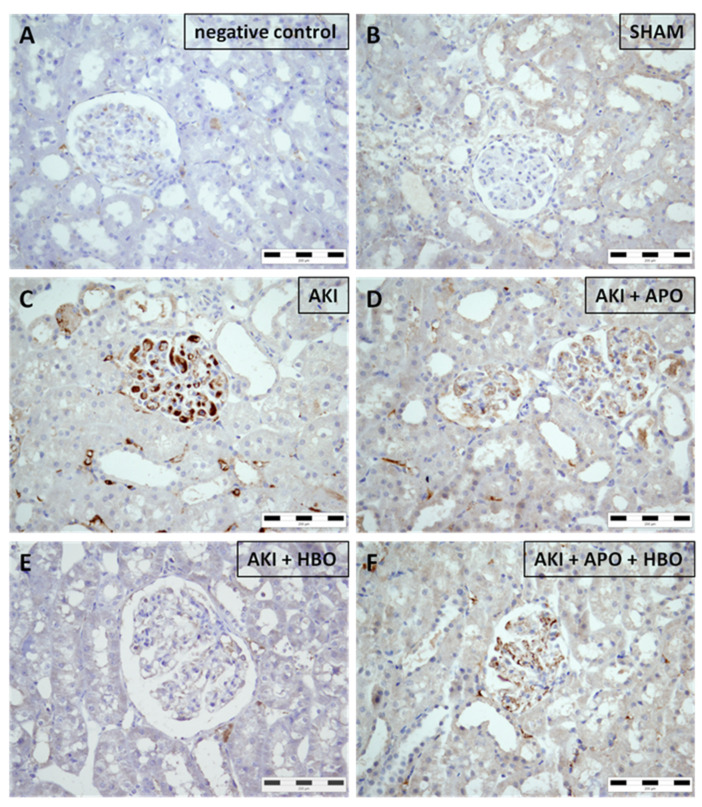
Oxidative stress has been considered as a central aggravating factor in the development of postischemic acute kidney injury (AKI). The aim of this study was to perform the immunohistochemical analysis of 4-hydroxynonenal (4-HNE), neutrophil gelatinase-associated lipocalin (NGAL), and heme oxygenase-1 (HO-1) tissue expression after apocynin (APO) treatment and hyperbaric oxygenation (HBO) preconditioning, applied as single or combined protocol, in postischemic acute kidney injury induced in spontaneously hypertensive rats (SHR). Twenty-four hours before AKI induction, HBO preconditioning was carried out by exposing to pure oxygen (2.026 bar) twice a day, for 60 min in two consecutive days. Acute kidney injury was induced by removal of the right kidney while the left renal artery was occluded for 45 min by atraumatic clamp. Apocynin was applied in a dose of 40 mg/kg body weight, intravenously, 5 min before reperfusion. We showed increased 4-HNE renal expression in postischemic AKI compared to Sham-operated (SHAM) group. Apocynin treatment, with or without HBO preconditioning, improved creatinine and phosphate clearances, in postischemic AKI. This improvement in renal function was accompanied with decreased 4-HNE, while HO-1 kidney expression restored close to the control group level. NGAL renal expression was also decreased after apocynin treatment, and HBO preconditioning, with or without APO treatment. Considering our results, we can say that 4-HNE tissue expression can be used as a marker of oxidative stress in postischemic AKI. On the other hand, apocynin treatment and HBO preconditioning reduced oxidative damage, and this protective effect might be expected even in experimental hypertensive condition.
氧化应激被认为是缺血后急性肾损伤(AKI)发展过程中的一个核心加重因素。本研究的目的是对载脂蛋白(APO)治疗和高压氧(HBO)预处理(单独或联合方案)后,自发性高血压大鼠(SHR)缺血后急性肾损伤中4-羟基壬烯醛(4-HNE)、中性粒细胞明胶酶相关脂质运载蛋白(NGAL)和血红素加氧酶-1(HO-1)的组织表达进行免疫组化分析。在诱导AKI前24小时,通过每天两次暴露于纯氧(2.026巴),连续两天,每次60分钟进行HBO预处理。通过切除右肾,同时用无创伤夹将左肾动脉夹闭45分钟诱导急性肾损伤。在再灌注前5分钟,以40mg/kg体重的剂量静脉注射载脂蛋白。与假手术(SHAM)组相比,我们发现缺血后AKI中4-HNE的肾表达增加。载脂蛋白治疗,无论是否进行HBO预处理,均可改善缺血后AKI中的肌酐和磷酸盐清除率。肾功能的这种改善伴随着4-HNE的减少,而HO-1的肾表达恢复到接近对照组水平。载脂蛋白治疗后,无论是否进行APO治疗,HBO预处理也可使NGAL的肾表达降低。根据我们的结果,可以说4-HNE组织表达可作为缺血后AKI氧化应激的标志物。另一方面,载脂蛋白治疗和HBO预处理可减少氧化损伤,即使在实验性高血压条件下也可能预期有这种保护作用。