Division of Neurodegenerative Disorders, St. Boniface Hospital Research, Winnipeg, MB R2H 2A6, Canada.
Department of Pharmacology & Therapeutics, University of Manitoba, Winnipeg, MB R3E 0T6, Canada.
Cells. 2021 Jul 25;10(8):1884. doi: 10.3390/cells10081884.
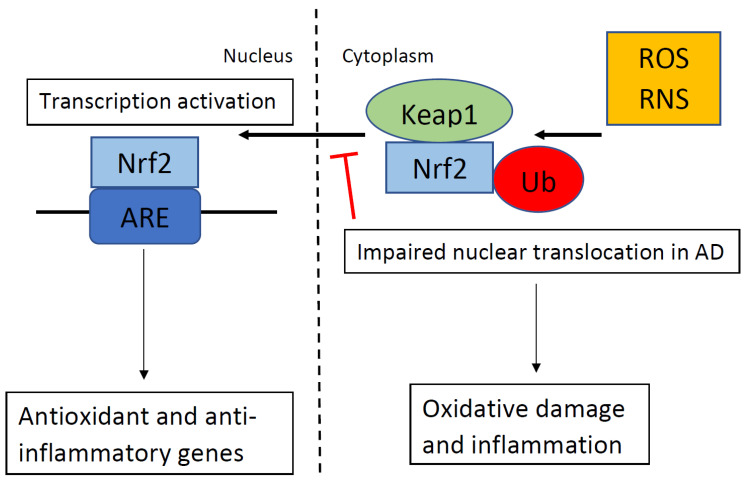
Nuclear factor erythroid 2-related factor 2 (Nrf2) is an important transcription factor that reduces oxidative stress. When reactive oxygen species (ROS) or reactive nitrogen species (RNS) are detected, Nrf2 translocates from the cytoplasm into the nucleus and binds to the antioxidant response element (ARE), which regulates the expression of antioxidant and anti-inflammatory genes. Nrf2 impairments are observed in the majority of neurodegenerative disorders, including Alzheimer's disease (AD). The classic hallmarks of AD include β-amyloid (Aβ) plaques, and neurofibrillary tangles (NFTs). Oxidative stress is observed early in AD and is a novel therapeutic target for the treatment of AD. The nuclear translocation of Nrf2 is impaired in AD compared to controls. Increased oxidative stress is associated with impaired memory and synaptic plasticity. The administration of Nrf2 activators reverses memory and synaptic plasticity impairments in rodent models of AD. Therefore, Nrf2 activators are a potential novel therapeutic for neurodegenerative disorders including AD.
核因子红细胞 2 相关因子 2(Nrf2)是一种重要的转录因子,可减少氧化应激。当检测到活性氧(ROS)或活性氮(RNS)时,Nrf2 从细胞质易位到细胞核,并与抗氧化反应元件(ARE)结合,调节抗氧化和抗炎基因的表达。在包括阿尔茨海默病(AD)在内的大多数神经退行性疾病中都观察到 Nrf2 损伤。AD 的典型特征包括β-淀粉样蛋白(Aβ)斑块和神经原纤维缠结(NFTs)。氧化应激在 AD 中很早就出现,是治疗 AD 的新的治疗靶点。与对照组相比,AD 中 Nrf2 的核易位受损。氧化应激增加与记忆和突触可塑性受损有关。在 AD 的啮齿动物模型中,给予 Nrf2 激活剂可逆转记忆和突触可塑性损伤。因此,Nrf2 激活剂是包括 AD 在内的神经退行性疾病的一种有潜力的新型治疗方法。