Adlimoghaddam Aida, Odero Gary G, Glazner Gordon, Turner R Scott, Albensi Benedict C
1Division of Neurodegenerative Disorders, St. Boniface Hospital Research, Winnipeg, MB, Canada.
2Department of Pharmacology & Therapeutics, University of Manitoba, Winnipeg, MB, Canada.
Aging Dis. 2021 Apr 1;12(2):441-465. doi: 10.14336/AD.2020.0910. eCollection 2021 Apr.
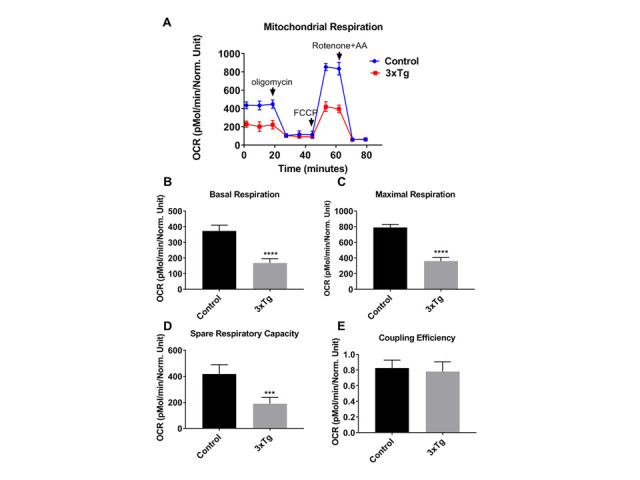
Current treatments targeting amyloid beta in Alzheimer's disease (AD) have minimal efficacy, which results in a huge unmet medical need worldwide. Accumulating data suggest that brain mitochondrial dysfunction play a critical role in AD pathogenesis. Targeting cellular mechanisms associated with mitochondrial dysfunction in AD create a novel approach for drug development. This study investigated the effects of nilotinib, as a selective tyrosine kinase inhibitor, in astroglia derived from 3xTg-AD mice versus their C57BL/6-controls. Parameters included oxygen consumption rates (OCR), ATP, cytochrome c oxidase (COX), citrate synthase (CS) activity, alterations in oxidative phosphorylation (OXPHOS), nuclear factor kappa B (NF-κB), key regulators of mitochondrial dynamics (mitofusin (Mfn1), dynamin-related protein 1 (Drp1)), and mitochondrial biogenesis (peroxisome proliferator-activated receptor gamma coactivator1-alpha (PGC-1α), calcium/calmodulin-dependent protein kinase II (CaMKII), and nuclear factor (erythroid-derived 2)-like 2 (Nrf2)). Nilotinib increased OCR, ATP, COX, Mfn1, and OXPHOS levels in 3xTg astroglia. No significant differences were detected in levels of Drp1 protein and CS activity. Nilotinib enhanced mitochondrial numbers, potentially through a CaMKII-PGC1α-Nrf2 pathway in 3xTg astroglia. Additionally, nilotinib-induced OCR increases were reduced in the presence of the NF-κB inhibitor, Bay11-7082. The data suggest that NF-κB signaling is intimately involved in nilotinib-induced changes in bioenergetics in 3xTg brain astroglia. Nilotinib increased translocation of the NF-κB p50 subunit into the nucleus of 3xTg astroglia that correlates with an increased expression and activation of NF-κB. The current findings support a role for nilotinib in improving mitochondrial function and suggest that astroglia may be a key therapeutic target in treating AD.
目前针对阿尔茨海默病(AD)中β淀粉样蛋白的治疗效果甚微,这在全球范围内造成了巨大的未满足医疗需求。越来越多的数据表明,脑线粒体功能障碍在AD发病机制中起关键作用。针对AD中线粒体功能障碍相关的细胞机制为药物开发创造了一种新方法。本研究调查了作为选择性酪氨酸激酶抑制剂的尼洛替尼对源自3xTg-AD小鼠及其C57BL/6对照小鼠的星形胶质细胞的影响。参数包括耗氧率(OCR)、ATP、细胞色素c氧化酶(COX)、柠檬酸合酶(CS)活性、氧化磷酸化(OXPHOS)的改变、核因子κB(NF-κB)、线粒体动力学的关键调节因子(线粒体融合蛋白(Mfn1)、动力蛋白相关蛋白1(Drp1))以及线粒体生物发生(过氧化物酶体增殖物激活受体γ共激活因子1-α(PGC-1α)、钙/钙调蛋白依赖性蛋白激酶II(CaMKII)和核因子(红细胞衍生2)样2(Nrf2))。尼洛替尼增加了3xTg星形胶质细胞中的OCR、ATP、COX、Mfn1和OXPHOS水平。在Drp1蛋白水平和CS活性方面未检测到显著差异。尼洛替尼可能通过3xTg星形胶质细胞中的CaMKII-PGC1α-Nrf2途径增加线粒体数量。此外,在存在NF-κB抑制剂Bay11-7082的情况下,尼洛替尼诱导的OCR增加有所降低。数据表明,NF-κB信号通路密切参与了尼洛替尼诱导的3xTg脑星形胶质细胞生物能量学变化。尼洛替尼增加了NF-κB p50亚基向3xTg星形胶质细胞核内的转位,这与NF-κB表达和激活的增加相关。目前的研究结果支持尼洛替尼在改善线粒体功能方面的作用,并表明星形胶质细胞可能是治疗AD的关键治疗靶点。