
饲养基质对黑水虻总蛋白和氨基酸组成的影响。
Effect of the Rearing Substrate on Total Protein and Amino Acid Composition in Black Soldier Fly.
作者信息
Fuso Andrea, Barbi Silvia, Macavei Laura Ioana, Luparelli Anna Valentina, Maistrello Lara, Montorsi Monia, Sforza Stefano, Caligiani Augusta
机构信息
Food and Drug Department, University of Parma, Via Parco Area delle Scienze 17/A, 43124 Parma, Italy.
Interdepartmental Research Center for Industrial Research and Technology Transfer in the Field of Integrated Technologies for Sustainable Research, Efficient Energy Conversion, Energy Efficiency of Buildings, Lighting and Home Automation-En&Tech, University of Modena and Reggio Emilia, Via Amendola 2, 42122 Reggio Emilia, Italy.
出版信息
Foods. 2021 Jul 30;10(8):1773. doi: 10.3390/foods10081773.
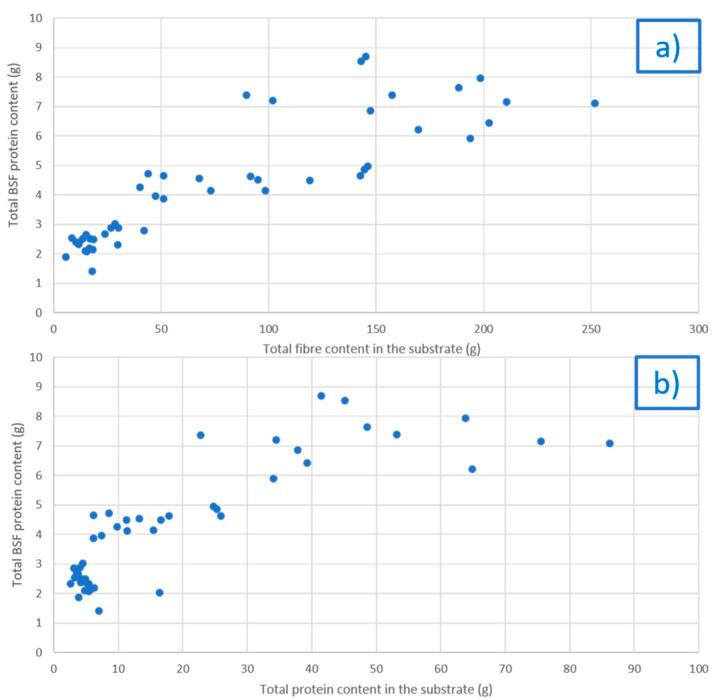
Insects are becoming increasingly relevant as protein sources in food and feed. The Black Soldier Fly (BSF) is one of the most utilized, thanks to its ability to live on many leftovers. Vegetable processing industries produce huge amounts of by-products, and it is important to efficiently rear BSF on different substrates to assure an economical advantage in bioconversion and to overcome the seasonality of some leftovers. This work evaluated how different substrates affect the protein and amino acid content of BSF. BSF prepupae reared on different substrates showed total protein content varying between 35% and 49% on dry matter. Significant lower protein contents were detected in BSF grown on fruit by-products, while higher contents were observed when autumnal leftovers were employed. BSF protein content was mainly correlated to fibre and protein content in the diet. Among amino acids, lysine, valine and leucine were most affected by the diet. Essential amino acids satisfied the Food and Agricultural Organization (FAO) requirements for human nutrition, except for lysine in few cases. BSF could be a flexible tool to bio-convert a wide range of vegetable by-products of different seasonality in a high-quality protein-rich biomass, even if significant differences in the protein fraction were observed according to the rearing substrate.
昆虫作为食品和饲料中的蛋白质来源正变得越来越重要。黑水虻是最常被利用的昆虫之一,这得益于其能够以许多剩菜剩饭为食。蔬菜加工行业会产生大量副产品,高效地在不同底物上饲养黑水虻对于确保生物转化中的经济优势以及克服某些剩菜剩饭的季节性至关重要。这项工作评估了不同底物如何影响黑水虻的蛋白质和氨基酸含量。在不同底物上饲养的黑水虻预蛹干物质中的总蛋白质含量在35%至49%之间变化。在以水果副产品为食的黑水虻中检测到的蛋白质含量显著较低,而使用秋季剩菜剩饭时则观察到较高的含量。黑水虻的蛋白质含量主要与饲料中的纤维和蛋白质含量相关。在氨基酸中,赖氨酸、缬氨酸和亮氨酸受饲料影响最大。除少数情况下的赖氨酸外,必需氨基酸满足了联合国粮食及农业组织(FAO)对人类营养的要求。即使根据饲养底物观察到蛋白质部分存在显著差异,黑水虻仍可能是一种灵活的工具,可将各种不同季节性的蔬菜副产品生物转化为富含优质蛋白质的生物质。




 Zotero 插件