Department of Basic Medical Sciences, College of Osteopathic Medicine, Western University of Health Sciences, Pomona, CA 91766, USA.
Department of Health and Human Development, University of Suceava, 7200229 Suceava, Romania.
Nutrients. 2021 Jul 27;13(8):2581. doi: 10.3390/nu13082581.
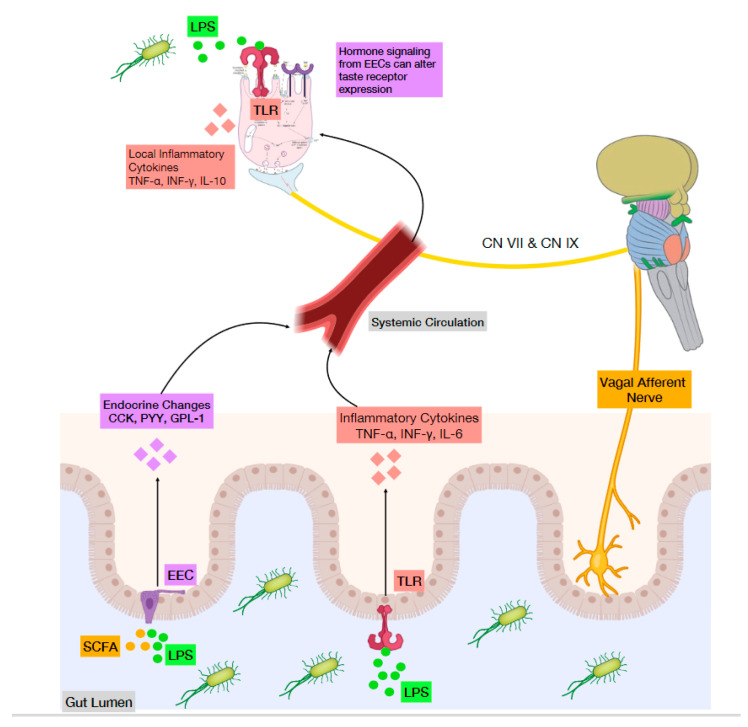
Gut microbiota has emerged as a major metabolically active organ with critical functions in both health and disease. The trillions of microorganisms hosted by the gastrointestinal tract are involved in numerous physiological and metabolic processes including modulation of appetite and regulation of energy in the host spanning from periphery to the brain. Indeed, bacteria and their metabolic byproducts are working in concert with the host chemosensory signaling pathways to affect both short- and long-term ingestive behavior. Sensing of nutrients and taste by specialized G protein-coupled receptor cells is important in transmitting food-related signals, optimizing nutrition as well as in prevention and treatment of several diseases, notably obesity, diabetes and associated metabolic disorders. Further, bacteria metabolites interact with specialized receptors cells expressed by gut epithelium leading to taste and appetite response changes to nutrients. This review describes recent advances on the role of gut bacteria in taste perception and functions. It further discusses how intestinal dysbiosis characteristic of several pathological conditions may alter and modulate taste preference and food consumption via changes in taste receptor expression.
肠道微生物群已成为一个主要的代谢活跃器官,在健康和疾病中具有关键功能。胃肠道中存在的数以万亿计的微生物参与了许多生理和代谢过程,包括调节食欲和调节宿主从外周到大脑的能量。事实上,细菌及其代谢产物与宿主化学感觉信号通路协同作用,影响短期和长期的摄食行为。专门的 G 蛋白偶联受体细胞对营养物质和味觉的感知在传递与食物相关的信号、优化营养以及预防和治疗肥胖症、糖尿病和相关代谢紊乱等多种疾病方面非常重要。此外,细菌代谢物与肠道上皮表达的专门受体细胞相互作用,导致对营养物质的味觉和食欲反应发生变化。这篇综述描述了肠道细菌在味觉感知和功能中的作用的最新进展。它进一步讨论了几种病理情况下肠道微生物失调如何通过改变味觉受体表达来改变和调节味觉偏好和食物摄入。