Jeon Joong Suk, Kang He Mi, Park Ju Ha, Kang Jum Soon, Lee Yong Jae, Park Young Hoon, Je Byoung Il, Park Sun Young, Choi Young Whan
Department of Horticultural Bioscience, Pusan National University, Myrang 627-706, Korea.
Bio-IT Fusion Technology Research Institute, Pusan National University, Busan 609-735, Korea.
Plants (Basel). 2021 Aug 9;10(8):1633. doi: 10.3390/plants10081633.
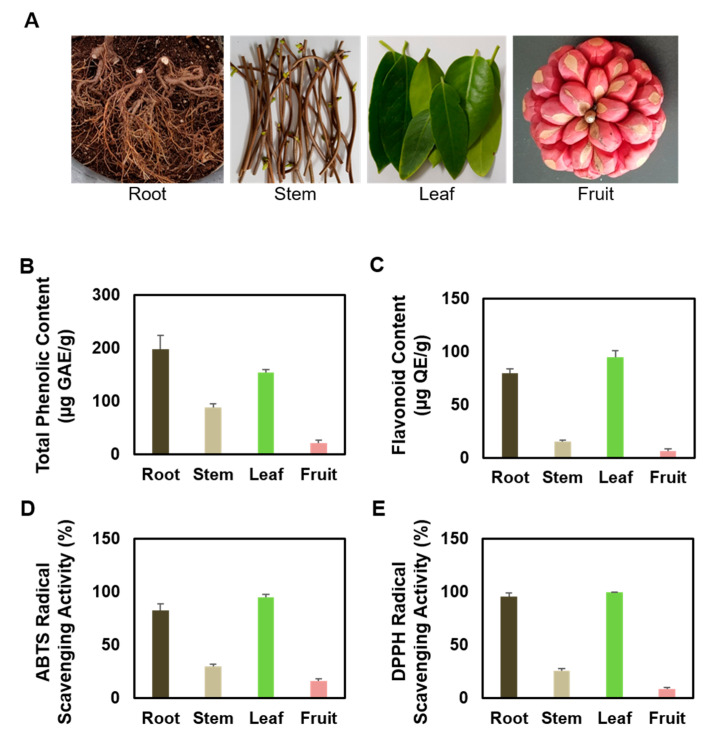
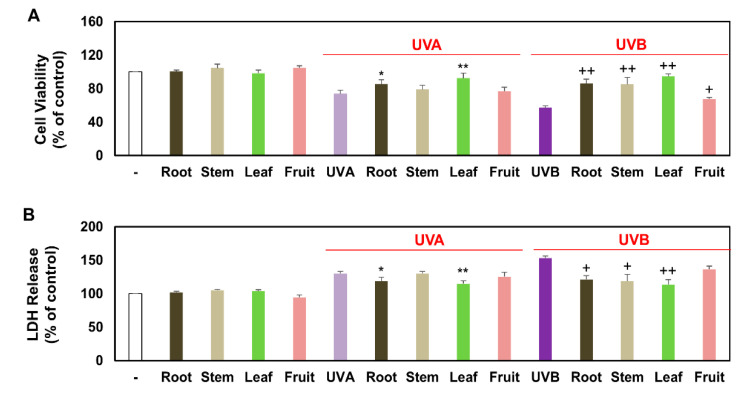
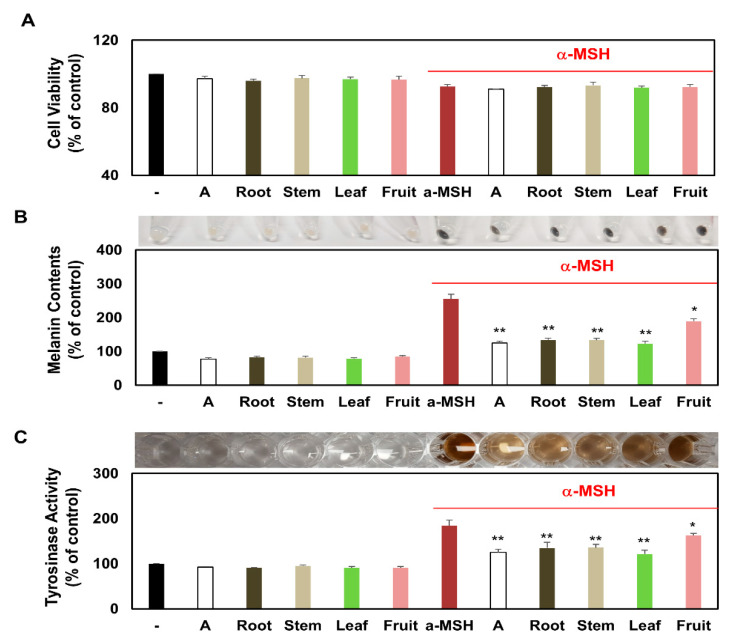
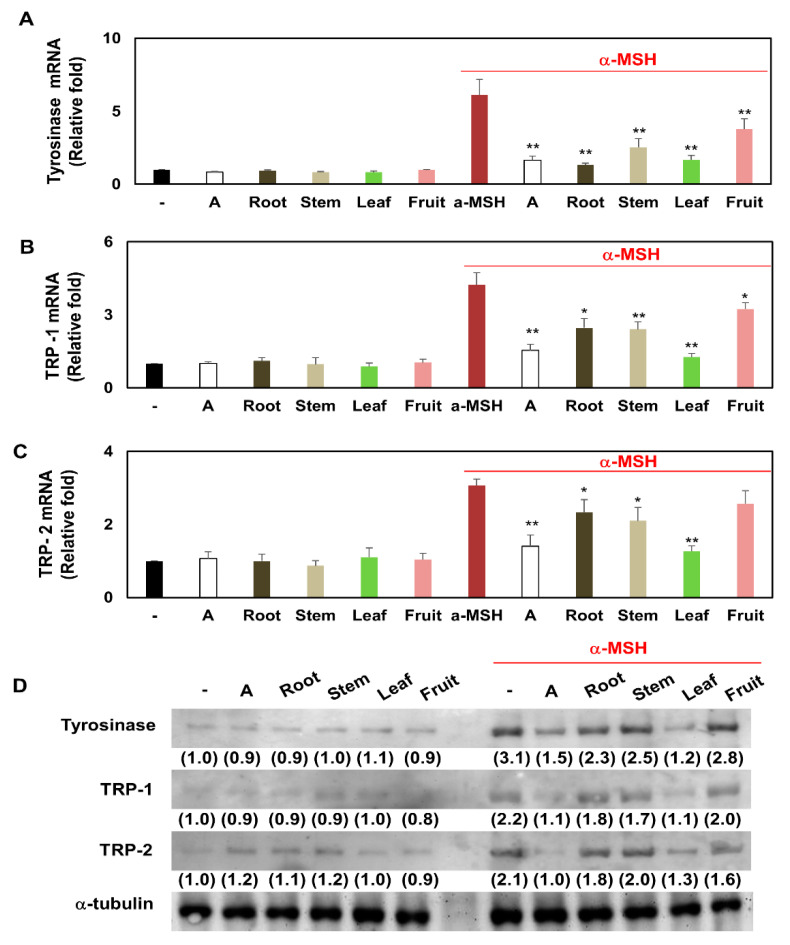
(KC), a beneficial plant for human health, has been used for centuries in China, Thailand, and Korea in folk medicine and food. There is evidence supporting the biological effects of highly bioactive ingredients in KC such as lignans, triterpenoids, flavonoids, phenolic acids, steroids, and amino acids. In this study, we aimed to explore the effects, functions, and mechanisms of the extracts from KC root (KCR), stem (KCS), leaf (KCL), and fruit (KCF) in UVA and UVB-irradiated keratinocytes and α-melanocyte stimulating hormone (α-MSH)-stimulated melanocytes. First, the total polyphenol and flavonoid contents of KCR, KCS, KCL, and KCF and their radical scavenging activities were investigated. These parameters were found to be in the following order: KCL > KCR > KCS > KCF. UVA and UVB-irradiated keratinocytes were treated with KCR, KCS, KCL, and KCF, and keratinocyte viability, LDH release, intracellular ROS production, and apoptosis were examined. Our results demonstrated that KC extracts improved keratinocyte viability and reduced LDH release, intracellular ROS production, and apoptosis in the presence UVA and UVB irradiation. The overall photoprotective activity of the KC extracts was confirmed in the following order: KCL > KCR > KCS > KCF. Moreover, KC extracts significantly decreased the intracellular melanin content and tyrosinase activity in α-MSH-stimulated melanocytes. Mechanistically, KC extracts reduced the protein and mRNA expression levels of tyrosinase, tyrosinase-related protein-1 (TRP-1), and tyrosinase-related protein-2 (TRP-2) in α-MSH-stimulated melanocytes. In addition, these extracts markedly downregulated myophthalmosis-related transcription factor expression and cAMP-related binding protein phosphorylation, which is upstream of the regulation of Tyrosinase, TRP-1, and TRP-2. The overall anti-melanogenic activity of the KC extracts was established in the following order. KCL > KCR > KCS > KCF. Overall, the KC extracts exert photoprotective and anti-melanogenic effects, providing a basis for developing potential skin-whitening and photoprotective agents.
苦参(KC)是一种对人体健康有益的植物,在中国、泰国和韩国已被用于民间医学和食品领域达数百年之久。有证据支持苦参中高生物活性成分如木脂素、三萜类化合物、黄酮类化合物、酚酸、甾体和氨基酸的生物学效应。在本研究中,我们旨在探讨苦参根(KCR)、茎(KCS)、叶(KCL)和果实(KCF)提取物对紫外线A(UVA)和紫外线B(UVB)照射的角质形成细胞以及α-黑素细胞刺激素(α-MSH)刺激的黑素细胞的作用、功能及机制。首先,研究了KCR、KCS、KCL和KCF的总多酚和黄酮含量及其自由基清除活性。发现这些参数按以下顺序排列:KCL>KCR>KCS>KCF。用KCR、KCS、KCL和KCF处理UVA和UVB照射的角质形成细胞,并检测角质形成细胞活力、乳酸脱氢酶(LDH)释放、细胞内活性氧(ROS)产生和细胞凋亡。我们的结果表明,在UVA和UVB照射下,苦参提取物可提高角质形成细胞活力,并减少LDH释放、细胞内ROS产生和细胞凋亡。苦参提取物的总体光保护活性按以下顺序得到证实:KCL>KCR>KCS>KCF。此外,苦参提取物可显著降低α-MSH刺激的黑素细胞内的黑色素含量和酪氨酸酶活性。从机制上讲,苦参提取物降低了α-MSH刺激的黑素细胞中酪氨酸酶、酪氨酸酶相关蛋白-1(TRP-1)和酪氨酸酶相关蛋白-2(TRP-2)的蛋白质和mRNA表达水平。此外,这些提取物显著下调了小眼症相关转录因子表达和环磷酸腺苷(cAMP)相关结合蛋白磷酸化,而这两者位于酪氨酸酶、TRP-1和TRP-2调控的上游。苦参提取物的总体抗黑素生成活性按以下顺序确定:KCL>KCR>KCS>KCF。总体而言,苦参提取物具有光保护和抗黑素生成作用,为开发潜在的皮肤美白和光保护剂提供了依据。