Department of Environmental Science, Policy and Management University of California, 130 Mulford Hall, 94720, Berkeley, CA, USA.
School of Public Health, University of California, Berkeley, CA, USA.
Environ Health. 2021 Aug 28;20(1):97. doi: 10.1186/s12940-021-00778-z.
Environmental chemical exposures can affect telomere length, which in turn has been associated with adverse health outcomes including cancer. Firefighters are occupationally exposed to many hazardous chemicals and have higher rates of certain cancers. As a potential biomarker of effect, we assessed associations between chemical exposures and telomere length in women firefighters and office workers from San Francisco, CA.
We measured serum concentrations of polyfluoroalkyl substances (PFAS), urinary metabolites of flame retardants, including organophosphate flame retardants (OPFRs), and telomere length in peripheral blood leukocytes in women firefighters (N = 84) and office workers (N = 79) who participated in the 2014-15 Women Workers Biomonitoring Collaborative. Multiple linear regression models were used to assess associations between chemical exposures and telomere length.
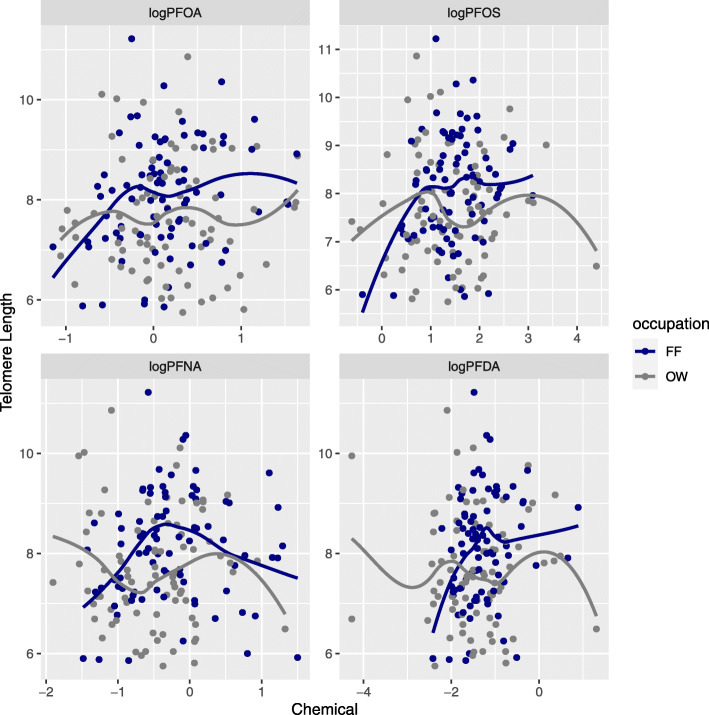
Regression results revealed significant positive associations between perfluorooctanoic acid (PFOA) and telomere length and perfluorooctanesulfonic acid (PFOS) and telomere length among the whole cohort. Models stratified by occupation showed stronger and more significant associations among firefighters as compared to office workers. Among firefighters in models adjusted for age, we found positive associations between telomere length and log-transformed PFOA (β (95%CI) = 0.57(0.12, 1.02)), PFOS (0.44 (0.05, 0.83)), and perfluorodecanoic acid (PFDA) (0.43 (0.02, 0.84)). Modeling PFAS as categories of exposure showed significant associations between perfluorononanoic acid (PFNA) and telomere length among firefighters. Significant associations between OPFR metabolites and telomere length were seen for bis (1,3-dichloro-2-propyl) phosphate (BDCPP) and telomere length among office workers (0.21(0.03, 0.40)) and bis (2-chloroethyl) phosphate (BCEP) and telomere length among firefighters (- 0.14(- 0.28, - 0.01)). For OPFRs, the difference in the direction of effect by occupational group may be due to the disparate detection frequencies and concentrations of exposure between the two groups and/or potential unmeasured confounding.
Our findings suggest positive associations between PFAS and telomere length in women workers, with larger effects seen among firefighters as compared to office workers. The OPFR metabolites BDCPP and BCEP are also associated with telomere length in firefighters and office workers. Associations between chemical exposures and telomere length reported here and by others suggest mechanisms by which these chemicals may affect carcinogenesis and other adverse health outcomes.
环境化学暴露会影响端粒长度,而端粒长度又与癌症等不良健康结果有关。消防员职业性接触多种有害化学物质,某些癌症的发病率较高。作为一种潜在的效应生物标志物,我们评估了加利福尼亚州旧金山的女性消防员和办公室工作人员的化学暴露与端粒长度之间的关联。
我们测量了 84 名女性消防员和 79 名办公室工作人员血清中的全氟辛烷磺酸(PFOS)和多氟辛酸(PFOA)等多氟烷基物质(PFAS)浓度、尿液中阻燃剂代谢物,包括有机磷酸酯阻燃剂(OPFRs)和外周血白细胞中的端粒长度。多线性回归模型用于评估化学暴露与端粒长度之间的关联。
回归结果显示,整个队列中,全氟辛酸(PFOA)和端粒长度以及全氟辛烷磺酸(PFOS)和端粒长度之间存在显著正相关。按职业分层的模型显示,与办公室工作人员相比,消防员之间的关联更强、更显著。在调整年龄的模型中,我们发现端粒长度与 PFOA 的对数(β(95%CI)= 0.57(0.12,1.02))、PFOS(0.44(0.05,0.83))和全氟癸酸(PFDA)(0.43(0.02,0.84))之间存在正相关。将 PFAS 建模为暴露类别时,发现 PFNA 与消防员的端粒长度之间存在显著关联。在办公室工作人员中,双(1,3-二氯-2-丙基)磷酸酯(BDCPP)和端粒长度(0.21(0.03,0.40))以及双(2-氯乙基)磷酸酯(BCEP)和端粒长度(-0.14(-0.28,-0.01))之间也存在 OPFR 代谢物和端粒长度之间的显著关联。职业组之间 OPFR 代谢物方向效应的差异可能归因于两组之间不同的检测频率和暴露浓度,或者潜在的未测量混杂因素。
我们的研究结果表明,女性工人的 PFAS 与端粒长度呈正相关,与办公室工作人员相比,消防员的相关性更强。OPFR 代谢物 BDCPP 和 BCEP 也与消防员和办公室工作人员的端粒长度有关。这里和其他人报告的化学暴露与端粒长度之间的关联表明,这些化学物质可能通过影响致癌作用和其他不良健康结果的机制发挥作用。