Bai Zhixun, Ma Yi, Shi Zhiyun, Li Ting, Hu Shan, Shi Bei
Department of Internal Medicine, The Second Affiliated Hospital of Zunyi Medical University, Zunyi, Guizhou, People's Republic of China.
Department of Cardiology, Affiliated Hospital of Zunyi Medical University, Zunyi, Guizhou, People's Republic of China.
Ther Clin Risk Manag. 2021 Aug 21;17:863-875. doi: 10.2147/TCRM.S320533. eCollection 2021.
This study aimed to establish an accurate and easy predictive model for ST-segment elevation myocardial infarction (STEMI) patients with hyperuricemia, using readily available features to estimate intrahospital mortality risk.
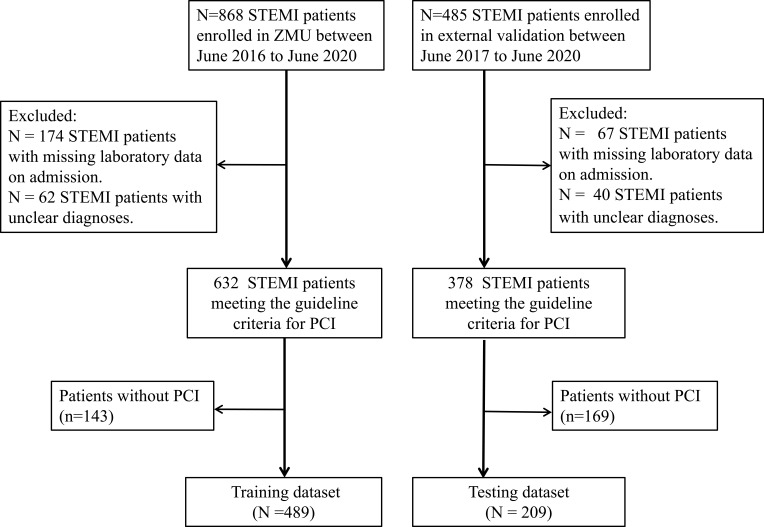
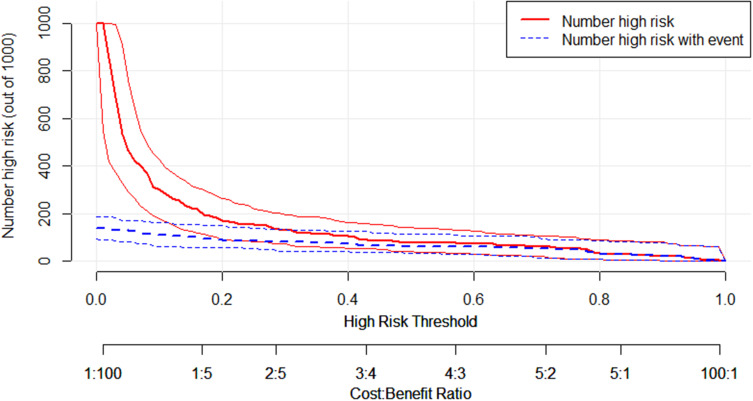
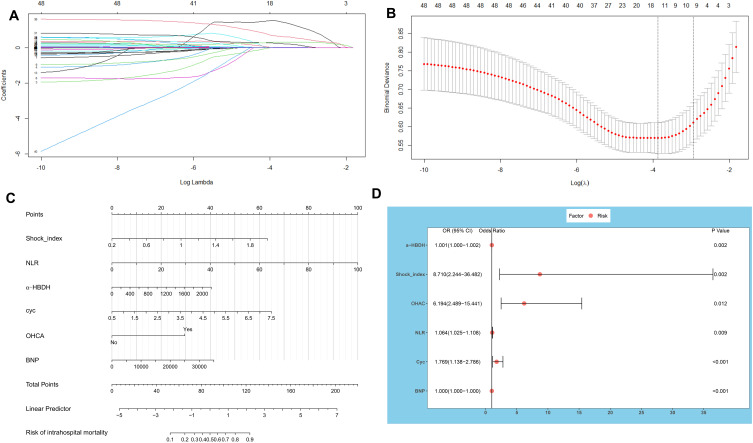
This was a multicenter retrospective study involving the development of risk prediction models for intrahospital mortality among all STEMI patients with hyperuricemia from Zunyi Medical University Chest Pain Center's specialized alliance between January 1, 2016 and June 30, 2020. The primary outcome was intrahospital mortality. A total of 48 candidate variables were considered from demographic and clinical data. The least absolute shrinkage and selection operator (LASSO) was used to develop a nomogram. Concordance index values, decision curve analysis, the area under the curve (AUC), and clinical impact curves were examined. In this study, 489 patients with STEMI were included in the training dataset and an additional 209 patients from the 44 chest pain centers were included in the test cohort. B-type natriuretic peptides, α-hydroxybutyrate dehydrogenase (α-HBDH), cystatin C, out-of-hospital cardiac arrest (OHCA), shock index, and neutrophil-to-lymphocyte ratio were associated with intrahospital mortality and included in the nomogram.
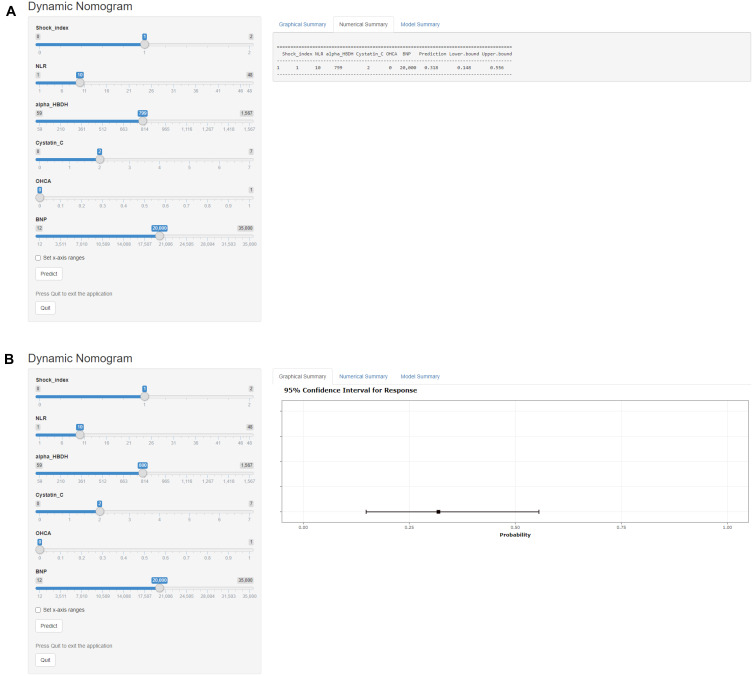
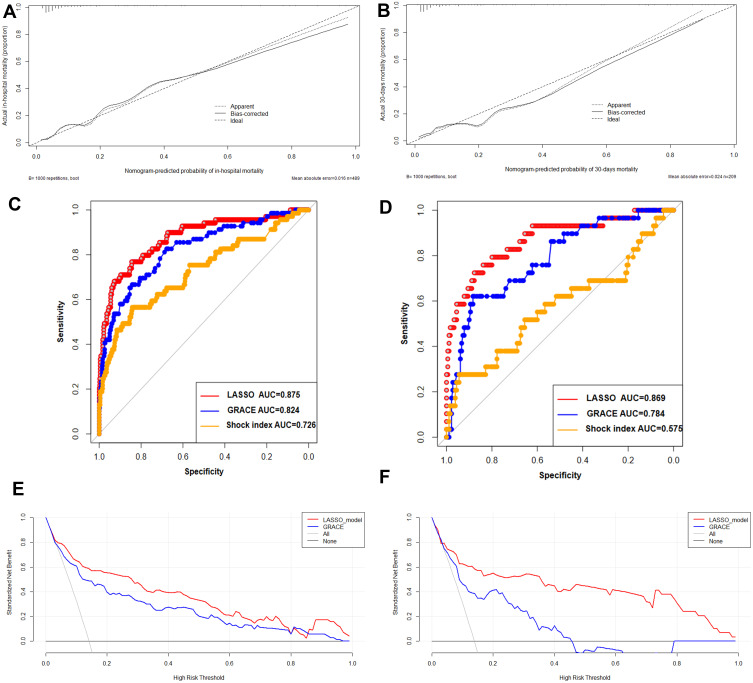
The model showed good discrimination power, and the AUC generated to predict survival in the training set was 0.875 (95% confidence interval, 0.825-0.925). In the validation set, the AUC of survival predictions was 0.87 (95% confidence interval, 0.792-0.947). Calibration plots and decision curve analysis showed good model performance in both datasets. A web-based calculator (https://bzxzmu.shinyapps.io/STEMI-with-Hyperuricemia-intrahospital-mortality/) was established based on the nomogram model, which was used to measure the levels of OHCA, neutrophil-to-lymphocyte ratio, shock index, α-HBDH, cystatin C, and B-type natriuretic peptides.
For practical applications, this model may prove clinically useful for personalized therapy management in patients with STEMI with hyperuricemia.
本研究旨在为高尿酸血症的ST段抬高型心肌梗死(STEMI)患者建立一个准确且简便的预测模型,利用易于获取的特征来估计院内死亡风险。
这是一项多中心回顾性研究,涉及为2016年1月1日至2020年6月30日期间遵义医科大学胸痛中心专科联盟内所有高尿酸血症的STEMI患者建立院内死亡风险预测模型。主要结局是院内死亡。从人口统计学和临床数据中总共考虑了48个候选变量。使用最小绝对收缩和选择算子(LASSO)构建列线图。检查一致性指数值、决策曲线分析、曲线下面积(AUC)和临床影响曲线。在本研究中,489例STEMI患者被纳入训练数据集,另外来自44个胸痛中心的209例患者被纳入测试队列。B型利钠肽、α-羟丁酸脱氢酶(α-HBDH)、胱抑素C、院外心脏骤停(OHCA)、休克指数和中性粒细胞与淋巴细胞比值与院内死亡相关,并被纳入列线图。
该模型显示出良好的区分能力,训练集中预测生存的AUC为0.875(95%置信区间,0.825 - 0.925)。在验证集中,生存预测的AUC为0.87(95%置信区间,0.792 - 0.947)。校准图和决策曲线分析表明该模型在两个数据集中均表现良好。基于列线图模型建立了一个基于网络的计算器(https://bzxzmu.shinyapps.io/STEMI-with-Hyperuricemia-intrahospital-mortality/),用于测量OHCA、中性粒细胞与淋巴细胞比值、休克指数、α-HBDH、胱抑素C和B型利钠肽的水平。
在实际应用中,该模型可能对高尿酸血症的STEMI患者进行个性化治疗管理具有临床实用价值。