Chen Wenwan, Sabharwal Ashutosh, Taylor Erica, Patel Ankit B, Moukaddam Nidal
Department of Electrical and Computer Engineering, Rice University, Houston, TX, United States.
Menninger Department of Psychiatry, Baylor College of Medicine, Houston, TX, United States.
Front Psychiatry. 2021 Aug 11;12:670020. doi: 10.3389/fpsyt.2021.670020. eCollection 2021.
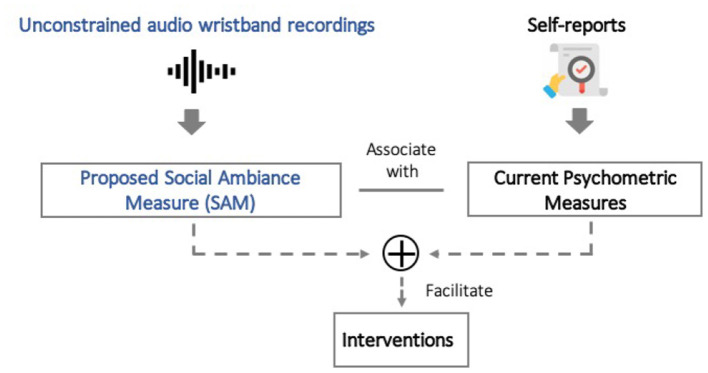
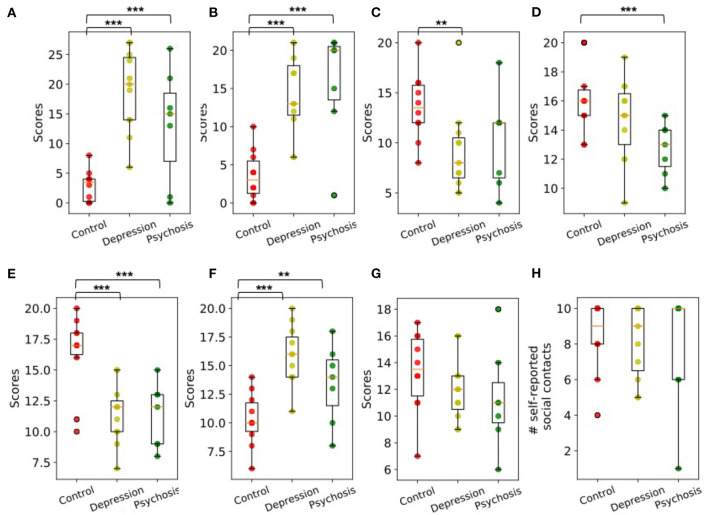
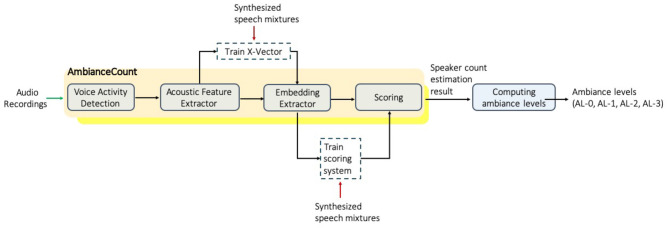
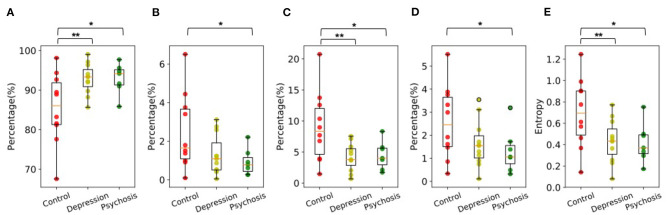
A social interaction consists of contributions by the individual, the environment and the interaction between the two. Ideally, to enable effective assessment and interventions for social isolation, an issue inherent to depressive and psychotic illnesses, the isolation must be identified in real-time and at an individual level. However, research addressing sociability deficits is largely focused on determining loneliness, rather than isolation, and lacks focus on the richness of the social environment the individual revolves in. In this paper, We describe the development of an automated, objective and privacy-preserving Social Ambiance Measure (SAM) that converts unconstrained audio recordings collected from wrist-worn audio-bands into four levels, ranging from none to active. The ambiance levels are based on the number of simultaneous speakers, which is a proxy for overall social activity in the environment. Results show that social ambiance patterns and time spent at each ambiance level differed between participants with depressive or psychotic disorders and healthy controls. Individuals with depression/psychosis spent less time in diverse environments and less time in moderate/active ambiance levels. Moreover, social ambiance patterns are found associated with the severity of self-reported depression, anxiety symptoms and personality traits. The results in this paper suggest that objectively measured social ambiance can be used as a marker of sociability, and holds potential to be leveraged to better understand social isolation and develop effective interventions for sociability challenges, thus improving mental health outcomes.
社交互动由个体、环境以及两者之间的相互作用构成。理想情况下,为了对抑郁和精神疾病所固有的社会隔离问题进行有效的评估和干预,必须在个体层面实时识别出隔离状态。然而,针对社交能力缺陷的研究主要集中在确定孤独感而非隔离状态,并且缺乏对个体所处社会环境丰富性的关注。在本文中,我们描述了一种自动化、客观且保护隐私的社交氛围测量方法(SAM)的开发,该方法将从腕戴式音频设备收集的无约束音频记录转换为从无到活跃的四个级别。氛围级别基于同时说话者的数量,这是环境中整体社交活动的一个指标。结果表明,抑郁或精神疾病患者与健康对照组在社交氛围模式以及在每个氛围级别所花费的时间上存在差异。患有抑郁症/精神病的个体在多样化环境中花费的时间较少,在中等/活跃氛围级别中花费的时间也较少。此外,发现社交氛围模式与自我报告的抑郁、焦虑症状以及人格特质的严重程度相关。本文的结果表明,客观测量的社交氛围可以用作社交能力的一个指标,并且有潜力被用于更好地理解社会隔离以及为社交挑战制定有效的干预措施,从而改善心理健康状况。