Electrical and Computer Engineering, Rice University, Houston, USA.
Menninger Department of Psychiatry and Behavioral Sciences, Baylor College of Medicine, Houston, TX, USA.
Sci Rep. 2024 Aug 13;14(1):18808. doi: 10.1038/s41598-024-69739-z.
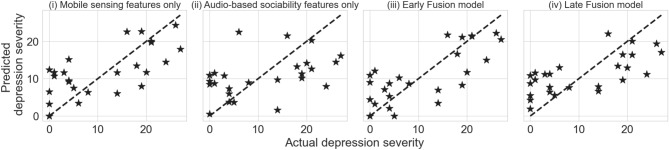
Mobile sensing-based depression severity assessment could complement the subjective questionnaires-based assessment currently used in practice. However, previous studies on mobile sensing for depression severity assessment were conducted on homogeneous mental health condition participants; evaluation of possible generalization across heterogeneous groups has been limited. Similarly, previous studies have not investigated the potential of free-living audio data for depression severity assessment. Audio recordings from free-living could provide rich sociability features to characterize depressive states. We conducted a study with 11 healthy individuals, 13 individuals with major depressive disorder, and eight individuals with schizoaffective disorders. Communication logs and location data from the participants' smartphones and continuous audio recordings of free-living from a wearable audioband were obtained over a week for each participant. The depression severity prediction model trained using communication log and location data features had a root mean squared error (rmse) of 6.80. Audio-based sociability features further reduced the rmse to 6.07 (normalized rmse of 0.22). Audio-based sociability features also improved the F1 score in the five-class depression category classification model from 0.34 to 0.46. Thus, free-living audio-based sociability features complement the commonly used mobile sensing features to improve depression severity assessment. The prediction results obtained with mobile sensing-based features are better than the rmse of 9.83 (normalized rmse of 0.36) and the F1 score of 0.25 obtained with a baseline model. Additionally, the predicted depression severity had a significant correlation with reported depression severity (correlation coefficient of 0.76, 0.001). Thus, our work shows that mobile sensing could model depression severity across participants with heterogeneous mental health conditions, potentially offering a screening tool for depressive symptoms monitoring in the broader population.
基于移动感知的抑郁严重程度评估可以补充当前实践中基于主观问卷的评估。然而,之前基于移动感知的抑郁严重程度评估的研究是在同质的心理健康条件参与者中进行的;评估跨异质群体的可能推广一直受到限制。同样,以前的研究也没有调查自由生活音频数据在抑郁严重程度评估中的潜力。自由生活中的音频记录可以提供丰富的社交特征来描述抑郁状态。我们对 11 名健康个体、13 名重度抑郁症患者和 8 名精神分裂情感障碍患者进行了一项研究。为每位参与者在一周内获得了来自参与者智能手机的通信日志和位置数据以及来自可穿戴音频带的自由生活的连续音频记录。使用通信日志和位置数据特征训练的抑郁严重程度预测模型的均方根误差(rmse)为 6.80。基于音频的社交特征进一步将 rmse 降低到 6.07(归一化 rmse 为 0.22)。基于音频的社交特征还提高了五分类抑郁类别分类模型的 F1 分数,从 0.34 提高到 0.46。因此,自由生活基于音频的社交特征补充了常用的移动感知特征,以改善抑郁严重程度评估。基于移动感知特征获得的预测结果优于基线模型获得的 9.83(归一化 rmse 为 0.36)的 rmse 和 0.25 的 F1 分数。此外,预测的抑郁严重程度与报告的抑郁严重程度具有显著相关性(相关系数为 0.76,p<0.001)。因此,我们的工作表明,移动感知可以在具有不同心理健康状况的参与者中对抑郁严重程度进行建模,可能为更广泛人群的抑郁症状监测提供一种筛查工具。