Yi Xu, Yang Yujia, Zhao Zhengfan, Xu Manyu, Zhang Yuan, Sheng Yingying, Tian Junying, Xu Zhiqiang
Department of Neurology and Center for Clinical Neuroscience, Daping Hospital, Third Military Medical University, Chongqing, China.
Department of Foreign Language, Chongqing Medical University, Chongqing, China.
Front Neurol. 2021 Aug 11;12:680765. doi: 10.3389/fneur.2021.680765. eCollection 2021.
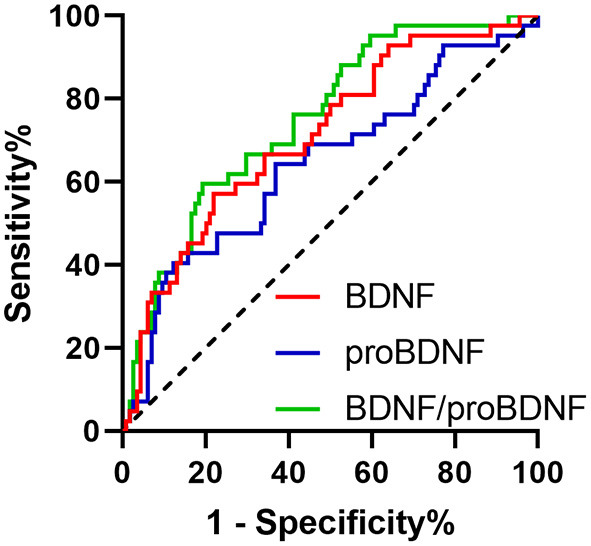
Parkinson's disease (PD) is one of the most common chronic, progressive, and neurodegenerative diseases characterized clinically by resting tremor, bradykinesia, rigidity, and postural instability. As this disease is usually detected in the later stages, the cure is often delayed, ultimately leading to disability due to the lack of early diagnostic techniques. Therefore, it is of great importance to identify reliable biomarkers with high sensitivity and specificity for the early diagnosis of PD. In this study, we aimed to investigate whether serum expressions of mature brain-derived neurotrophic factor (mBDNF) and proBDNF can serve as biomarkers for the diagnosis of PD at early stage. One hundred and fifty-six patients with limb tremor and/or bradykinesia meeting the inclusion criteria were assigned to either ex-PD group (PD cases) or ex-NPD group (non-PD cases) and then reassigned to either po-PD group (with PD) or po-NPD group (without PD) at 1-year follow-up based on the results of the rediagnoses as performed in accordance with MDS Parkinson's diagnostic criteria. To improve early diagnostic accuracy, grouping (PD group and non-PD group) at initial visit and follow-up was performed differently and independently. Serum mBDNF and proBDNF levels were measured by enzyme-linked immunosorbent assays. The results demonstrated that serum levels of mBDNF and mBDNF/proBDNF were significantly lower in the ex-PD group (19.73 ± 7.31 and 0.09 ± 0.05 ng/ml) as compared with the ex-NPD group (23.47 ± 8.21 and 0.15 ± 0.12 ng/ml) ( < 0.01 for both) and in the po-PD group (19.24 ± 7.20 and 0.09 ± 0.05 ng/ml) as compared with the po-NPD group (25.05 ± 7.67 and 0.16 ± 0.14 ng/ml) ( < 0.01 for both). However, a significantly higher serum level of proBDNF was noted in the ex-PD group (235.49 ± 60.75 ng/ml) as compared with the ex-NPD group (191.75 ± 66.12 ng/ml) ( < 0.01) and in the po-PD group (235.56 ± 60.80 ng/ml) as compared with the po-NPD group (188.42 ± 65.08 ng/ml) ( < 0.01). In conclusion, mBDNF/proBDNF can be used as biomarkers for early stage Parkinson's disease; in addition, mBDNF plus proBDNF has better diagnostic value than mBDNF alone in the diagnosis of PD.
帕金森病(PD)是最常见的慢性、进行性神经退行性疾病之一,临床特征为静止性震颤、运动迟缓、肌强直和姿势不稳。由于这种疾病通常在晚期才被发现,治疗往往被延误,最终因缺乏早期诊断技术而导致残疾。因此,识别具有高敏感性和特异性的可靠生物标志物对于PD的早期诊断至关重要。在本研究中,我们旨在调查成熟脑源性神经营养因子(mBDNF)和前体BDNF的血清表达是否可作为PD早期诊断的生物标志物。156例符合纳入标准的肢体震颤和/或运动迟缓患者被分为既往PD组(PD病例)或既往非PD组(非PD病例),然后根据按照MDS帕金森诊断标准进行的重新诊断结果,在1年随访时重新分为现患PD组(患有PD)或现患非PD组(未患有PD)。为提高早期诊断准确性,初诊和随访时的分组(PD组和非PD组)方式不同且相互独立。采用酶联免疫吸附测定法测量血清mBDNF和前体BDNF水平。结果表明,既往PD组血清mBDNF和mBDNF/前体BDNF水平(分别为19.73±7.31和0.09±0.05 ng/ml)显著低于既往非PD组(分别为23.47±8.21和0.15±0.12 ng/ml)(两者均P<0.01),现患PD组(分别为19.24±7.20和0.09±0.05 ng/ml)显著低于现患非PD组(分别为25.05±7.67和0.16±0.14 ng/ml)(两者均P<0.01)。然而,既往PD组血清前体BDNF水平(235.49±60.75 ng/ml)显著高于既往非PD组(191.75±66.12 ng/ml)(P<0.01),现患PD组(235.56±60.80 ng/ml)显著高于现患非PD组(188.42±65.08 ng/ml)(P<0.01)。总之,mBDNF/前体BDNF可作为帕金森病早期的生物标志物;此外,在PD诊断中,mBDNF加前体BDNF比单独的mBDNF具有更好的诊断价值。