Zhang Yongxin, Hua Weilong, Li Zifu, Peng Ya, Han Zhian, Li Tong, Yin Congguo, Wang Shoucun, Nan Guangxian, Zhao Zhenwei, Yang Hua, Zhou Bin, Li Tianxiao, Cai Yiling, Zhang Jianmin, Li Guifu, Peng Xiaoxiang, Guan Sheng, Zhou Junshan, Ye Ming, Wang Liqin, Zhang Lei, Hong Bo, Zhang Yongwei, Wan Jieqing, Wang Yang, Zhu Qing, Liu Jianmin, Yang Pengfei
Department of Stroke Center, Changhai Hospital, Naval Military Medical University, Shanghai, China.
Department of Neurosurgery, The First People's Hospital of Changzhou, Changzhou, China.
Front Neurol. 2021 Aug 12;12:686253. doi: 10.3389/fneur.2021.686253. eCollection 2021.
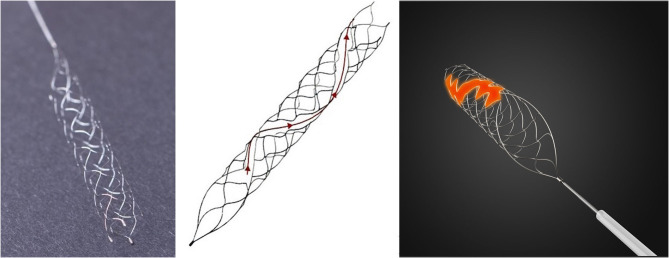
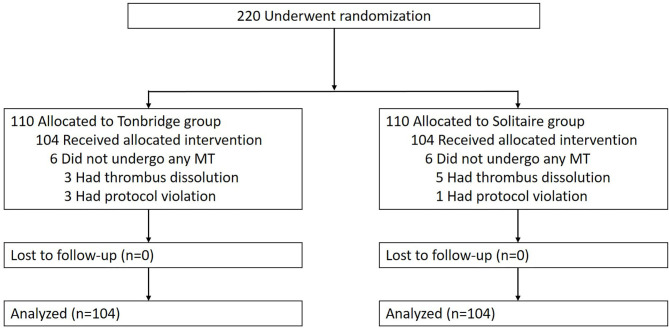
The Tonbridge stent is a novel retriever with several design improvements which aim to achieve promising flow reperfusion in the treatment of acute ischemic stroke (AIS). We conducted a randomized controlled, multicenter, non-inferiority trial to compare the safety and efficacy of the Tonbridge stent with the Solitaire FR. AIS patients aged 18-85 years with large vessel occlusion in anterior circulation who could undergo puncture within 6 h of symptom onset were included. Randomization was performed on a 1:1 ratio to thrombectomy with either the Tonbridge stent or the Solitaire FR. The primary efficacy endpoint was successful reperfusion using a modified thrombolysis in cerebral infarction score (mTICI) of 2b/3. Safety outcomes were symptomatic intracranial hemorrhage (sICH) within 24 ± 6 h and all-cause mortality within 90 days. A clinically relevant non-inferiority margin of 12% was chosen as the acceptable difference between groups. Secondary endpoints included time from groin puncture to reperfusion, National Institutes of Health Stroke Scale (NIHSS) score at 24 h and at 7 days, and a modified Rankin Scale (mRS) score of 0-2 at 90 days. A total of 220 patients were enrolled; 104 patients underwent thrombectomy with the Tonbridge stent and 104 were treated with the Solitaire FR. In all test group patients, the Tonbridge was used as a single retriever without rescuing by other thrombectomy devices. Angioplasty with balloon and/or stent was performed in 26 patients in the Tonbridge group and 16 patients in the Solitaire group ( = 0.084). Before angioplasty, 86.5% of those in the Tonbridge group and 81.7% of those in the Solitaire group reached successful reperfusion ( = 0.343). Finally, more patients in the Tonbridge group achieved successful reperfusion (92.3 vs. 84.6%, 95% CI of difference value 0.9-16.7%, < 0.0001). There were no significant differences on sICH within 24 ± 6 h between the two groups. All-cause mortality within 90 days was 13.5% in the Tonbridge group and 16.3% in the Solitaire group ( = 0.559). We noted no significant differences between groups on the NIHSS at either 24 h or 7 days and the mRS of 0-2 at 90 days. The trial indicated that the Tonbridge stent was non-inferior to the Solitaire FR within 6 h of symptom onset in cases of large vessel occlusion stroke. ClinicalTrials.gov, number: NCT03210623.
汤布里奇支架是一种新型取栓装置,在设计上有多项改进,旨在实现急性缺血性卒中(AIS)治疗中良好的血流再灌注。我们进行了一项随机对照、多中心、非劣效性试验,比较汤布里奇支架与Solitaire FR的安全性和有效性。纳入年龄在18 - 85岁、前循环大血管闭塞且症状发作6小时内可进行穿刺的AIS患者。按1:1比例随机分为使用汤布里奇支架或Solitaire FR进行血栓切除术。主要疗效终点是使用改良脑梗死溶栓评分(mTICI)2b/3实现成功再灌注。安全性结局为24±6小时内的症状性颅内出血(sICH)和90天内的全因死亡率。选择12%的临床相关非劣效界值作为组间可接受差异。次要终点包括从股动脉穿刺到再灌注的时间、24小时和7天时的美国国立卫生研究院卒中量表(NIHSS)评分以及90天时改良Rankin量表(mRS)0 - 2分。共纳入220例患者;104例患者使用汤布里奇支架进行血栓切除术,104例使用Solitaire FR治疗。在所有试验组患者中,汤布里奇支架作为单一取栓装置使用,未用其他血栓切除装置进行补救。汤布里奇组26例患者和Solitaire组16例患者进行了球囊和/或支架血管成形术(P = 0.084)。血管成形术前,汤布里奇组86.5%的患者和Solitaire组81.7%的患者实现了成功再灌注(P = 0.343)。最终,汤布里奇组更多患者实现了成功再灌注(92.3%对84.6%,差异值的95%CI为0.9 - 16.7%,P < 0.0001)。两组在24±6小时内的sICH无显著差异。汤布里奇组90天内全因死亡率为13.5%,Solitaire组为16.3%(P = 0.559)。我们注意到两组在24小时或7天时的NIHSS评分以及90天时mRS 0 - 2分方面无显著差异。该试验表明,在大血管闭塞性卒中症状发作6小时内,汤布里奇支架不劣于Solitaire FR。ClinicalTrials.gov编号:NCT03210623。