Durrance-Bagale Anna, Rudge James W, Singh Nanda Bahadur, Belmain Steven R, Howard Natasha
London School of Hygiene and Tropical Medicine, Department of Global Health and Development, 15-17 Tavistock Place, London WC1H 9SH, United Kingdom.
Mahidol University, Faculty of Public Health, 420/1 Rajvithi Road, Bangkok, Thailand.
One Health. 2021 Aug 14;13:100310. doi: 10.1016/j.onehlt.2021.100310. eCollection 2021 Dec.
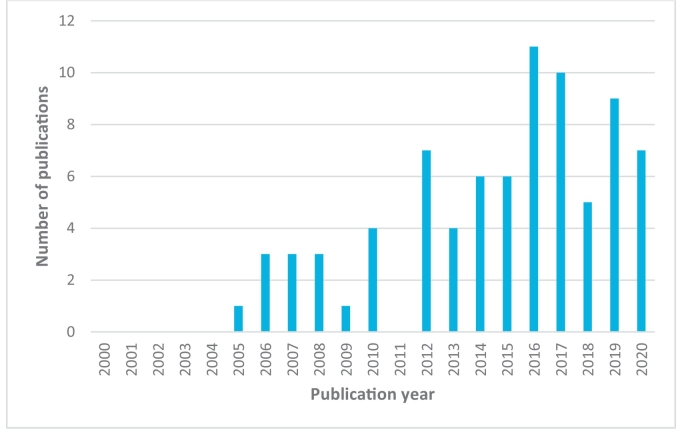
Literature on potential anthropogenic drivers of zoonotic disease risk in the Indian subcontinent is sparse. We conducted a scoping review to identify primary sources, published 2000-2020, to clarify what research exists and on which areas future research should focus. We summarised findings thematically by disease. Of 80 sources included, 78 (98%) were original research articles and two were conference abstracts. Study designs and methods were not always clearly described, but 74 (93%) were quantitative (including one randomised trial), five (6%) were mixed-methods, and one was qualitative. Most sources reported research from India (39%) or Bangladesh (31%), followed by Pakistan (9%), Nepal (9%), Bhutan and Sri Lanka (6% each). Topically, most focused on rabies (18; 23%), Nipah virus (16; 20%) or leptospirosis (11; 14%), while 12 (15%) did not focus on a disease but instead on knowledge in communities. People generally did not seek post-exposure prophylaxis for rabies even when vaccination programmes were available and they understood that rabies was fatal, instead often relying on traditional medicines. Similarly, people did not take precautions to protect themselves from leptospirosis infection, even when they were aware of the link with rice cultivation. Nipah was correlated with presence of bats near human habitation. Official information on diseases, modes of transmission and prevention was lacking, or shared informally between friends, relatives, and neighbours. Behaviour did not correspond to disease knowledge. This review identifies various human behaviours which may drive zoonotic disease risk in the Indian subcontinent. Increasing community knowledge and awareness alone is unlikely to be sufficient to successfully change these behaviours. Further research, using interdisciplinary and participatory methods, would improve understanding of risks and risk perceptions and thus help in co-designing context-specific, relevant interventions.
关于印度次大陆人畜共患病风险潜在人为驱动因素的文献稀少。我们进行了一项范围综述,以确定2000年至2020年发表的主要资料来源,以阐明现有哪些研究以及未来研究应聚焦哪些领域。我们按疾病主题总结了研究结果。在纳入的80篇资料来源中,78篇(98%)为原创研究文章,两篇为会议摘要。研究设计和方法并非总是描述清晰,但74篇(93%)为定量研究(包括一项随机试验),5篇(6%)为混合方法研究,1篇为定性研究。大多数资料来源报告的是来自印度(39%)或孟加拉国(31%)的研究,其次是巴基斯坦(9%)、尼泊尔(9%)、不丹和斯里兰卡(各6%)。从主题上看,大多数研究聚焦于狂犬病(18篇;23%)、尼帕病毒(16篇;20%)或钩端螺旋体病(11篇;14%),而12篇(15%)并非聚焦于某一种疾病,而是关注社区中的知识。即使有狂犬病疫苗接种项目且人们明白狂犬病是致命的,但人们通常也不会寻求狂犬病暴露后预防,而是常常依赖传统药物。同样,即使人们知道钩端螺旋体病与水稻种植的关联,他们也不会采取预防措施来保护自己免受感染。尼帕病毒与人类居住地附近蝙蝠的存在相关。缺乏关于疾病、传播方式和预防的官方信息,或者这些信息在朋友、亲戚和邻居之间非正式地分享。行为与疾病知识不相符。本综述确定了可能在印度次大陆引发人畜共患病风险的各种人类行为。仅提高社区知识和意识不太可能足以成功改变这些行为。采用跨学科和参与性方法进行进一步研究,将增进对风险和风险认知的理解,从而有助于共同设计针对具体情况的相关干预措施。