Khairat Saif, McDaniel Phillip, Jansen Matthew, Francis Tia, Edson Barbara, Gianforcaro Robert
Cecil G. Sheps Center for Health Services Research, Chapel Hill, NC, United States.
Carolina Health Informatics Program, University of North Carolina at Chapel Hill, Chapel Hill, NC, United States.
JMIR Pediatr Parent. 2021 Aug 30;4(3):e25873. doi: 10.2196/25873.
Telehealth is increasingly used to provide specialty consultations to infants and children receiving care. However, there is uncertainty if the COVID-19 pandemic has influenced the use of telehealth among vulnerable populations.
This research aims to compare the overall use of tele-urgent care visits for pediatric patients before and after the pandemic, especially among vulnerable populations.
We conducted a cross-sectional analysis of pediatric tele-urgent care visits at a virtual care center at a southeastern health care center. The main outcome of this study was the use of pediatrics tele-urgent visits across geographical regions with different levels of social disparities and between 2019 and 2020.
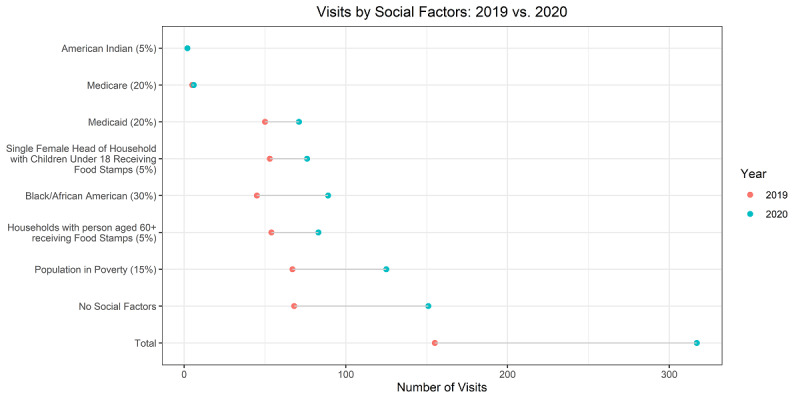
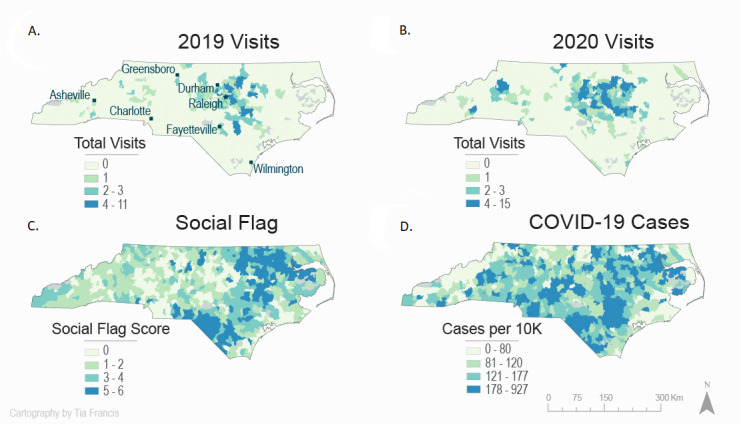
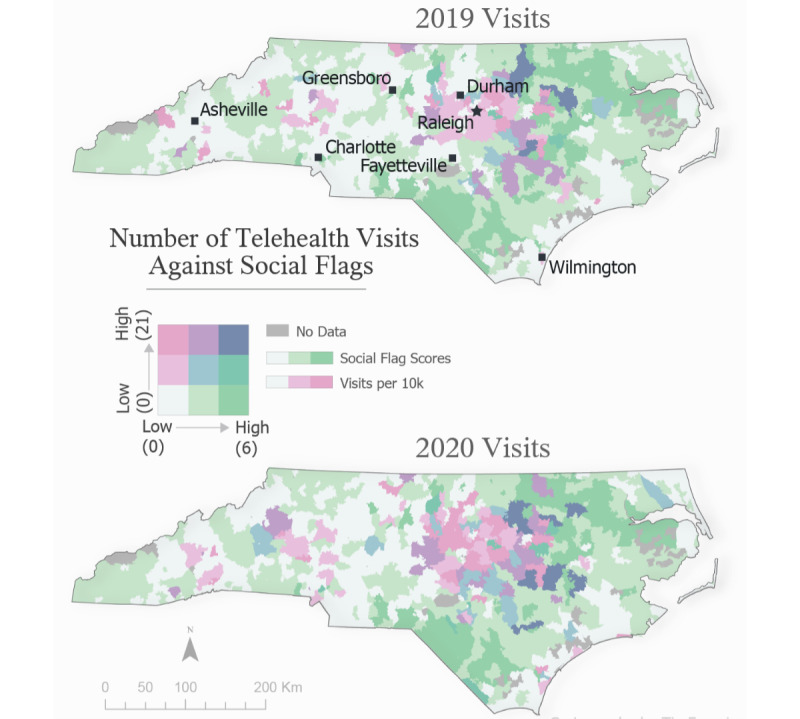
Of 584 tele-urgent care visits, 388 (66.4%) visits occurred in 2020 during the pandemic compared to 196 (33.6%) visits in 2019. Among 808 North Carolina zip codes, 181 (22%) consisted of a high concentration of vulnerable populations, where 17.7% (56/317) of the tele-urgent care visits originated from. The majority (215/317, 67.8%) of tele-urgent care visits originated from zip codes with a low concentration of vulnerable populations. There was a significant association between the rate of COVID-19 cases and the concentration level of social factors in a given Zip Code Tabulation Area.
The use of tele-urgent care visits for pediatric care doubled during the COVID-19 pandemic. The majority of the tele-urgent care visits after COVID-19 originated from regions where there is a low presence of vulnerable populations. In addition, our geospatial analysis found that geographic regions with a high concentration of vulnerable populations had a significantly higher rate of COVID-19-confirmed cases and deaths compared to regions with a low concentration of vulnerable populations.
远程医疗越来越多地用于为接受护理的婴幼儿和儿童提供专科会诊。然而,新冠疫情是否影响了弱势群体对远程医疗的使用尚不确定。
本研究旨在比较疫情前后儿科患者远程紧急护理就诊的总体使用情况,尤其是弱势群体中的使用情况。
我们对东南部医疗中心的一个虚拟护理中心的儿科远程紧急护理就诊进行了横断面分析。本研究的主要结果是2019年至2020年期间不同社会差异水平的地理区域内儿科远程紧急就诊的使用情况。
在584次远程紧急护理就诊中,2020年疫情期间有388次(66.4%),而2019年为196次(33.6%)。在北卡罗来纳州的808个邮政编码区域中,181个(22%)有高浓度的弱势群体,其中17.7%(56/317)的远程紧急护理就诊来自这些区域。大多数(215/317,67.8%)的远程紧急护理就诊来自弱势群体浓度低的邮政编码区域。在给定的邮政编码分区中,新冠病例率与社会因素浓度水平之间存在显著关联。
在新冠疫情期间,儿科护理的远程紧急护理就诊使用量翻了一番。新冠疫情后的大多数远程紧急护理就诊来自弱势群体较少的地区。此外,我们的地理空间分析发现,弱势群体高度集中的地理区域与弱势群体浓度低的区域相比,新冠确诊病例和死亡的发生率显著更高。