Blood and Marrow Transplant Program, University of Minnesota, Minneapolis, MN.
Division of Hematology/Oncology, University of Virginia School of Medicine, Charlottesville, VA.
Blood Adv. 2021 Oct 26;5(20):4064-4072. doi: 10.1182/bloodadvances.2021004462.
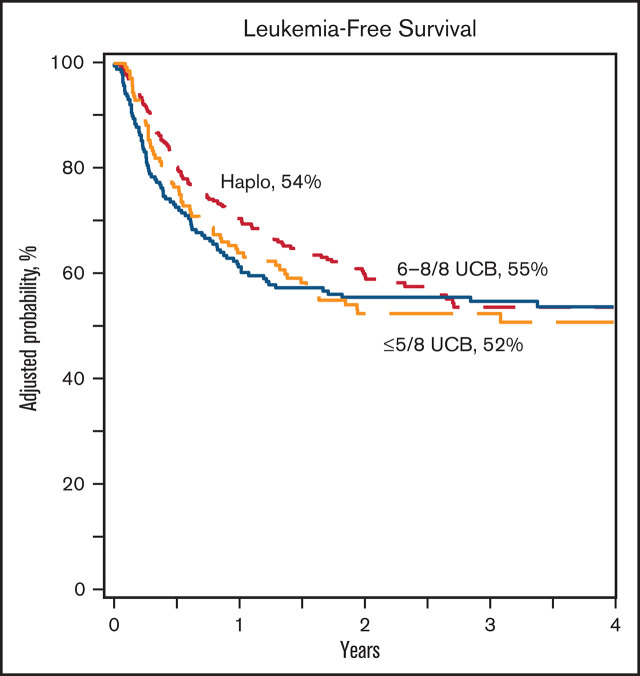
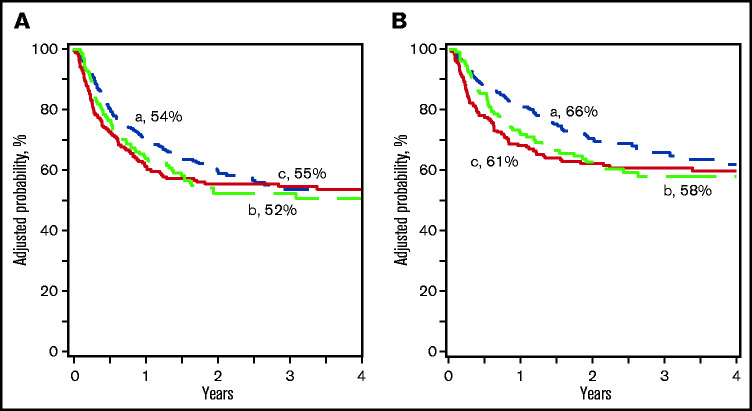
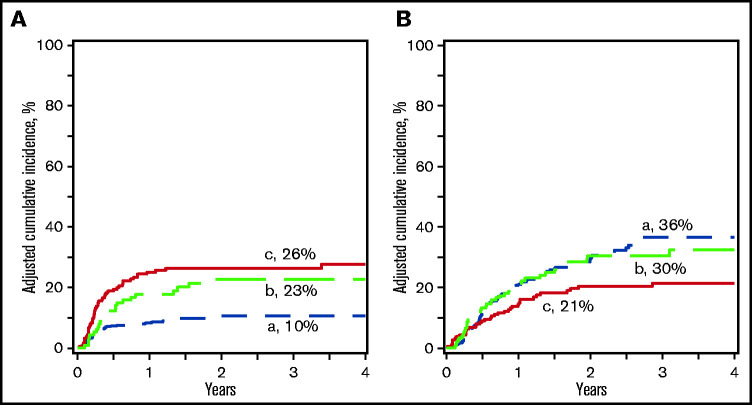
Haploidentical hematopoietic stem cell transplantation (haplo-HSCT) has emerged as an important treatment modality. Most reports comparing haplo-HSCT with posttransplant cyclophosphamide (PTCy) and other donor sources have focused on outcomes in older adults treated with reduced intensity conditioning. Therefore, in the current study, we evaluated outcomes in patients with hematological malignancy treated with myeloablative conditioning prior to haplo- (n = 375) or umbilical cord blood (UCB; n = 333) HSCT. All haplo recipients received a 4 of 8 HLA-matched graft, whereas recipients of UCB were matched at 6-8/8 (n = 145) or ≤5/8 (n = 188) HLA antigens. Recipients of 6-8/8 UCB transplants were younger (14 years vs 21 and 29 years) and more likely to have lower comorbidity scores compared with recipients of ≤5/8 UCB and haplo-HSCT (81% vs 69% and 63%, respectively). UCB recipients were more likely to have acute lymphoblastic leukemia and transplanted in second complete remission (CR), whereas haplo-HSCT recipients were more likely to have acute myeloid leukemia in the first CR. Other characteristics, including cytogenetic risk, were similar. Survival at 3 years was similar for the donor sources (66% haplo- and 61% after ≤5/8 and 58% after 6-8/8 UCB). Notably, relapse at 3 years was lower in recipients of ≤5/8 UCB (21%, P = .03) compared with haplo- (36%) and 6-8/8 UCB (30%). However, nonrelapse mortality was higher in ≤5/8 UCB (21%) compared with other groups (P < .0001). These data suggest that haplo-HSCT with PTCy after myeloablative conditioning provides an overall survival outcome comparable to that after UCB regardless HLA match group.
单倍体造血干细胞移植(haplo-HSCT)已成为一种重要的治疗方式。大多数比较 haplo-HSCT 与移植后环磷酰胺(PTCy)和其他供体来源的报告都集中在接受低强度预处理的老年患者的结局上。因此,在本研究中,我们评估了在接受清髓性预处理后接受 haplo-(n=375)或脐带血(UCB;n=333)HSCT 的血液恶性肿瘤患者的结局。所有 haplo 受者均接受了 4/8 HLA 匹配的移植物,而 UCB 受者的匹配程度为 6-8/8(n=145)或≤5/8(n=188)HLA 抗原。6-8/8 UCB 移植受者年龄较小(14 岁 vs 21 岁和 29 岁),与≤5/8 UCB 和 haplo-HSCT 受者相比,合并症评分较低(分别为 81%、69%和 63%)。UCB 受者更可能患有急性淋巴细胞白血病,并在第二次完全缓解(CR)中接受移植,而 haplo-HSCT 受者更可能在第一次 CR 中患有急性髓细胞白血病。其他特征,包括细胞遗传学风险,相似。3 年生存率在供体来源之间相似(66% haplo-,≤5/8 为 61%,6-8/8 为 58%)。值得注意的是,≤5/8 UCB 组的 3 年复发率较低(21%,P=0.03),低于 haplo-(36%)和 6-8/8 UCB(30%)组。然而,≤5/8 UCB 组的非复发死亡率较高(21%),与其他组相比差异有统计学意义(P<0.0001)。这些数据表明,在清髓性预处理后接受 PTCy 的 haplo-HSCT 提供的总体生存结果与 UCB 无论 HLA 匹配组如何都相当。