De Pauw Hélène, Donders Gilbert, Weyers Steven, De Sutter Philippe, Doyen Jean, Tjalma Wiebren A A, Vanden Broeck Davy, Peeters Eliana, Van Keer Severien, Vorsters Alex, Arbyn Marc
Unit of Cancer Epidemiology, Belgian Cancer Centre, Sciensano, J. Wytsmanstreet 14, B1050, Brussels, Belgium.
Department of Obstetrics and Gynaecology of the General Regional Hospital Heilig Hart (RZ Tienen), Tienen, Belgium.
Arch Public Health. 2021 Aug 30;79(1):155. doi: 10.1186/s13690-021-00667-4.
Interventions to reach women who do not participate regularly in screening may reduce the risk of cervical cancer. Self-collection of a vaginal specimen has been shown to increase participation. The relative clinical accuracy of human papillomavirus (HPV) testing on first-void urine (with Colli-Pee) and on vaginal self-samples versus on cervical clinician-collected samples is being investigated in the VALHUDES trial. The current study assesses attitudes and experiences regarding self-sampling among women enrolled in VALHUDES.
Questionnaires from 515 women (age 25-64 years [N = 498]; < 25 [N = 10], age ≥ 65 [N = 3], enrolled between December 2017 - January 2020) referred to colposcopy because of previous cervical abnormalities and enrolled in VALHUDES (NCT03064087) were analysed.
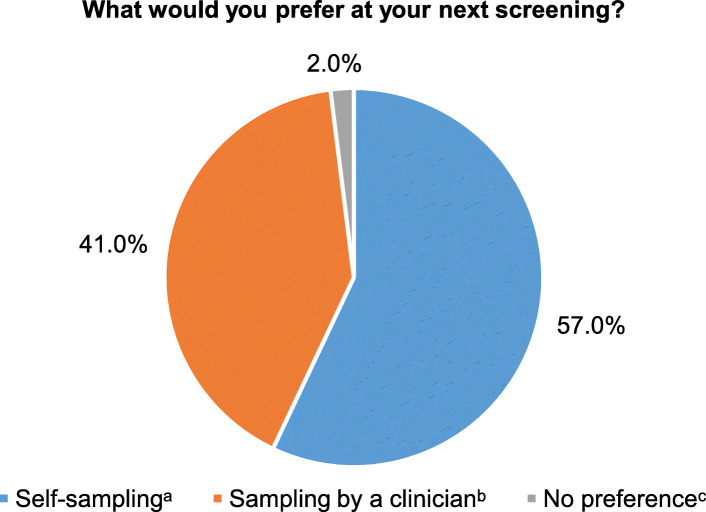
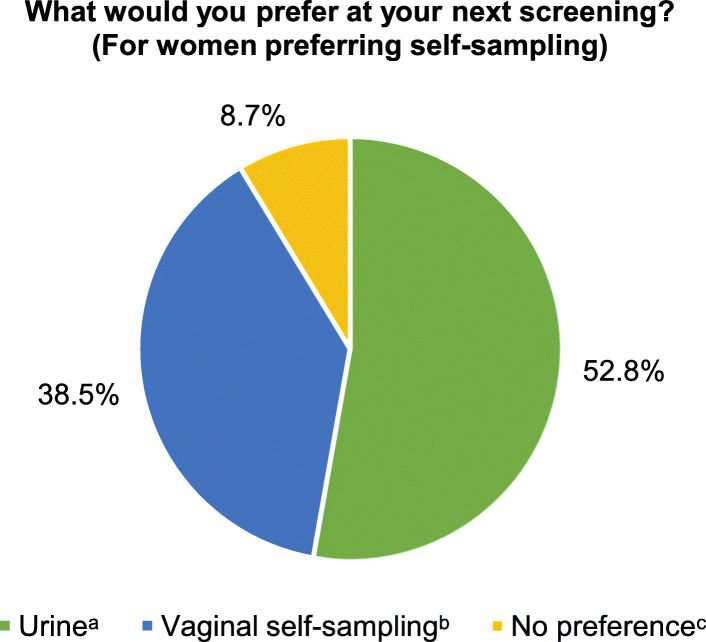
Of the 515 participants, nearly all women confirmed that self-sampling may help in reaching under-screened women (93%). Nevertheless, 44% of the participants stated before starting collection that a clinician-collected sample is more effective than a self-collected sample. After self-sampling, the large majority of women (> 95%) declared that instructions for self-collection were clear, that collection was easy, and that they were confident about having performed the procedure correctly, for both urine and vaginal collection. However, a proportion of women found self-sampling unpleasant (9.5% [49/515] for urine collection; 18.6% [96/515] and 15.5% [80/515] for vaginal sampling with cotton swabs or plastic brushes, respectively). For their next screening round, 57% would prefer self-sampling whereas 41% opted for collection by a clinician. Among women preferring self-sampling, 53% would choose for urine collection, 38% for vaginal self-collection and 9% had no preference. Age did not modify preferences.
We conclude that both urine and vaginal self-sampling are well accepted by women, with a preference for urine sampling. Although the large majority of women are confident in their ability to perform self-sampling, four to five over ten women preferred specimen collection by a clinician.
The study VALHUDES was registered in ClinicalTrials.gov (identifier: NCT03064087 ).
针对未定期参加筛查的女性开展干预措施可能会降低宫颈癌风险。研究表明,自行采集阴道样本可提高参与率。在VALHUDES试验中,正在研究人乳头瘤病毒(HPV)检测首次晨尿样本(使用Colli-Pee)、阴道自行采集样本与宫颈临床医生采集样本相比的相对临床准确性。本研究评估了VALHUDES试验中女性对自行采样的态度和体验。
分析了515名女性(年龄25 - 64岁 [N = 498];<25岁 [N = 10],年龄≥65岁 [N = 3])的问卷,这些女性因先前的宫颈异常转诊至阴道镜检查,并参加了VALHUDES试验(NCT03064087),她们于2017年12月至2020年1月期间入组。
在515名参与者中,几乎所有女性都确认自行采样可能有助于覆盖筛查不足的女性(93%)。然而,44%的参与者在开始采集前表示临床医生采集的样本比自行采集的样本更有效。自行采样后,绝大多数女性(>95%)表示自行采集的说明清晰、采集容易,并且她们对正确完成采样过程有信心,无论是尿液还是阴道样本采集。然而,一部分女性觉得自行采样不愉快(尿液采集为9.5% [49/515];使用棉签或塑料刷进行阴道采样分别为18.6% [96/515] 和15.5% [80/515])。对于下一轮筛查,57%的女性更喜欢自行采样,而41%的女性选择由临床医生采集。在更喜欢自行采样的女性中,53%会选择尿液采集,38%会选择阴道自行采集,9%没有偏好。年龄并未改变偏好。
我们得出结论,尿液和阴道自行采样都为女性所接受,女性更倾向于尿液采样。尽管绝大多数女性对自行采样的能力有信心,但仍有十分之四到五的女性更喜欢由临床医生采集样本。
VALHUDES研究已在ClinicalTrials.gov注册(标识符:NCT03064087)。