Department of Ophthalmology, Emory University School of Medicine, 1365B Clifton Rd NE, Atlanta, GA, 30322, USA.
Department of Pediatrics, Emory University School of Medicine, Atlanta, GA, USA.
J Neurooncol. 2021 Sep;154(3):365-373. doi: 10.1007/s11060-021-03835-2. Epub 2021 Aug 30.
Brain tumors are the leading cause of death from childhood cancer. Although overall survival has improved due to earlier detection, better therapies, and improved surveillance, visual dysfunction and impaired vision-related quality-of-life (VR-QOL) are often unrecognized in children. This project investigated VR-QOL in pediatric brain tumor patients.
We evaluated visual impairment and quality-of-life (QOL) in a quality improvement project at one tertiary care center. Patients ≤ 18, greater than 6 months from diagnosis of brain tumor, excluding intrinsic anterior visual pathway tumors, underwent standardized neuro-ophthalmologic examination. Health-related QOL (HR-QOL) (PedsQL Brain Tumor Module) and VR-QOL questionnaires [CVFQ (Children's Visual Function Questionnaire) in children < 8, and EYE-Q in children 8-18] were obtained from patients and parents.
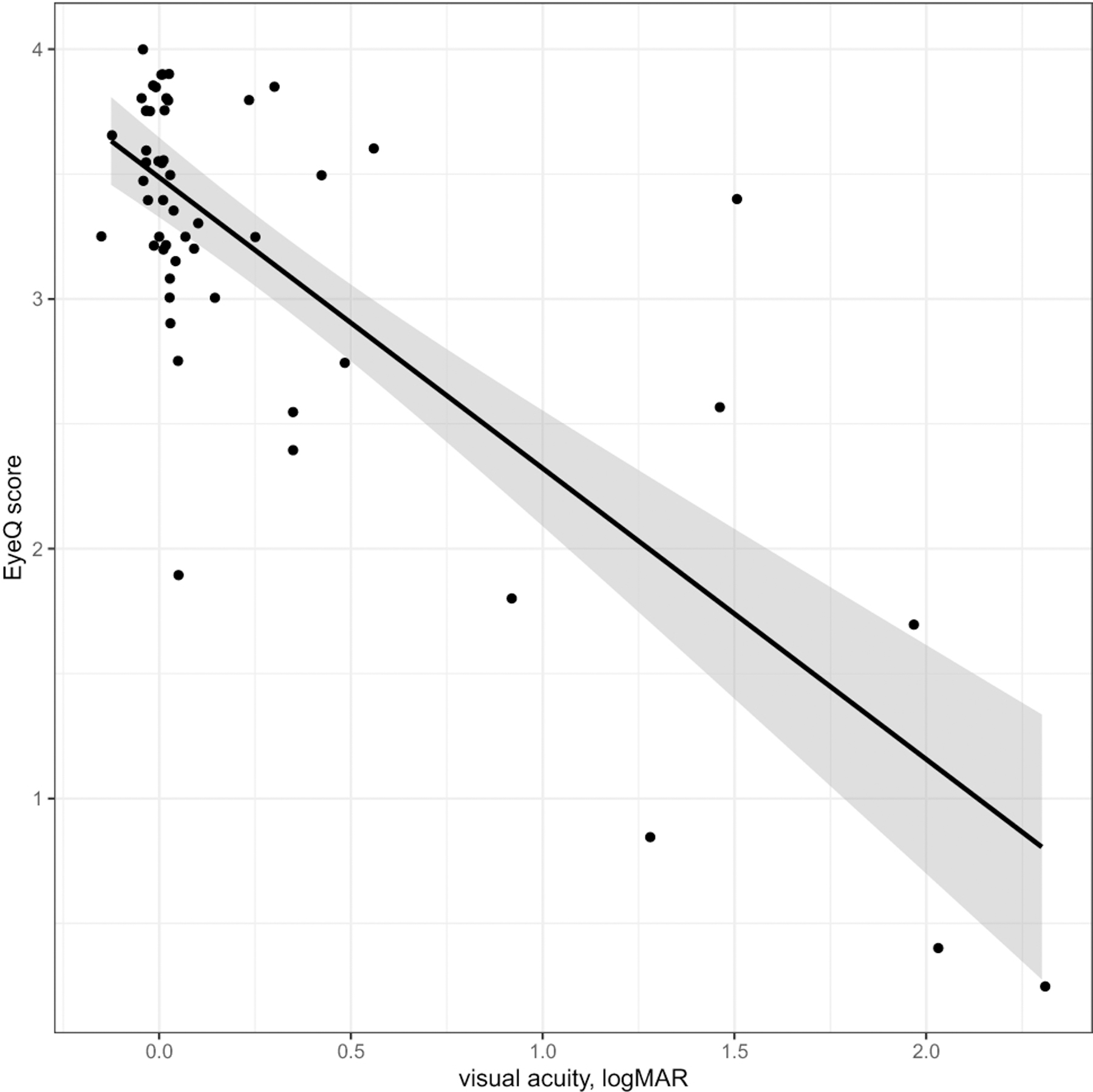
Among 77 patients, craniopharyngiomas (n = 16, 21%) and astrocytomas (n = 15, 20%) were the most common tumors. Among 44/77 (57%) visually impaired children, 7 (16%) were legally blind. Eye-Q median score was 3.40 (interquartile range 3.00-3.75), worse than average scores for normal children. Eye-Q score decreased 0.12 with every 0.1 increase in logMAR visual acuity (p < 0.001). Patients who were legally blind had a significantly lower Eye-Q score than those who were not [0.70 vs. 3.44 (p < 0.001)]. Cognitive HR-QOL scores decreased 1.3 for every 0.1 increase in logMAR visual acuity (p = 0.02).
Pediatric brain tumor patients' vision, HR-QOL, and VR-QOL were often severely affected even when tumors were considered cured. Visual acuity and legal blindness correlated with VR-QOL. Systematic neuro-ophthalmologic examinations in pediatric primary brain tumor patients are necessary to facilitate early preventative and corrective ophthalmologic interventions.
脑瘤是儿童癌症死亡的主要原因。尽管由于早期发现、更好的治疗方法和更好的监测,整体存活率有所提高,但儿童的视觉功能障碍和与视觉相关的生活质量(VR-QOL)常常未被认识到。本项目研究了儿科脑肿瘤患者的 VR-QOL。
我们在一家三级护理中心的质量改进项目中评估了视觉障碍和生活质量(QOL)。患者年龄≤18 岁,脑瘤诊断后 6 个月以上,不包括固有前视路肿瘤,接受了标准化的神经眼科检查。健康相关生活质量(HR-QOL)(PedsQL 脑肿瘤模块)和 VR-QOL 问卷[8 岁以下儿童使用 CVFQ(儿童视觉功能问卷),8-18 岁儿童使用 EYE-Q]从患者和家长处获得。
在 77 名患者中,颅咽管瘤(n=16,21%)和星形细胞瘤(n=15,20%)是最常见的肿瘤。在 44/77(57%)视力受损的儿童中,7 人(16%)为法定盲人。EYE-Q 中位数评分为 3.40(四分位距 3.00-3.75),低于正常儿童的平均评分。EYE-Q 评分每增加 0.1,logMAR 视力就会降低 0.12(p<0.001)。法定盲人的 EYE-Q 评分明显低于非盲人[0.70 与 3.44(p<0.001)]。logMAR 视力每增加 0.1,认知 HR-QOL 评分就会降低 1.3(p=0.02)。
即使肿瘤被认为已治愈,儿科脑肿瘤患者的视力、HR-QOL 和 VR-QOL 仍常常受到严重影响。视力和法定失明与 VR-QOL 相关。对儿科原发性脑肿瘤患者进行系统的神经眼科检查是必要的,以促进早期预防和矫正眼科干预。