Department of Chemistry, New York University, 100 Washington Square East, New York, New York 10003, United States.
Department of Chemical Engineering, Purdue University, 480 Stadium Mall Drive, West Lafayette, Indiana 47906, United States.
J Am Chem Soc. 2021 Sep 15;143(36):14458-14463. doi: 10.1021/jacs.1c07139. Epub 2021 Aug 31.
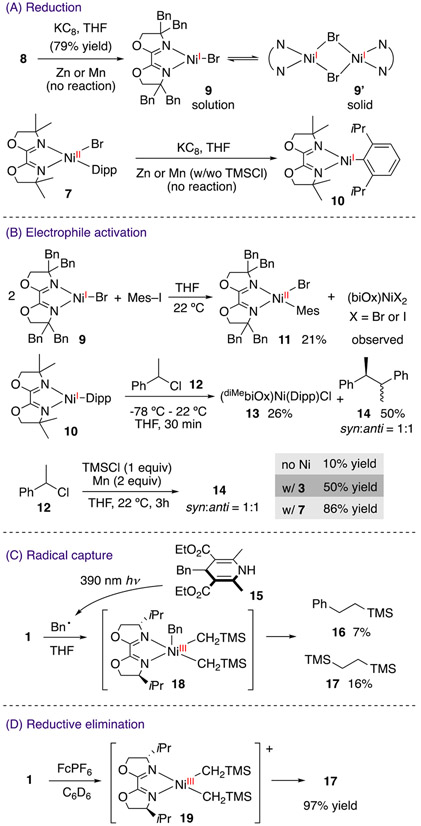
Bi-Oxazoline (biOx) has emerged as an effective ligand framework for promoting nickel-catalyzed cross-coupling, cross-electrophile coupling, and photoredox-nickel dual catalytic reactions. This report fills the knowledge gap of the organometallic reactivity of (biOx)Ni complexes, including catalyst reduction, oxidative electrophile activation, radical capture, and reductive elimination. The biOx ligand displays no redox activity in (biOx)Ni(I) complexes, in contrast to other chelating imine and oxazoline ligands. The lack of ligand redox activity results in more negative reduction potentials of (biOx)Ni(II) complexes and accounts for the inability of zinc and manganese to reduce (biOx)Ni(II) species. On the basis of these results, we revise the formerly proposed "sequential reduction" mechanism of a (biOx)Ni-catalyzed cross-electrophile coupling reaction by excluding catalyst reduction steps.
双恶唑啉(biOx)已成为促进镍催化交叉偶联、交叉电偶联和光还原-镍双催化反应的有效配体框架。本报告填补了(biOx)Ni 配合物的有机金属反应性的知识空白,包括催化剂还原、氧化亲电试剂活化、自由基捕获和还原消除。与其他螯合亚胺和恶唑啉配体不同,biOx 配体在(biOx)Ni(I)配合物中没有氧化还原活性。配体氧化还原活性的缺乏导致(biOx)Ni(II)配合物的还原电位更负,并解释了锌和锰不能还原(biOx)Ni(II)物种的原因。基于这些结果,我们通过排除催化剂还原步骤,修正了先前提出的(biOx)Ni 催化交叉电偶联反应的“顺序还原”机制。