Zhao Binbin, Wu Yanhua, Jin Xiaoying, Yang Lihong, Yang Jian, Ma Xiancang, Yan Bin
Department of Psychiatry, The First Affiliated Hospital of Xi'an Jiaotong University, Xi'an, People's Republic of China.
Department of Clinical Research Center, The First Affiliated Hospital of Xi'an Jiaotong University, Xi'an, People's Republic of China.
Nat Sci Sleep. 2021 Aug 24;13:1485-1494. doi: 10.2147/NSS.S313891. eCollection 2021.
Sleep disorders are associated with the prevalence of stroke. However, there is limited evidence regarding the association between objectively measured sleep characteristics and ischemic stroke.
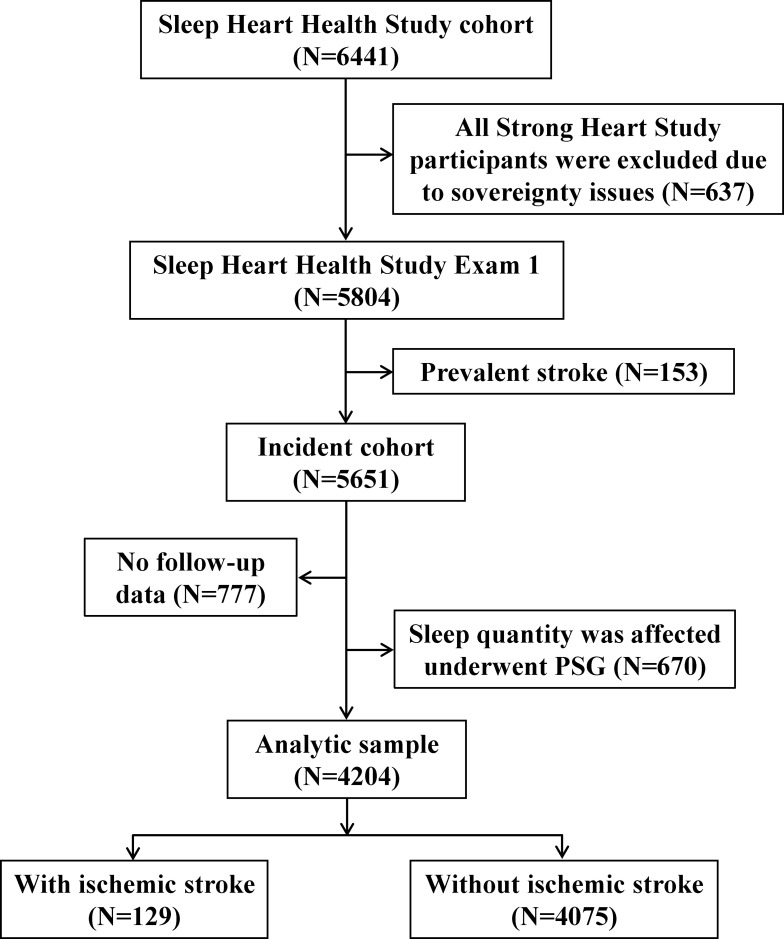
Ischemic stroke was assessed during the mean follow-up period of 11 years in the Sleep Heart Health Study. Sleep parameters such as wake after sleep onset (WASO) and sleep efficiency (SE) were objectively measured based on in-home polysomnography records. Multivariable Cox regression analysis was utilized to examine the relationship between objective sleep characteristics and ischemic stroke incidence.
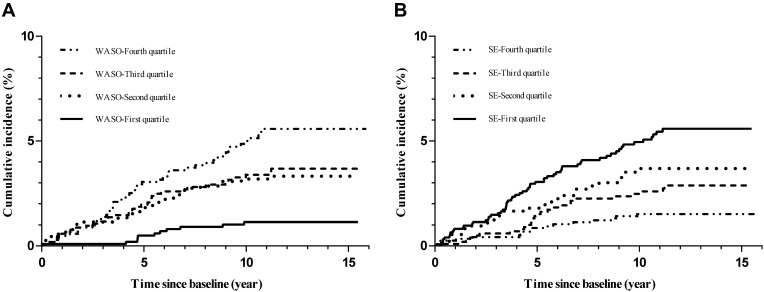
This study involved 4204 participants (1978 males and 2226 females, 63.8±11.1 years). The incidence of ischemic stroke increased in individuals with long WASO, poor SE, and short sleep duration. Multivariable Cox regression analysis showed that WASO within the fourth quartile (hazard ratio [HR] 3.771, 95% confidence interval [CI] 1.805-7.877, P<0.001), third quartile (HR 3.009, 95% CI 1.433-6.317, P=0.004), and second quartile (HR 3.108, 95% CI 1.470-6.568, P=0.003) had a higher incidence of ischemic stroke than WASO within the first quartile. Poor SE (<80.0%) was also found to be a predictor for ischemic stroke (HR 2.220, 95% CI 1.244-3.960, P=0.007). Additionally, a short sleep duration (<6 h) was associated with an increased risk of ischemic stroke (HR 1.725, 95% CI 1.026-2.899, P=0.040).
Our results revealed a relationship between WASO, SE, and sleep duration and ischemic stroke. Therefore, these sleep characteristics may be adequate predictors for the incidence of ischemic stroke.
睡眠障碍与中风的患病率相关。然而,关于客观测量的睡眠特征与缺血性中风之间的关联,证据有限。
在睡眠心脏健康研究中,对平均随访11年期间的缺血性中风进行了评估。基于家庭多导睡眠图记录,客观测量了睡眠参数,如睡眠开始后觉醒时间(WASO)和睡眠效率(SE)。采用多变量Cox回归分析来检验客观睡眠特征与缺血性中风发病率之间的关系。
本研究纳入了4204名参与者(1978名男性和2226名女性,年龄63.8±11.1岁)。WASO时间长、SE差和睡眠时间短的个体缺血性中风发病率增加。多变量Cox回归分析显示,第四四分位数的WASO(风险比[HR] 3.771,95%置信区间[CI] 1.805 - 7.877,P<0.001)、第三四分位数(HR 3.009,95% CI 1.433 - 6.317,P = 0.004)和第二四分位数(HR 3.108,95% CI 1.470 - 6.568,P = 0.003)的缺血性中风发病率高于第一四分位数的WASO。SE差(<80.0%)也被发现是缺血性中风的一个预测因素(HR 2.220,95% CI 1.244 - 3.960,P = 0.007)。此外,睡眠时间短(<6小时)与缺血性中风风险增加相关(HR 1.725,95% CI 1.026 - 2.899,P = 0.040)。
我们的结果揭示了WASO、SE和睡眠时间与缺血性中风之间的关系。因此,这些睡眠特征可能是缺血性中风发病率的充分预测指标。