Dipartimento di Medicina Molecolare e Biotecnologie Mediche, Università degli Studi di Napoli Federico II, Napoli, Italy.
CEINGE Biotecnologie Avanzate, Napoli, Italy.
Am J Hematol. 2021 Dec 1;96(12):1666-1678. doi: 10.1002/ajh.26340. Epub 2021 Sep 23.
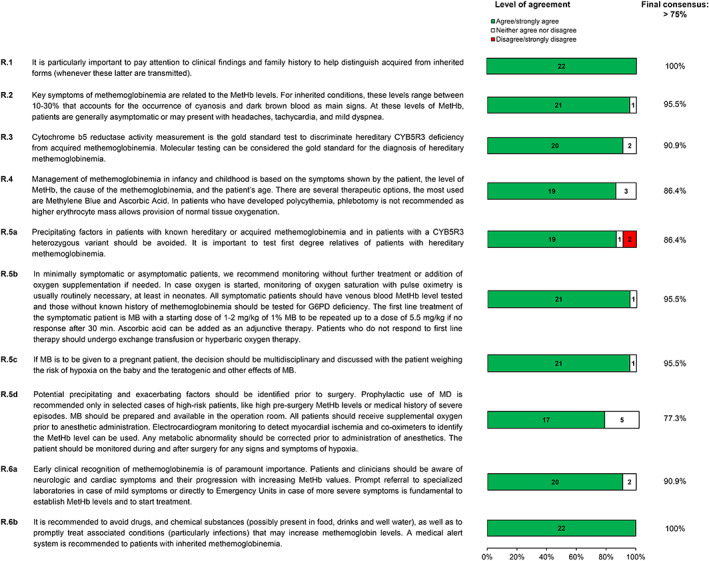
Methemoglobinemia is a rare disorder associated with oxidization of divalent ferro-iron of hemoglobin (Hb) to ferri-iron of methemoglobin (MetHb). Methemoglobinemia can result from either inherited or acquired processes. Acquired forms are the most common, mainly due to the exposure to substances that cause oxidation of the Hb both directly or indirectly. Inherited forms are due either to autosomal recessive variants in the CYB5R3 gene or to autosomal dominant variants in the globin genes, collectively known as HbM disease. Our recommendations are based on a systematic literature search. A series of questions regarding the key signs and symptoms, the methods for diagnosis, the clinical management in neonatal/childhood/adulthood period, and the therapeutic approach of methemoglobinemia were formulated and the relative recommendations were produced. An agreement was obtained using a Delphi-like approach and the experts panel reached a final consensus >75% of agreement for all the questions.
高铁血红蛋白血症是一种罕见的疾病,与血红蛋白(Hb)中二价亚铁离子氧化为高铁血红蛋白(MetHb)的铁离子有关。高铁血红蛋白血症可由遗传或获得性因素引起。获得性高铁血红蛋白血症最为常见,主要是由于接触直接或间接导致 Hb 氧化的物质。遗传性高铁血红蛋白血症是由于 CYB5R3 基因的常染色体隐性变异或珠蛋白基因的常染色体显性变异引起的,统称为 HbM 病。我们的建议是基于系统的文献检索。针对高铁血红蛋白血症的关键体征和症状、诊断方法、新生儿/儿童/成人期的临床管理以及治疗方法等问题进行了一系列的提问,并给出了相应的建议。采用德尔菲法(Delphi-like approach)达成了一致意见,专家组对所有问题的最终共识度>75%。