Centers for Disease Control and Prevention, Atlanta, Georgia, United States of America.
Epidemic Intelligence Service, Centers for Disease Control and Prevention, Atlanta, Georgia, United States of America.
PLoS One. 2021 Sep 2;16(9):e0256917. doi: 10.1371/journal.pone.0256917. eCollection 2021.
Most current evidence on risk factors for hospitalization because of coronavirus disease 2019 (COVID-19) comes from studies using data abstracted primarily from electronic health records, limited to specific populations, or that fail to capture over-the-counter medications and adjust for potential confounding factors. Properly understanding risk factors for hospitalization will help improve clinical management and facilitate targeted prevention messaging and forecasting and prioritization of clinical and public health resource needs.
To identify risk factors for hospitalization using patient questionnaires and chart abstraction.
We randomly selected 600 of 1,738 laboratory-confirmed Colorado COVID-19 cases with known hospitalization status and illness onset during March 9-31, 2020. In April 2020, we collected demographics, social history, and medications taken in the 30 days before illness onset via telephone questionnaire and collected underlying medical conditions in patient questionnaires and medical record abstraction.
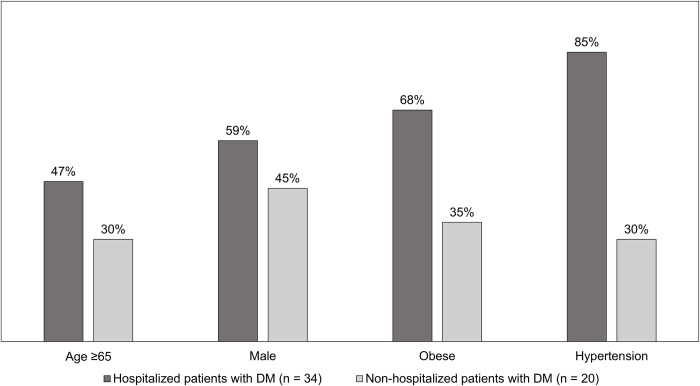
Overall, 364 patients participated; 128 were hospitalized and 236 were non-hospitalized. In multivariable analysis, chronic hypoxemic respiratory failure with oxygen requirement (adjusted odds ratio [aOR] 14.64; 95% confidence interval [CI] 1.45-147.93), taking opioids (aOR 8.05; CI 1.16-55.77), metabolic syndrome (aOR 5.71; CI 1.18-27.54), obesity (aOR 3.35; CI 1.58-7.09), age ≥65 years (aOR 3.22; CI 1.20-7.97), hypertension (aOR 3.14; CI 1.47-6.71), arrhythmia (aOR 2.95; CI 1.00-8.68), and male sex (aOR 2.65; CI 1.44-4.88), were significantly associated with hospitalization.
We identified patient characteristics, medications, and medical conditions, including some novel ones, associated with hospitalization. These data can be used to inform clinical and public health resource needs.
大多数关于 2019 年冠状病毒病(COVID-19)住院风险因素的现有证据来自主要从电子健康记录中提取数据的研究,这些研究仅限于特定人群,或者未能捕捉到非处方药物,也没有调整潜在的混杂因素。正确了解住院的风险因素有助于改善临床管理,并有助于针对预防信息传递以及预测和优先考虑临床和公共卫生资源需求。
使用患者问卷和图表摘录来确定住院的风险因素。
我们随机选择了 2020 年 3 月 9 日至 31 日期间科罗拉多州已知住院状态和发病时间的 1738 例实验室确诊 COVID-19 病例中的 600 例。在 2020 年 4 月,我们通过电话问卷收集了发病前 30 天内的人口统计学,社会史和服用的药物,并从患者问卷和病历摘录中收集了基础医疗状况。
共有 364 名患者参与;128 名住院,236 名未住院。在多变量分析中,伴有氧气需求的慢性低氧性呼吸衰竭(调整后的优势比[OR] 14.64;95%置信区间[CI] 1.45-147.93),服用阿片类药物(OR 8.05;CI 1.16-55.77),代谢综合征(OR 5.71;CI 1.18-27.54),肥胖症(OR 3.35;CI 1.58-7.09),年龄≥65 岁(OR 3.22;CI 1.20-7.97),高血压(OR 3.14;CI 1.47-6.71),心律失常(OR 2.95;CI 1.00-8.68)和男性(OR 2.65;CI 1.44-4.88)与住院显着相关。
我们确定了与住院相关的患者特征,药物和医疗状况,包括一些新的特征。这些数据可用于为临床和公共卫生资源需求提供信息。