Department of Medicine, Perelman School of Medicine, University of Pennsylvania, Philadelphia, PA.
St. Michael's Hospital, Division of Hematology/Oncology, University of Toronto, Toronto, ON, Canada.
Blood Adv. 2021 Oct 26;5(20):3951-3959. doi: 10.1182/bloodadvances.2021005493.
COVID-19-related critical illness is associated with an increased risk of venous thromboembolism (VTE).
These evidence-based guidelines of the American Society of Hematology (ASH) are intended to support patients, clinicians, and other health care professionals in making decisions about the use of anticoagulation for thromboprophylaxis in patients with COVID-19-related critical illness who do not have confirmed or suspected VTE.
ASH formed a multidisciplinary guideline panel that included 3 patient representatives and applied strategies to minimize potential bias from conflicts of interest. The McMaster University Grading of Recommendations Assessment, Development and Evaluation (GRADE) Centre supported the guideline development process by performing systematic evidence reviews (up to 5 March 2021). The panel prioritized clinical questions and outcomes according to their importance for clinicians and patients. The panel used the GRADE approach to assess evidence and make recommendations, which were subject to public comment. This is an update on guidelines published in February 2021.
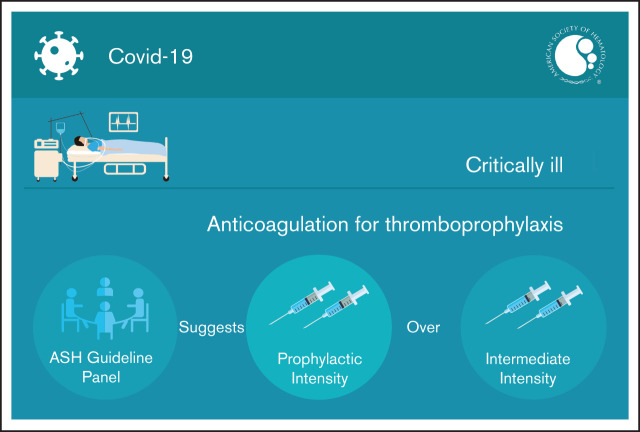
The panel agreed on 1 additional recommendation. The panel issued a conditional recommendation in favor of prophylactic-intensity over intermediate-intensity anticoagulation in patients with COVID-19-related critical illness who do not have confirmed or suspected VTE.
This recommendation was based on low certainty in the evidence, which underscores the need for additional high-quality, randomized, controlled trials comparing different intensities of anticoagulation in critically ill patients. Other key research priorities include better evidence regarding predictors of thrombosis and bleeding risk in critically ill patients with COVID-19 and the impact of nonanticoagulant therapies (eg, antiviral agents, corticosteroids) on thrombotic risk.
COVID-19 相关危重症与静脉血栓栓塞症(venous thromboembolism,VTE)风险增加相关。
这些美国血液学会(American Society of Hematology,ASH)的循证指南旨在为患者、临床医生和其他医疗保健专业人员提供决策依据,以确定 COVID-19 相关危重症且无确诊或疑似 VTE 患者的抗凝药物在血栓预防中的应用。
ASH 成立了一个多学科指南小组,其中包括 3 名患者代表,并采取了策略来最大程度地减少潜在的利益冲突偏倚。麦克马斯特大学分级评估、制定与评价(Grading of Recommendations Assessment, Development and Evaluation,GRADE)中心通过系统的证据审查(截至 2021 年 3 月 5 日)支持指南的制定过程。专家组根据对临床医生和患者的重要性对临床问题和结局进行了优先排序。专家组使用 GRADE 方法评估证据并提出建议,该建议需接受公众评议。这是对 2021 年 2 月发布指南的更新。
专家组同意增加 1 条建议。专家组提出了一项有条件的推荐意见,即在无确诊或疑似 VTE 的 COVID-19 相关危重症患者中,预防性抗凝强度优于中等强度抗凝强度。
该推荐意见的证据确定性较低,这突出表明需要开展更多高质量的随机对照试验,以比较不同强度抗凝治疗在危重症患者中的效果。其他关键研究重点包括更好地了解 COVID-19 危重症患者血栓形成和出血风险的预测因素,以及非抗凝治疗(如抗病毒药物、皮质类固醇)对血栓形成风险的影响。