Marrie Ruth Ann, Kosowan Leanne, Cutter Gary R, Fox Robert, Salter Amber
Departments of Internal Medicine and Community Health Sciences (RAM), Max Rady College of Medicine, Rady Faculty of Health Sciences, University of Manitoba, Winnipeg, Canada; Department of Family Medicine Max Rady College of Medicine (LK), Rady Faculty of Health Sciences, University of Manitoba, Winnipeg, Canada; Department of Biostatistics (GRC), University of Alabama at Birmingham, AL; Mellen Center for Multiple Sclerosis (RF), Neurological Institute, Cleveland Clinic, OH; and Department of Biostatistics (AS), Washington University in St. Louis, MO.
Neurol Clin Pract. 2021 Aug;11(4):327-334. doi: 10.1212/CPJ.0000000000001099.
By surveying a multiple sclerosis (MS) population, we tested the hypothesis that influenza vaccine uptake would not meet public health targets and that vaccine misconceptions would contribute to lower than desired uptake.
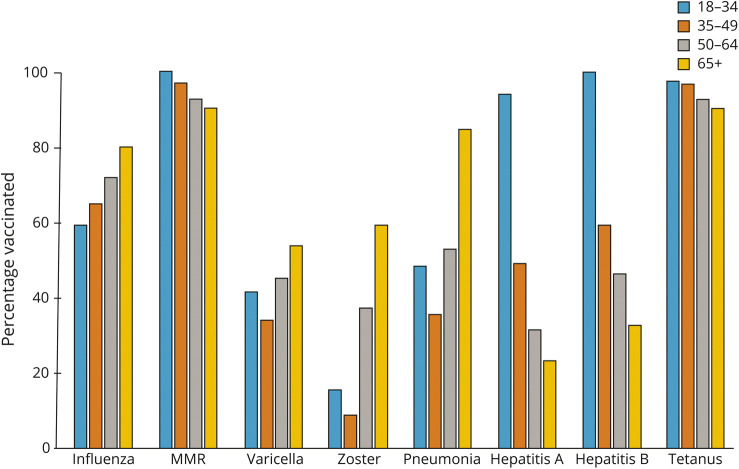
In spring 2020, we surveyed participants in the North American Research Committee on Multiple Sclerosis Registry regarding vaccinations. Participants reported whether they had received hepatitis A, hepatitis B, pneumococcal, shingles, varicella, measles/mumps/rubella, tetanus, or influenza vaccines. Participants who had not received influenza vaccine last year reported the reasons. We summarized responses descriptively. Using multivariable logistic regression, we assessed participant characteristics associated with uptake of seasonal influenza vaccine.
Of 5,244 eligible respondents, 80.8% were female, with a mean (SD) age of 61.8 (10.1) years. Overall, 43.0% (2,161/5,032) of participants reported that their neurologist had ever asked about their immunization history. The percentage of participants who received the seasonal flu vaccine last year ranged from 59.1% among those aged 18-24 years to 79.9% for persons aged ≥65 years. Among those who did not get the influenza vaccination, the most common reasons were personal preference (29.6%), concerns about possible adverse effects in general (29.3%), and concerns that the vaccine would worsen their MS (23.7%).
Vaccination uptake is lower than desired in the MS population compared with existing recommendations, including for seasonal influenza. Misconceptions about the safety of vaccination in the context of MS and personal preference appear to play important roles in vaccination choices, highlighting the importance of education about these issues.
通过对多发性硬化症(MS)人群进行调查,我们检验了以下假设:流感疫苗接种率未达到公共卫生目标,且疫苗误解会导致接种率低于预期。
2020年春季,我们对北美多发性硬化症研究委员会登记处的参与者进行了疫苗接种情况调查。参与者报告他们是否接种过甲型肝炎、乙型肝炎、肺炎球菌、带状疱疹、水痘、麻疹/腮腺炎/风疹、破伤风或流感疫苗。去年未接种流感疫苗的参与者报告了原因。我们对回答进行了描述性总结。使用多变量逻辑回归,我们评估了与季节性流感疫苗接种相关的参与者特征。
在5244名符合条件的受访者中,80.8%为女性,平均(标准差)年龄为61.8(10.1)岁。总体而言,43.0%(2161/5032)的参与者报告称他们的神经科医生曾询问过他们的免疫史。去年接种季节性流感疫苗的参与者比例从18 - 24岁人群中的59.1%到65岁及以上人群中的79.9%不等。在未接种流感疫苗的人群中,最常见的原因是个人偏好(29.6%)、对一般可能的不良反应的担忧(29.3%)以及担心疫苗会使他们的MS病情恶化(23.7%)。
与现有建议相比,包括季节性流感疫苗在内,MS人群的疫苗接种率低于预期。在MS背景下对疫苗安全性的误解和个人偏好似乎在疫苗接种选择中起重要作用,凸显了对这些问题进行教育的重要性。