Centre de Recherche du CHUM, axe Immunopathologie, Montreal, Quebec, Canada; Département de Microbiologie, Infectiologie et Immunologie, Université de Montréal, Montreal, Quebec, Canada.
Centre de Recherche du CHUM, axe Immunopathologie, Montreal, Quebec, Canada.
J Biol Chem. 2021 Oct;297(4):101151. doi: 10.1016/j.jbc.2021.101151. Epub 2021 Aug 31.
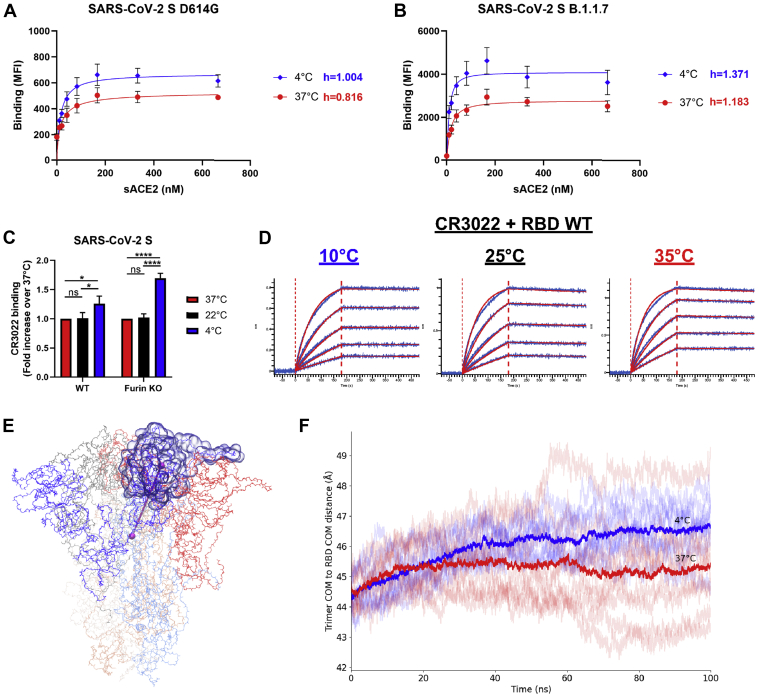
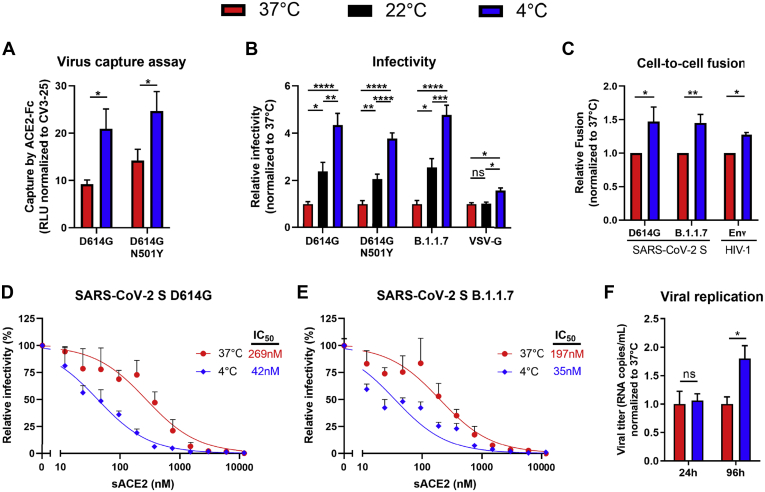
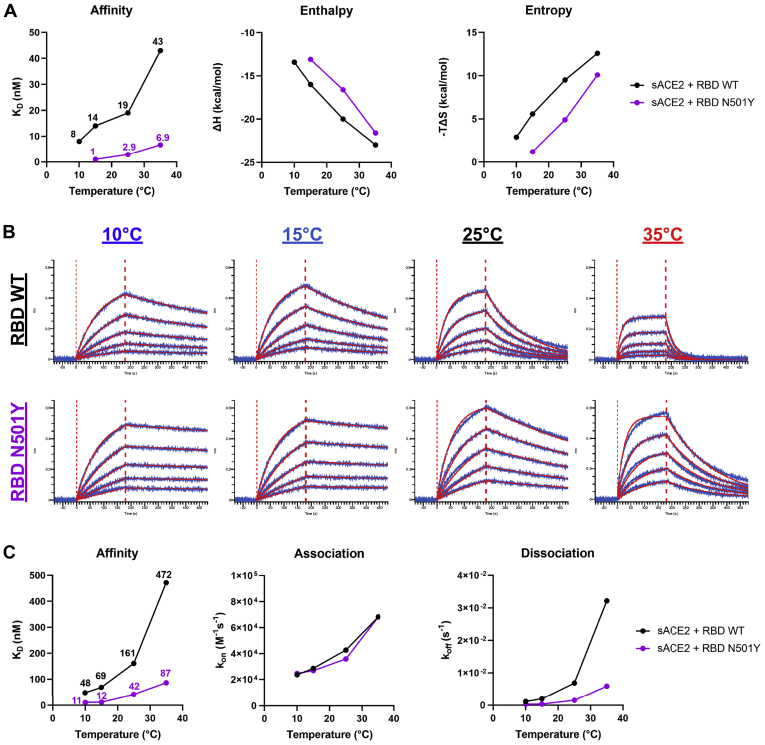
The seasonal nature of outbreaks of respiratory viral infections with increased transmission during low temperatures has been well established. Accordingly, temperature has been suggested to play a role on the viability and transmissibility of SARS-CoV-2, the virus responsible for the COVID-19 pandemic. The receptor-binding domain (RBD) of the Spike glycoprotein is known to bind to its host receptor angiotensin-converting enzyme 2 (ACE2) to initiate viral fusion. Using biochemical, biophysical, and functional assays to dissect the effect of temperature on the receptor-Spike interaction, we observed a significant and stepwise increase in RBD-ACE2 affinity at low temperatures, resulting in slower dissociation kinetics. This translated into enhanced interaction of the full Spike glycoprotein with the ACE2 receptor and higher viral attachment at low temperatures. Interestingly, the RBD N501Y mutation, present in emerging variants of concern (VOCs) that are fueling the pandemic worldwide (including the B.1.1.7 (α) lineage), bypassed this requirement. This data suggests that the acquisition of N501Y reflects an adaptation to warmer climates, a hypothesis that remains to be tested.
呼吸道病毒感染的季节性爆发与低温下传播增加的关系已得到充分证实。因此,温度被认为对导致 COVID-19 大流行的 SARS-CoV-2 病毒的存活和传染性起着一定作用。刺突糖蛋白的受体结合结构域(RBD)已知与宿主受体血管紧张素转换酶 2(ACE2)结合,从而引发病毒融合。通过生化、生物物理和功能测定来剖析温度对受体-刺突相互作用的影响,我们观察到在低温下 RBD-ACE2 亲和力显著且逐步增加,导致解离动力学变慢。这转化为全长 Spike 糖蛋白与 ACE2 受体的相互作用增强,以及在低温下更高的病毒附着。有趣的是,存在于正在全球范围内引发大流行的新兴关注变体(VOC)中的 RBD N501Y 突变(包括 B.1.1.7(α)谱系)绕过了这一要求。该数据表明,N501Y 的获得反映了对温暖气候的适应,这一假设仍有待检验。