Hubei Province Key Laboratory of Occupational Hazard Identification and Control, Wuhan University of Science and Technology, Wuhan, China.
New Medicine Innovation and Development Institute, Department of Pharmacy, College of Medicine, Wuhan University of Science and Technology, Wuhan, China.
Cell Commun Signal. 2021 Sep 3;19(1):90. doi: 10.1186/s12964-021-00771-6.
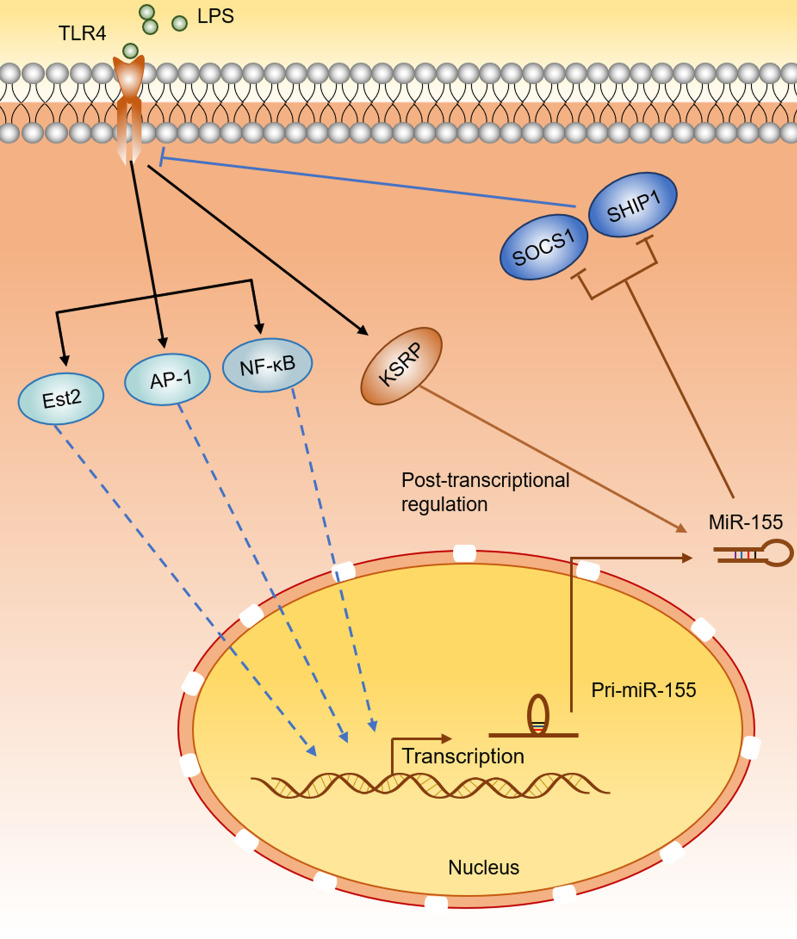
Ulcerative colitis (UC) has closely been associated with an increased risk of colorectal cancer. However, the exact mechanisms underlying colitis-associated cancer (CAC) development remain unclear. As a classic pattern-recognition receptor, Toll like receptor (TLR)4 is a canonical receptor for lipopolysaccharide of Gram-negative bacteria (including two CAC-associated pathogens Fusobacterium nucleatum and Salmonella), and functions as a key bridge molecule linking oncogenic infection to colonic inflammatory and malignant processes. Accumulating studies verified the overexpression of TLR4 in colitis and CAC, and the over-expressed TLR4 might promote colitis-associated tumorigenesis via facilitating cell proliferation, protecting malignant cells against apoptosis, accelerating invasion and metastasis, as well as contributing to the creation of tumor-favouring cellular microenvironment. In recent years, considerable attention has been focused on the regulation of TLR4 signaling in the context of colitis-associated tumorigenesis. MicroRNA (miR)-155 and TLR4 exhibited a similar dynamic expression change during CAC development and shared similar CAC-promoting properties. The available data demonstrated an interplay between TLR4 and miR-155 in the context of different disorders or cell lines. miR-155 could augment TLR4 signaling through targeting negative regulators SOCS1 and SHIP1; and TLR4 activation would induce miR-155 expression via transcriptional and post-transcriptional mechanisms. This possible TLR4-miR-155 positive feedback loop might result in the synergistic accelerating effect of TLR4 and miR-155 on CAC development. Video abstract.
溃疡性结肠炎(UC)与结直肠癌风险增加密切相关。然而,结肠炎相关癌症(CAC)发展的确切机制仍不清楚。Toll 样受体 4(TLR4)作为一种经典的模式识别受体,是革兰氏阴性菌(包括两种 CAC 相关病原体具核梭杆菌和沙门氏菌)脂多糖的典型受体,是将致癌性感染与结肠炎症和恶性过程联系起来的关键桥接分子。越来越多的研究证实了 TLR4 在结肠炎和 CAC 中的过度表达,并且过度表达的 TLR4 可能通过促进细胞增殖、保护恶性细胞免受凋亡、加速侵袭和转移以及有助于创造有利于肿瘤的细胞微环境来促进 CAC 相关肿瘤的发生。近年来,人们对 TLR4 信号通路在 CAC 相关肿瘤发生中的调控作用给予了相当多的关注。miR-155 和 TLR4 在 CAC 发展过程中表现出相似的动态表达变化,并具有相似的 CAC 促进特性。现有数据表明,TLR4 和 miR-155 之间在不同疾病或细胞系中存在相互作用。miR-155 可以通过靶向负调节剂 SOCS1 和 SHIP1 来增强 TLR4 信号通路;TLR4 的激活可以通过转录和转录后机制诱导 miR-155 的表达。这种可能的 TLR4-miR-155 正反馈回路可能导致 TLR4 和 miR-155 对 CAC 发展的协同加速作用。视频摘要。