Economic and Social Research Institute, Whitaker Square, Sir John Rogerson's Quay, Dublin 2, Dublin, Ireland.
Department of Economics, Trinity College Dublin, Dublin, Ireland.
Eur J Health Econ. 2022 Apr;23(3):499-510. doi: 10.1007/s10198-021-01373-2. Epub 2021 Sep 4.
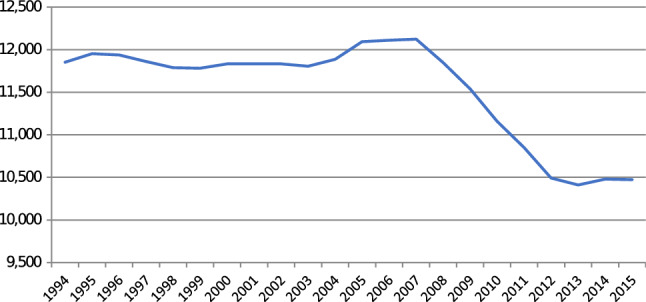
Large reductions in inpatient length of stay and inpatient bed supply have occurred across health systems in recent years. However, the direction of causation between length of stay and bed supply is often overlooked. This study examines the impact of changes to inpatient bed supply, as a result of recession-induced healthcare expenditure changes, on emergency inpatient length of stay in Ireland between 2010 and 2015.
We analyse all public hospital emergency inpatient discharges in Ireland from 2010 to 2015 using the administrative Hospital In-Patient Enquiry dataset. We use changes to inpatient bed supply across hospitals over time to examine the impact of bed supply on length of stay. Linear, negative binomial, and hospital-month-level fixed effects models are estimated.
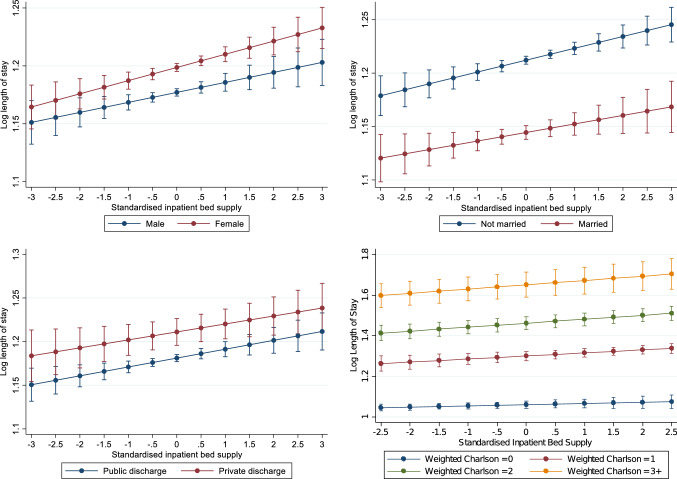
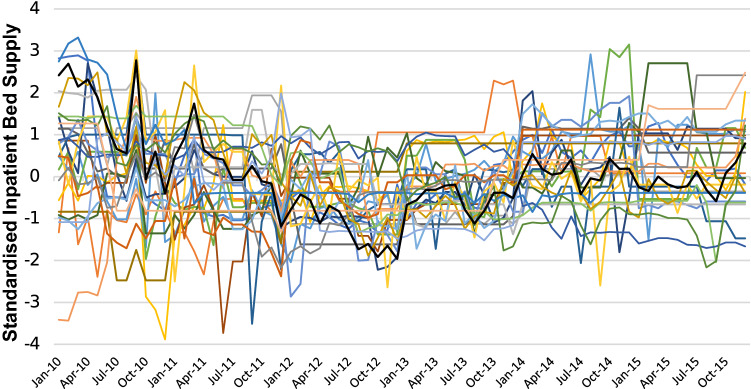
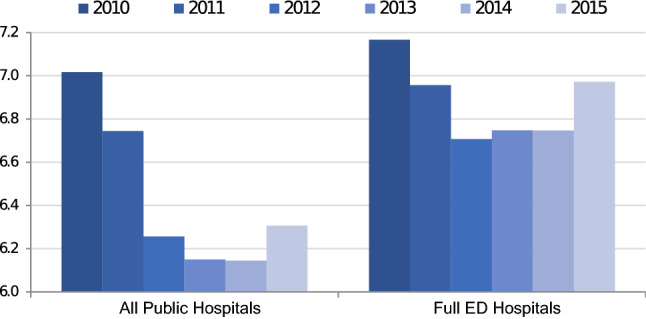
U-shaped trends are observed for both average length of stay and inpatient bed supply between 2010 and 2015. A consistently large positive relationship is found between bed supply and length of stay across all regression analyses. Between 2010 and 2012 while length of stay fell by 6.4%, our analyses estimate that approximately 42% (2.7% points) of this reduction was associated with declines in bed supply.
Changes in emergency inpatient length of stay in Ireland between 2010 and 2015 were closely related to changes in bed supply during those years. The use of length of stay as an efficiency measure should be understood in the contextual basis of other health system changes. Lower length of stay may be indicative of the lack of resources or available bed supply as opposed to reduced demand for care or the shifting of care to other settings.
近年来,医疗体系中的住院患者住院时间和住院床位供应都大幅减少。然而,住院时间和床位供应之间的因果关系往往被忽视。本研究考察了 2010 年至 2015 年期间,由于经济衰退导致医疗支出变化而导致住院床位供应变化对爱尔兰急诊住院患者住院时间的影响。
我们使用行政医院住院查询数据集分析了 2010 年至 2015 年期间爱尔兰所有公立医院的急诊住院患者出院情况。我们利用医院随时间变化的住院床位供应变化来考察床位供应对住院时间的影响。我们估计了线性、负二项式和医院-月固定效应模型。
2010 年至 2015 年期间,平均住院时间和住院床位供应都呈现出 U 型趋势。在所有回归分析中,床位供应与住院时间之间存在一致的强正相关关系。在 2010 年至 2012 年期间,尽管住院时间下降了 6.4%,但我们的分析估计,这一下降的约 42%(2.7 个百分点)与床位供应下降有关。
2010 年至 2015 年期间,爱尔兰急诊住院患者住院时间的变化与当年床位供应的变化密切相关。在考虑其他卫生系统变化的背景下,应理解使用住院时间作为效率衡量标准。较短的住院时间可能表明缺乏资源或可用床位供应,而不是对护理的需求减少或护理转移到其他环境。