Yamamoto Hiroyuki, Ebihara Yuma, Tanaka Kimitaka, Matsui Aya, Nakanishi Yoshitsugu, Asano Toshimichi, Noji Takehiro, Kurashima Yo, Murakami Soichi, Nakamura Toru, Tsuchikawa Takahiro, Okamura Keisuke, Shichinohe Toshiaki, Hirano Satoshi
Department of Gastroenterological Surgery II, Hokkaido University Faculty School of Medicine, North 15 West 7, Kita-ku, Sapporo 0608638, Hokkaido, Japan.
Department of Gastroenterological Surgery II, Hokkaido University Faculty School of Medicine, North 15 West 7, Kita-ku, Sapporo 0608638, Hokkaido, Japan.
Int J Surg Case Rep. 2021 Sep;86:106335. doi: 10.1016/j.ijscr.2021.106335. Epub 2021 Aug 26.
A gastrointestinal stromal tumor (GIST) often arises in the stomach and small intestine, while esophageal GIST is rare. The first-choice treatment is surgical resection, but there is no standard technique. Herein, we describe our experience in the treatment of esophageal GIST and discuss the usefulness of robotic esophagectomy.
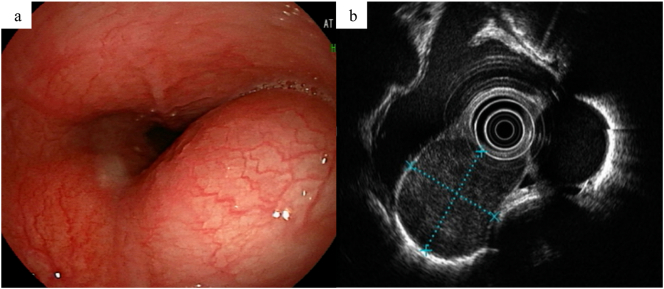
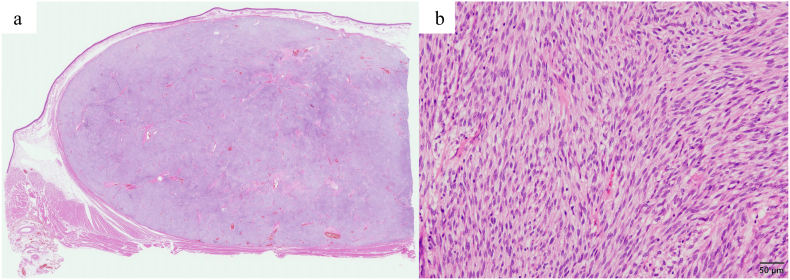
The patient was a 60-year-old woman, who was diagnosed with a 30 mm GIST in the middle thoracic esophagus. We underwent robot-assisted thoracoscopic esophagectomy in the prone position. The duration of the thoracoscopic part was 69 min and the total operation time was 319 min. Total blood loss was 135 ml. The patient's postoperative course was uneventful after surgery and the patient was discharged home in good condition on the 18th postoperative day.
The prognosis of esophageal GIST was less favorable compared with gastric GIST, and due to the anatomical peculiarities of the esophagus, which surgical procedure should be performed is still under debate. Robotic surgery has several technological advantages as it provides a three-dimensional view, ten times magnification, tremor control, and ambidexterity. Therefore, Robotic-assisted minimally invasive esophagectomy (RAMIE) allows achieving for safe R0 resection of esophageal GIST.
RAMIE may be useful for esophageal GIST because it facilitates safe and minimally invasive surgery in a limited space of the thoracic cavity.
胃肠道间质瘤(GIST)常发生于胃和小肠,而食管GIST较为罕见。首选治疗方法是手术切除,但尚无标准技术。在此,我们描述我们治疗食管GIST的经验,并讨论机器人食管切除术的实用性。
患者为一名60岁女性,被诊断为胸段食管中段有一个30毫米的GIST。我们在俯卧位进行了机器人辅助胸腔镜食管切除术。胸腔镜部分的时长为69分钟,总手术时间为319分钟。总失血量为135毫升。患者术后恢复顺利,术后第18天状况良好出院。
与胃GIST相比,食管GIST的预后较差,并且由于食管的解剖学特点,应采用何种手术方式仍存在争议。机器人手术具有多项技术优势,因为它能提供三维视野、十倍放大率、震颤控制和双手操作能力。因此,机器人辅助微创食管切除术(RAMIE)能够实现食管GIST的安全R0切除。
RAMIE可能对食管GIST有用,因为它有助于在胸腔有限空间内进行安全且微创的手术。