Furrer Daniela, Kröger Edeltraut, Marcotte Martine, Jauvin Nathalie, Bélanger Richard, Ware Mark, Foldes-Busque Guillaume, Aubin Michèle, Pluye Pierre, Dionne Clermont E
Centre d'excellence sur le vieillissement de Québec (CEVQ), Centre Intégré Universitaire de Santé et de Services Sociaux de la Capitale-Nationale (CIUSSSCN), Québec, QC, Canada.
Centre de Recherche du CHU de Québec-Université Laval, Québec, QC, Canada.
J Cannabis Res. 2021 Sep 4;3(1):41. doi: 10.1186/s42238-021-00096-8.
Chronic musculoskeletal pain (CMP) may lead to reduced physical function and is the most common cause of chronic non-cancer pain. Currently, the pharmacotherapeutic options against CMP are limited and frequently consist of pain management with non-steroidal anti-inflammatories, gabapentinoids, or opioids, which carry major adverse effects. Although the effectiveness of medical cannabis (MC) for CMP still lacks solid evidence, several patients suffering from it are exploring this therapeutic option with their physicians.
Little is known about patients' perceptions of their MC treatment for CMP. We aimed to increase this knowledge, useful for healthcare professionals and patients considering this treatment, by conducting a scoping literature review, following guidance by Arksey and O'Malley, to describe the views and perceptions of adult patients who had consumed MC to relieve chronic CMP.
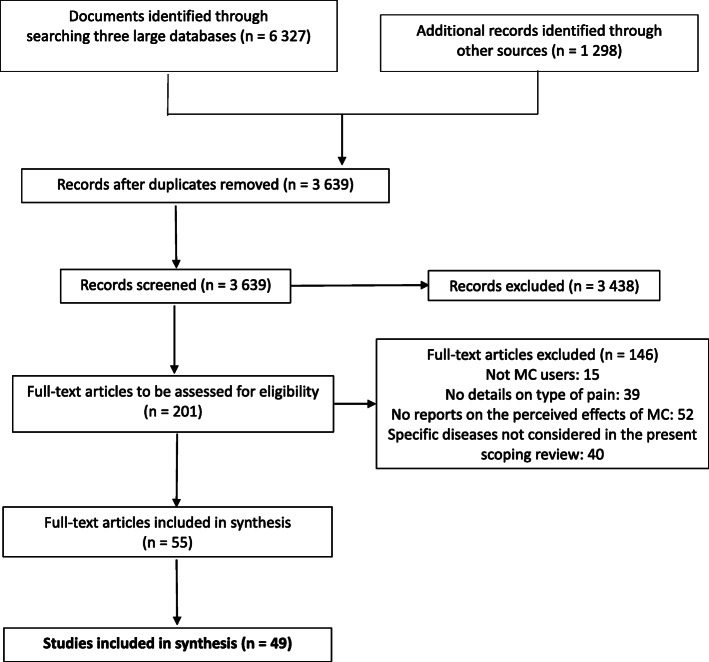
Databases (PUBMED, EMBASE, Web of Science) and websites were searched using combinations of controlled and free vocabulary. All studies and study designs reporting on patients' perceptions regarding MC against CMP were considered. Studies had to include adult patients reporting qualitatively or quantitatively, i.e., through questionnaires, on MC use to treat CMP or other non-cancer pain, since studies reporting exclusively on perceptions regarding CMP were very rare. Study characteristics were extracted and limitations of the study quality were assessed. The review includes patients' demographic characteristics, patterns of MC use, perceived positive and negative effects, use of alcohol or other drugs, reported barriers to CM use, and funding sources of the studies.
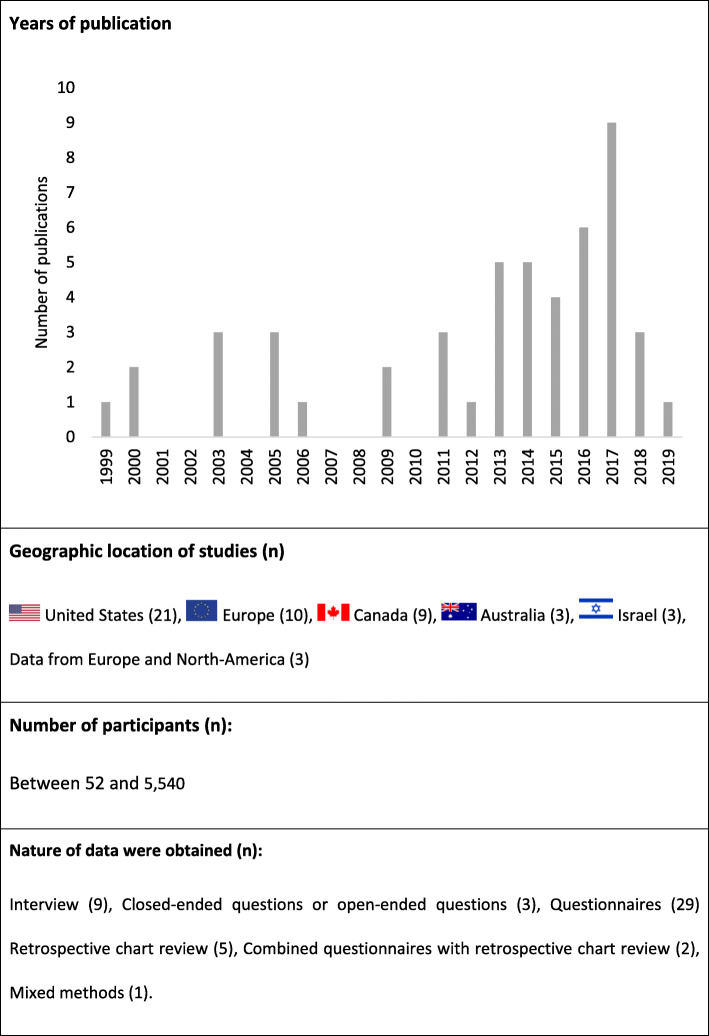
Participants of the 49 included studies reported that MC use helped them to reduce CMP and other chronic non-cancer pain, with only minor adverse effects, and some reported improved psychological well-being. In the included studies, men represent between 18 and 88% of the subjects. The mean age of participants in these studies (42/49) varied between 28.4 and 62.8 years old. The most common route of administration is inhalation.
MC users suffering from CMP or other chronic non-cancer pain perceived more benefits than harms. However, the information from these studies has several methodological limitations and results are exploratory. These user-reported experiences must thus be examined by well-designed and methodologically sound clinical or observational studies, particularly regarding CMP, where reports are very scarce.
慢性肌肉骨骼疼痛(CMP)可能导致身体功能下降,是慢性非癌性疼痛最常见的原因。目前,针对CMP的药物治疗选择有限,通常包括使用非甾体抗炎药、加巴喷丁类药物或阿片类药物进行疼痛管理,但这些药物有严重的副作用。尽管医用大麻(MC)治疗CMP的有效性仍缺乏确凿证据,但一些患有CMP的患者正在与医生探讨这种治疗选择。
对于患者对MC治疗CMP的看法知之甚少。我们旨在通过进行一项范围综述,遵循阿克西和奥马利的指导方针,以描述服用MC缓解慢性CMP的成年患者的观点和看法,从而增加这方面的知识,这对医疗保健专业人员和考虑这种治疗的患者都有用。
使用受控词汇和自由词汇的组合在数据库(PUBMED、EMBASE、科学网)和网站上进行搜索。所有报告患者对MC治疗CMP看法的研究和研究设计均被纳入考虑。研究必须包括成年患者,他们通过问卷调查等方式定性或定量地报告MC用于治疗CMP或其他非癌性疼痛的情况,因为专门报告对CMP看法的研究非常罕见。提取研究特征并评估研究质量的局限性。该综述包括患者的人口统计学特征、MC使用模式、感知到的正面和负面影响、酒精或其他药物的使用情况、报告的MC使用障碍以及研究的资金来源。
纳入的49项研究的参与者报告称,使用MC有助于他们减轻CMP和其他慢性非癌性疼痛,只有轻微的副作用,一些人还报告心理健康状况有所改善。在纳入的研究中,男性占受试者的18%至88%。这些研究(42/49)中参与者的平均年龄在28.4岁至62.8岁之间。最常见的给药途径是吸入。
患有CMP或其他慢性非癌性疼痛的MC使用者认为益处多于危害。然而,这些研究的信息存在一些方法学上的局限性,结果具有探索性。因此,这些用户报告的经验必须通过设计良好且方法合理的临床或观察性研究来检验,特别是关于CMP的研究,此类报告非常稀少。