Zhou Ling, Li Ting, Wu Xin, Lu Hongjuan, Lin Li, Ye Lingying, Yin Jian, Zhao Juan, Wang Xiuwen, Bian Jianye, Xu Huji
Department of Rheumatology and Immunology, Shanghai Changzheng Hospital, Naval Medical University, 415 Fengyang Road, Shanghai, 200003, China.
Peking-Tsinghua Center for Life Sciences, Tsinghua University, Beijing, 100084, China.
Pain Ther. 2021 Dec;10(2):1467-1479. doi: 10.1007/s40122-021-00310-8. Epub 2021 Sep 4.
Pain in ankylosing spondylitis is currently considered an inflammatory pain (IP). However, it was found that some patients still had the sensation of pain even without inflammation. Our study was to investigate the prevalence and characteristics of neuropathic pain (NeP) in Chinese Han ankylosing spondylitis (AS) patients.
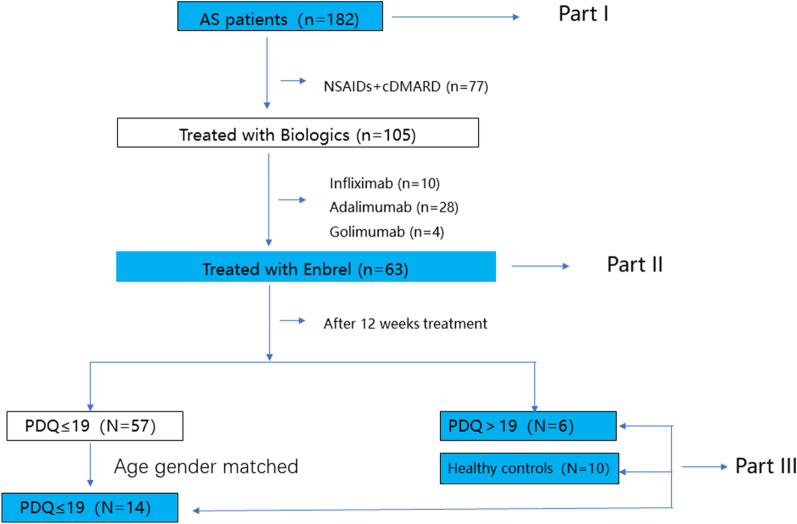
The study consisted of three parts. Firstly, we assessed the prevalence and clinical data of NeP in 182 AS patients. Secondly, we evaluated pain improvement after etanercept therapy in 63 patients. Finally, serum neurotransmitters were measured for 20 AS patients and ten healthy controls (HC).
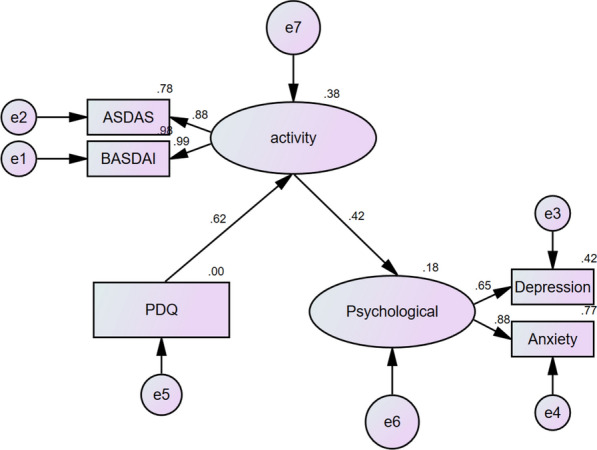
Out of 182 AS patients, our study showed that 14 patients (7.70%) had likely NeP and 55 (30.21%) had uncertain NeP. There were significant differences among the three groups with respect to nocturnal pain (NP), peripheral pain (PP), total back pain (TBP), BASDAI, ASDAS-CRP, HAD-A, HAD-D, and BASDAI-fatigue except fort CRP concentrations. Principal component analysis (PCA) of AS pain revealed that the weight of NeP was greater than PP in the first principal component (0.703 vs. 0.639). Structural equation modeling (SEM) revealed that NeP altered disease activity (β = 0.62, P < 0.001), which influenced psychological status (β = 0.42, P < 0.001). Of 63 patients who used etanercept for 3 months, significant improvement was found in NP, TBP, and PP (all P < 0.0001) but not in PDQ (10.60 ± 6.85 vs. 9.98 ± 6.40, P = 0.0671). Serum norepinephrine concentrations in patients with PDQ > 19 were higher than those in patients with PDQ ≤ 19 and HC.
We conclude that NeP contributes to pain in AS patients.
强直性脊柱炎中的疼痛目前被认为是一种炎性疼痛(IP)。然而,研究发现一些患者即使在没有炎症的情况下仍有疼痛感觉。我们的研究旨在调查中国汉族强直性脊柱炎(AS)患者中神经性疼痛(NeP)的患病率及特征。
本研究包括三个部分。首先,我们评估了182例AS患者中NeP的患病率及临床数据。其次,我们评估了63例患者接受依那西普治疗后的疼痛改善情况。最后,对20例AS患者和10例健康对照(HC)进行血清神经递质检测。
在182例AS患者中,我们的研究显示14例(7.70%)可能患有NeP,55例(30.21%)患有不确定的NeP。除CRP浓度外,三组在夜间疼痛(NP)、外周疼痛(PP)、总背痛(TBP)、BASDAI、ASDAS-CRP、HAD-A、HAD-D和BASDAI-疲劳方面存在显著差异。AS疼痛的主成分分析(PCA)显示,在第一主成分中NeP的权重高于PP(0.703对0.639)。结构方程模型(SEM)显示,NeP改变疾病活动(β = 0.62,P < 0.001),这又影响心理状态(β = 0.42,P < 0.001)。在63例使用依那西普3个月的患者中,NP、TBP和PP有显著改善(均P < 0.0001),但PDQ无改善(10.60 ± 6.85对9.98 ± 6.40,P = 0.0671)。PDQ > 19的患者血清去甲肾上腺素浓度高于PDQ≤19的患者和HC。
我们得出结论,NeP导致AS患者疼痛。