Department of Biology, Kazerun Branch, Islamic Azad University, Kazerun, Iran.
Ethiop J Health Sci. 2021 May;31(3):673-682. doi: 10.4314/ejhs.v31i3.25.
Alcohol consumption can cause hepatitis and long-term cirrhosis of the liver. The aim of this study was to evaluate the protective effects of curcumin (CUR) and ursodeoxycholic acid (UDCA) alone and together in the prevention and treatment of liver damage caused by overuse of ethanol.
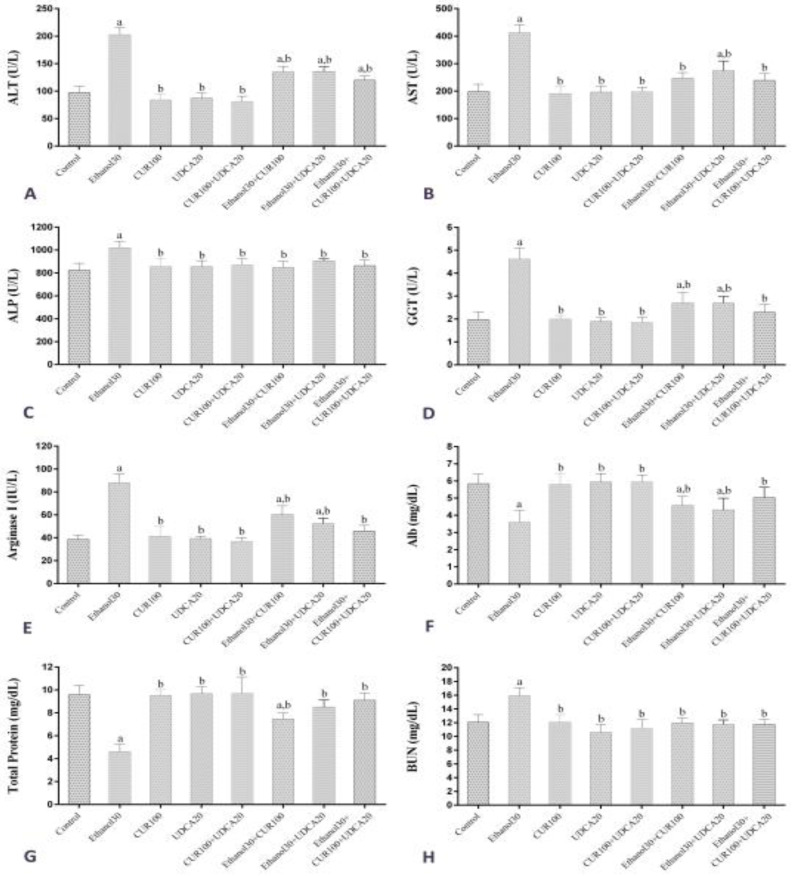
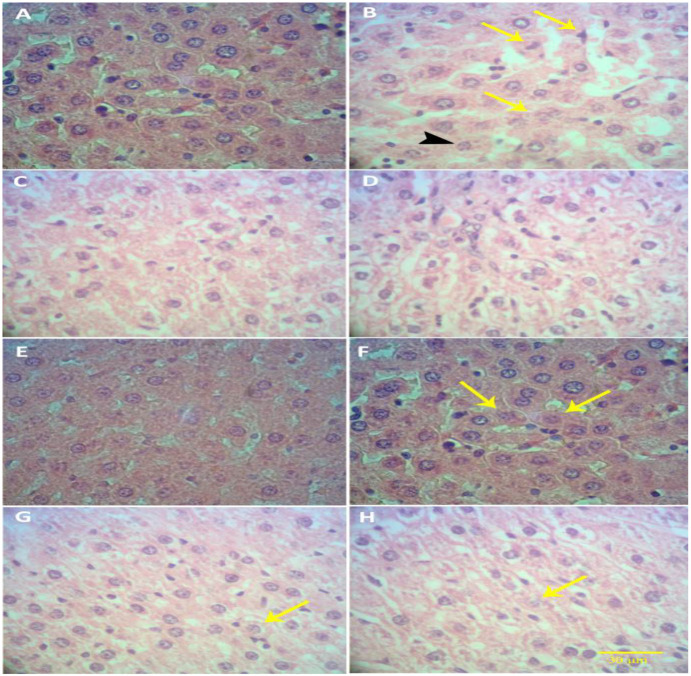
Adult Wistar rats were divided into 8 groups of 5, including the control group and various combinations of ethanol, CUR and UDCA groups. Twenty-eight days after the oral treatment, serum levels of aspartate transaminase (AST), alanine transaminase (ALT), alkaline phosphatase (ALP), gamma-glutamyl transferase (GGT) and Arginase I (ArgI) as well as serum levels of Albumin (Alb), total protein (TP) and Blood Urea Nitrogen (BUN) were measured, and liver tissue was evaluated histopathologically.
The solo administration of CUR, UDCA and CUR+UDCA had no effect on the blood parameters and liver tissue compared to the control group (p>0.05). The solo administration of CUR and UDCA in ethanol-treated rats significantly reduced ALT, AST, ALP, GGT, ArgI and BUN levels (p<0.05), while the solo administration increased Alb and TP levels compared to the ethanol group (p<0.05). In these groups, a significant decrease in cell necrosis and local inflammation of hepatocytes was observed, and the liver damage was mild. However, co-administration of ethanol, CUR and UDCA made significantly greater decrease in ALT, AST, ALP, GGT, ArgI and BUN levels (p>0.05), while the co-administration greatly increased Alb and TP levels compared to the ethanol group (p<0.05). Histopathologically, a decrease in structural changes in liver tissue and inflammation was observed, resulting in the improvement of liver tissue.
The solo administration of CUR and UDCA could reduce ethanol-induced liver damage in rats and improve liver's serum and blood parameters. However, the coadministration of CUR and UDCA has a greater efficacy.
饮酒可导致肝炎和长期肝硬化。本研究旨在评估姜黄素(CUR)和熊去氧胆酸(UDCA)单独及联合应用于预防和治疗乙醇过度使用引起的肝损伤的保护作用。
将成年 Wistar 大鼠分为 8 组,每组 5 只,包括对照组和乙醇、CUR 和 UDCA 各组合组。口服治疗 28 天后,测定血清天门冬氨酸转氨酶(AST)、丙氨酸转氨酶(ALT)、碱性磷酸酶(ALP)、γ-谷氨酰转移酶(GGT)和精氨酸酶 I(ArgI)以及血清白蛋白(Alb)、总蛋白(TP)和血尿素氮(BUN)水平,并进行肝组织病理评估。
与对照组相比,CUR、UDCA 单独给药以及 CUR+UDCA 单独给药对血液参数和肝组织均无影响(p>0.05)。在乙醇处理的大鼠中,CUR 和 UDCA 单独给药可显著降低 ALT、AST、ALP、GGT、ArgI 和 BUN 水平(p<0.05),同时与乙醇组相比,CUR 和 UDCA 单独给药可提高 Alb 和 TP 水平(p<0.05)。在这些组中,观察到肝细胞坏死和局部炎症明显减少,肝损伤较轻。然而,与乙醇组相比,乙醇、CUR 和 UDCA 联合给药使 ALT、AST、ALP、GGT、ArgI 和 BUN 水平显著降低(p>0.05),同时 Alb 和 TP 水平显著升高(p<0.05)。组织病理学检查显示,肝组织结构变化和炎症减轻,肝组织得到改善。
CUR 和 UDCA 单独给药可减轻乙醇诱导的大鼠肝损伤,改善肝脏的血清和血液参数。然而,CUR 和 UDCA 的联合给药具有更大的疗效。