Chen Sifang, Mao Jianyao, Chen Xi, Li Zhangyu, Zhu Zhi, Li Yukui, Jiang Zhengye, Zhao Wenpeng, Wang Zhanxiang, Zhong Ping, Huang Qinghai
Department of Neurosurgery, The First Affiliated Hospital of Xiamen University, Xiamen, China.
Department of Neurosurgery, Heze Municipal Hospital, Heze, China.
Front Aging Neurosci. 2021 Aug 16;13:716068. doi: 10.3389/fnagi.2021.716068. eCollection 2021.
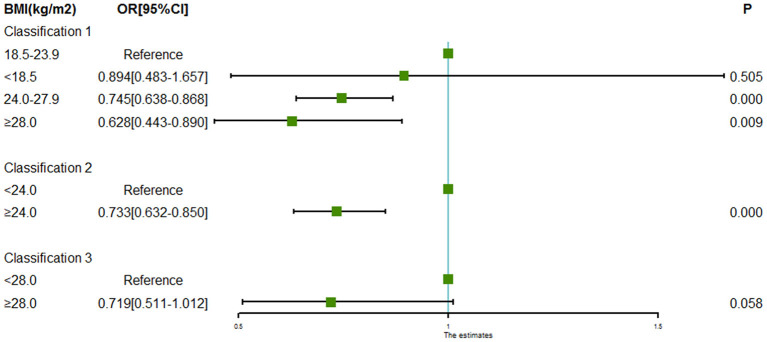
It has recently emerged the concept of "obesity paradox," a term used to describe an inverse association between obesity and clinical outcomes in cardiovascular diseases and stroke. The purpose of this study was to investigate the association between body mass index (BMI) and the risk of intracranial aneurysm rupture. In this study, we conducted a retrospective analysis of a prospectively maintained database of patients with intracranial aneurysms from 21 medical centers in China. A total of 3,965 patients with 4,632 saccular intracranial aneurysms were enrolled. Patients were separated into unruptured ( = 1,977) and ruptured groups ( = 1,988). Univariable and multivariable logistic regression analyses were performed to determine the association between BMI and intracranial aneurysm rupture. Compared to the patients with normal BMI (18.5 to < 24.0 kg/m), the odds of intracranial aneurysm rupture were significantly lower in patients with BMI 24.0 to < 28.0 kg/m (OR = 0.745, 95% CI = 0.638-0.868, = 0.000) and patients with BMI ≥ 28.0 kg/m (OR = 0.628, 95% CI = 0.443-0.890, = 0.009). Low BMI (<18.0 kg/m) was not associated with intracranial aneurysm rupture (OR = 0.894, 95% CI = 0.483-1.657, = 0.505). For males, both the BMI 24.0 to < 28.0 kg/m (OR = 0.606, 95% CI = 0.469-0.784, = 0.000) and the BMI ≥ 28.0 kg/m (OR = 0.384, 95% CI = 0.224-0.658, = 0.001) were associated with a lower rupture risk, whereas the inverse association was not observed in females. Both the BMI 24.0 to < 28.0 kg/m (OR = 0.722 for aged 50-60y, 95% CI = 0.554-0.938, = 0.015; OR = 0.737 for aged >60y, 95% CI = 0.586-0.928, = 0.009) and the BMI ≥ 28.0 kg/m (OR = 0.517 for aged 50-60y, 95% CI = 0.281-0.950, = 0.0034; OR = 0.535 for aged >60y, 95% CI = 0.318-0.899, = 0.0018) was associated with a lower rupture risk in patients aged ≥50 years, whereas the association was not significant in patients aged <50 years. Increased BMI is significantly and inversely associated with saccular intracranial aneurysm rupture in males and patients aged ≥50 years.
最近出现了“肥胖悖论”的概念,该术语用于描述肥胖与心血管疾病和中风临床结局之间的负相关关系。本研究的目的是调查体重指数(BMI)与颅内动脉瘤破裂风险之间的关联。在本研究中,我们对中国21个医疗中心前瞻性维护的颅内动脉瘤患者数据库进行了回顾性分析。共纳入3965例患者的4632个囊状颅内动脉瘤。患者被分为未破裂组(=1977)和破裂组(=1988)。进行单变量和多变量逻辑回归分析以确定BMI与颅内动脉瘤破裂之间的关联。与BMI正常(18.5至<24.0kg/m)的患者相比,BMI为24.0至<28.0kg/m的患者颅内动脉瘤破裂几率显著降低(OR=0.745,95%CI=0.638-0.868,=0.000),BMI≥28.0kg/m的患者(OR=0.628,95%CI=0.443-0.890,=0.009)。低BMI(<18.0kg/m)与颅内动脉瘤破裂无关(OR=0.894,95%CI=0.483-1.657,=0.505)。对于男性,BMI为24.0至<28.0kg/m(OR=0.606,95%CI=0.469-0.784,=0.000)和BMI≥28.0kg/m(OR=0.384,95%CI=0.224-0.658,=0.001)均与较低的破裂风险相关,而在女性中未观察到这种负相关关系。BMI为24.0至<28.0kg/m(50-60岁患者OR=0.722,95%CI=0.554-0.938,=0.015;>60岁患者OR=0.737,95%CI=0.586-0.928,=0.009)和BMI≥28.0kg/m(50-60岁患者OR=0.517,95%CI=0.281-0.950,=0.0034;>60岁患者OR=0.535,95%CI=0.318-0.899,=0.0018)与≥50岁患者较低的破裂风险相关,而在<50岁患者中这种关联不显著。BMI升高与男性和≥50岁患者的囊状颅内动脉瘤破裂显著负相关。