• 文献检索
  • 文档翻译
  • 深度研究
  • 学术资讯
  • Suppr Zotero 插件Zotero 插件
  • 邀请有礼
  • 套餐&价格
  • 历史记录
应用&插件
Suppr Zotero 插件Zotero 插件浏览器插件Mac 客户端Windows 客户端微信小程序
定价
高级版会员购买积分包购买API积分包
服务
文献检索文档翻译深度研究API 文档MCP 服务
关于我们
关于 Suppr公司介绍联系我们用户协议隐私条款
关注我们

Suppr 超能文献

核心技术专利:CN118964589B侵权必究
粤ICP备2023148730 号-1Suppr @ 2026

文献检索

告别复杂PubMed语法,用中文像聊天一样搜索,搜遍4000万医学文献。AI智能推荐,让科研检索更轻松。

立即免费搜索

文件翻译

保留排版,准确专业,支持PDF/Word/PPT等文件格式,支持 12+语言互译。

免费翻译文档

深度研究

AI帮你快速写综述,25分钟生成高质量综述,智能提取关键信息,辅助科研写作。

立即免费体验

在UChB大鼠的小脑中,咖啡因的摄入通过调节腺苷能受体减轻乙醇诱导的炎症。

Caffeine consumption attenuates ethanol-induced inflammation through the regulation of adenosinergic receptors in the UChB rats cerebellum.

作者信息

Rossetto Isabela Maria Urra, Cagnon Valéria Helena Alves, Kido Larissa Akemi, Lizarte Neto Fermino Sanches, Tirapelli Luís Fernando, Tirapelli Daniela Pretti da Cunha, de Almeida Chuffa Luiz Gustavo, Martinez Francisco Eduardo, Martinez Marcelo

机构信息

Department of Structural and Functional Biology, University of Campinas (UNICAMP), 255 Monteiro Lobato St, Campinas, SP 13083-862, Brazil.

Department of Food and Nutrition, University of Campinas (UNICAMP), 80 Monteiro Lobato St, Campinas, SP 13083-862, Brazil.

出版信息

Toxicol Res (Camb). 2021 Jul 24;10(4):835-849. doi: 10.1093/toxres/tfab067. eCollection 2021 Aug.

DOI:10.1093/toxres/tfab067
PMID:34484675
原文链接:https://pmc.ncbi.nlm.nih.gov/articles/PMC8403609/
Abstract

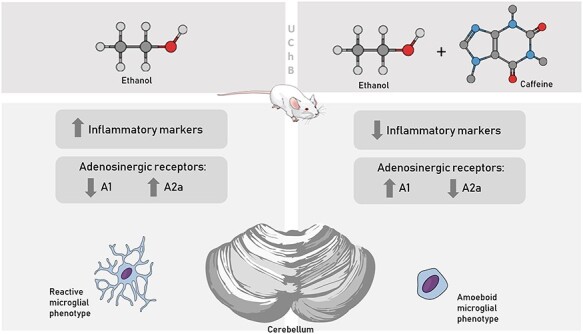
Caffeine consumption is able to interfere in cellular processes related to inflammatory mechanisms by acting through the adenosinergic system. This study aimed to recognize alterations related to adenosinergic system and inflammatory process in the cerebellum of University of Chile Bibulous (UChB) rats after the consumption of ethanol and caffeine. UChB and Wistar rats, males at 5 months old, were divided into the groups ( = 15/group): (i) Control (Wistar rats receiving water); (ii) Ethanol group (UChB rats receiving ethanol solution at 10%) and (iii) Ethanol+caffeine group (UChB rats receiving ethanol solution at 10% added of 3 g/L of caffeine). The cerebellar tissue was collected and processed for immunohistochemistry, Reverse transcription polymerase chain reaction (RT-PCR) and western blotting techniques for the adenosinergic receptors A1 and A2a and inflammatory markers, including Nuclear factor kappa B (NFkB), TLR4, TLR2, MyD88, TNF-α, COX-2, iNOS and microglial marker Iba-1. Results showed ethanol and caffeine consumption differentially altering the immunolocalization of adenosinergic receptors and inflammatory markers in the cerebellar tissue. The A2a receptor was overexpressed in the Ethanol group and was evident in the glial cells. The Ethanol group had increased protein levels for NFκB and TLR4, expressively in Bergmann glia and Purkinje cells. Caffeine reduced the expression of these markers to levels similar to those found in the Control group. The A1 gene was upregulated the Ethanol group, but not its protein levels, suggesting post-transcriptional interference. In conclusion, caffeine seems to attenuate ethanol-induced inflammation in the cerebellum of UChB rats through the A1 and A2a modulation, playing a neuroprotective role in the chronic context of ethanol consumption.

摘要

咖啡因的摄入能够通过腺苷能系统发挥作用,干扰与炎症机制相关的细胞过程。本研究旨在识别智利大学嗜酒(UChB)大鼠在摄入乙醇和咖啡因后,其小脑腺苷能系统和炎症过程的相关变化。5月龄雄性UChB大鼠和Wistar大鼠被分为以下几组(每组n = 15):(i)对照组(Wistar大鼠饮用清水);(ii)乙醇组(UChB大鼠饮用10%乙醇溶液);(iii)乙醇+咖啡因组(UChB大鼠饮用添加了3 g/L咖啡因的10%乙醇溶液)。收集小脑组织并进行处理,用于免疫组织化学、逆转录聚合酶链反应(RT-PCR)和蛋白质印迹技术,以检测腺苷能受体A1和A2a以及炎症标志物,包括核因子κB(NFκB)、Toll样受体4(TLR4)、Toll样受体2(TLR2)、髓样分化因子88(MyD88)、肿瘤坏死因子-α(TNF-α)、环氧化酶-2(COX-2)、诱导型一氧化氮合酶(iNOS)和小胶质细胞标志物离子钙结合衔接分子1(Iba-1)。结果显示,乙醇和咖啡因的摄入分别改变了小脑组织中腺苷能受体和炎症标志物的免疫定位。A2a受体在乙醇组中过度表达,在神经胶质细胞中明显可见。乙醇组中NFκB和TLR4的蛋白质水平升高,在伯格曼胶质细胞和浦肯野细胞中表现明显。咖啡因将这些标志物的表达降低至与对照组相似的水平。乙醇组中A1基因上调,但其蛋白质水平未上调,提示存在转录后干扰。总之,咖啡因似乎通过调节A1和A2a减轻了UChB大鼠小脑中乙醇诱导的炎症,在乙醇摄入的慢性情况下发挥神经保护作用。
https://cdn.ncbi.nlm.nih.gov/pmc/blobs/a1cd/8403609/333752a7a91f/tfab067ga1.jpg

相似文献

1
Caffeine consumption attenuates ethanol-induced inflammation through the regulation of adenosinergic receptors in the UChB rats cerebellum.在UChB大鼠的小脑中,咖啡因的摄入通过调节腺苷能受体减轻乙醇诱导的炎症。
Toxicol Res (Camb). 2021 Jul 24;10(4):835-849. doi: 10.1093/toxres/tfab067. eCollection 2021 Aug.
2
Ethanol and caffeine consumption modulates the expression of miRNAs in the cerebellum and plasma of UChB rats.乙醇和咖啡因的摄入可调节 UChB 大鼠小脑和血浆中 miRNAs 的表达。
Life Sci. 2019 Jul 15;229:180-186. doi: 10.1016/j.lfs.2019.05.016. Epub 2019 May 8.
3
Interactions of ethanol and caffeine on apoptosis in the rat cerebellum (voluntary ethanol consumers).乙醇和咖啡因对大鼠小脑细胞凋亡的相互作用(自愿性乙醇消费者)。
Cell Biol Int. 2018 Nov;42(11):1575-1583. doi: 10.1002/cbin.11054. Epub 2018 Sep 26.
4
Serum miRNAs are differentially altered by ethanol and caffeine consumption in rats.在大鼠中,血清微小RNA(miRNA)会因摄入乙醇和咖啡因而发生不同的变化。
Toxicol Res (Camb). 2019 Jul 17;8(6):842-849. doi: 10.1039/c9tx00069k. eCollection 2019 Nov 1.
5
Interaction of maternal separation on the UCh rat cerebellum.母体分离对UCh大鼠小脑的影响
Microsc Res Tech. 2014 Jan;77(1):44-51. doi: 10.1002/jemt.22311. Epub 2013 Nov 6.
6
Baclofen reduces ethanol intake in high-alcohol-drinking University of Chile bibulous rats.巴氯芬可减少智利大学高饮酒量嗜酒大鼠的乙醇摄入量。
Addict Biol. 2008 Sep;13(3-4):326-36. doi: 10.1111/j.1369-1600.2008.00102.x. Epub 2008 Apr 11.
7
The UChA and UChB rat lines: metabolic and genetic differences influencing ethanol intake.UChA和UChB大鼠品系:影响乙醇摄入的代谢和遗传差异。
Addict Biol. 2006 Sep;11(3-4):310-23. doi: 10.1111/j.1369-1600.2006.00030.x.
8
UFR2709, an Antagonist of Nicotinic Acetylcholine Receptors, Delays the Acquisition and Reduces Long-Term Ethanol Intake in Alcohol-Preferring UChB Bibulous Rats.UFR2709,一种烟碱型乙酰胆碱受体拮抗剂,可延缓酒精偏好型UChB嗜酒大鼠对乙醇的习得,并减少其长期乙醇摄入量。
Biomedicines. 2022 Jun 22;10(7):1482. doi: 10.3390/biomedicines10071482.
9
Long-term exogenous melatonin treatment modulates overall feed efficiency and protects ovarian tissue against injuries caused by ethanol-induced oxidative stress in adult UChB rats.长期外源性褪黑素治疗可调节总饲料效率,并保护成年 UChB 大鼠的卵巢组织免受乙醇诱导的氧化应激损伤。
Alcohol Clin Exp Res. 2011 Aug;35(8):1498-508. doi: 10.1111/j.1530-0277.2011.01486.x. Epub 2011 Mar 25.
10
Acute tolerance, alcohol sensitivity and drinking pattern in the F2 generation of UChA and UChB rats.UChA和UChB大鼠F2代的急性耐受性、酒精敏感性和饮酒模式
J Stud Alcohol. 2000 Sep;61(5):647-51. doi: 10.15288/jsa.2000.61.647.

引用本文的文献

1
Overview of Caffeine Effects on Human Health and Emerging Delivery Strategies.咖啡因对人体健康的影响及新兴递送策略概述
Pharmaceuticals (Basel). 2023 Jul 27;16(8):1067. doi: 10.3390/ph16081067.
2
Acute Effect of Caffeine on the Synthesis of Pro-Inflammatory Cytokines in the Hypothalamus and Choroid Plexus during Endotoxin-Induced Inflammation in a Female Sheep Model.咖啡因对雌性绵羊模型内毒素诱导炎症期间下丘脑和脉络丛中促炎细胞因子合成的急性影响。
Int J Mol Sci. 2021 Dec 8;22(24):13237. doi: 10.3390/ijms222413237.

本文引用的文献

1
The Neurophysiology of Caffeine as a Central Nervous System Stimulant and the Resultant Effects on Cognitive Function.咖啡因作为中枢神经系统兴奋剂的神经生理学及其对认知功能的影响
Cureus. 2021 May 14;13(5):e15032. doi: 10.7759/cureus.15032.
2
Chemokines, cytokines and substance use disorders.趋化因子、细胞因子与物质使用障碍。
Drug Alcohol Depend. 2021 Mar 1;220:108511. doi: 10.1016/j.drugalcdep.2021.108511. Epub 2021 Jan 8.
3
Caffeine increases alcohol self-administration, an effect that is independent of dopamine D receptor function.
咖啡因增加酒精的自我摄取,这种效果与多巴胺 D 受体功能无关。
Alcohol. 2021 Mar;91:61-73. doi: 10.1016/j.alcohol.2020.12.004. Epub 2021 Jan 9.
4
Ethanol exacerbates manganese-induced oxidative/nitrosative stress, pro-inflammatory cytokines, nuclear factor-κB activation, and apoptosis induction in rat cerebellar cortex.乙醇加剧锰诱导的氧化/硝化应激、促炎细胞因子、核因子-κB 激活和大鼠小脑皮质细胞凋亡。
J Biochem Mol Toxicol. 2021 Mar;35(3):e22681. doi: 10.1002/jbt.22681. Epub 2020 Dec 14.
5
Chronic alcohol-induced neuroinflammation involves CCR2/5-dependent peripheral macrophage infiltration and microglia alterations.慢性酒精诱导的神经炎症涉及 CCR2/5 依赖性外周巨噬细胞浸润和小胶质细胞改变。
J Neuroinflammation. 2020 Oct 9;17(1):296. doi: 10.1186/s12974-020-01972-5.
6
Acute ethanol exposure rapidly alters cerebellar and cortical microglial physiology.急性乙醇暴露会迅速改变小脑和大脑皮层小胶质细胞的生理学特性。
Eur J Neurosci. 2021 Sep;54(5):5834-5843. doi: 10.1111/ejn.14706. Epub 2020 Feb 28.
7
Serum miRNAs are differentially altered by ethanol and caffeine consumption in rats.在大鼠中,血清微小RNA(miRNA)会因摄入乙醇和咖啡因而发生不同的变化。
Toxicol Res (Camb). 2019 Jul 17;8(6):842-849. doi: 10.1039/c9tx00069k. eCollection 2019 Nov 1.
8
Defining a Time Window for Neuroprotection and Glia Modulation by Caffeine After Neonatal Hypoxia-Ischaemia.定义新生儿缺氧缺血后咖啡因的神经保护和神经胶质调节的时间窗。
Mol Neurobiol. 2020 May;57(5):2194-2205. doi: 10.1007/s12035-020-01867-9. Epub 2020 Jan 23.
9
Ethanol Exposure Induces Microglia Activation and Neuroinflammation through TLR4 Activation and SENP6 Modulation in the Adolescent Rat Hippocampus.乙醇暴露通过 TLR4 激活和 SENP6 调节诱导青春期大鼠海马小胶质细胞激活和神经炎症。
Neural Plast. 2019 Nov 12;2019:1648736. doi: 10.1155/2019/1648736. eCollection 2019.
10
Its complicated: The relationship between alcohol and microglia in the search for novel pharmacotherapeutic targets for alcohol use disorders.其错综复杂:在寻找酒精使用障碍的新型药物治疗靶点的过程中,酒精与小胶质细胞之间的关系。
Prog Mol Biol Transl Sci. 2019;167:179-221. doi: 10.1016/bs.pmbts.2019.06.011. Epub 2019 Jul 29.