Šikrová Darina, Cadar Vlad A, Ariyurek Yavuz, Laros Jeroen F J, Balog Judit, van der Maarel Silvère M
Department of Human Genetics, Leiden University Medical Center, 2333 ZC Leiden, the Netherlands.
Leiden University, 2300 RA Leiden, the Netherlands.
Mol Ther Nucleic Acids. 2021 Jun 1;25:342-354. doi: 10.1016/j.omtn.2021.05.020. eCollection 2021 Sep 3.
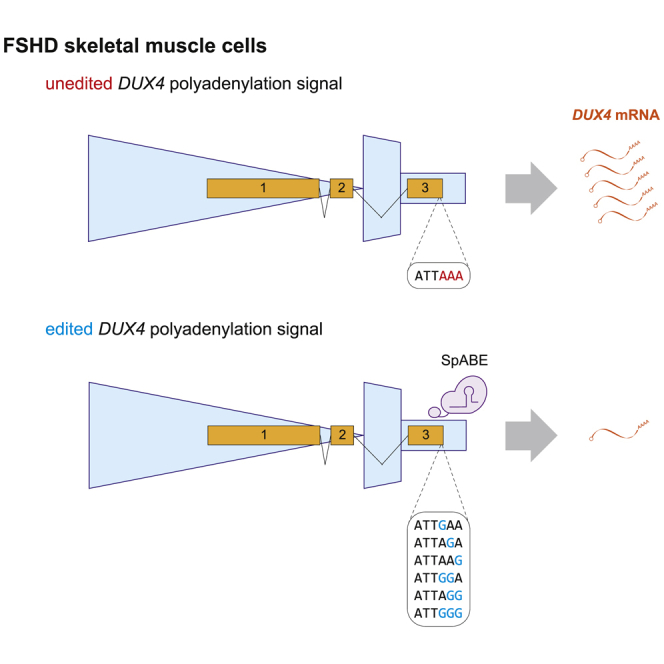
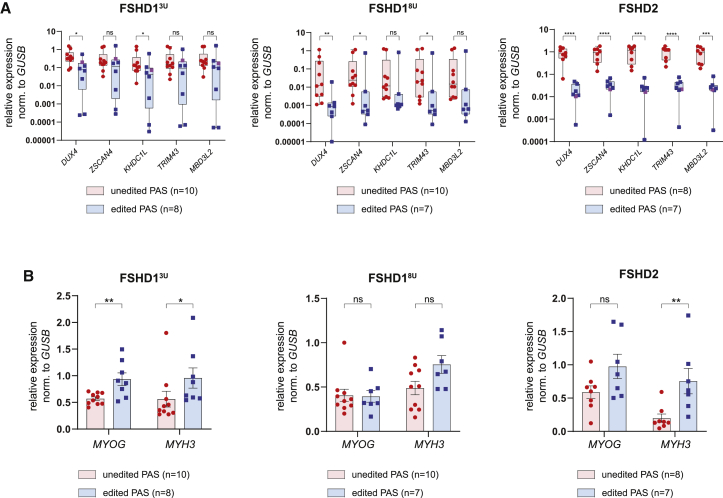
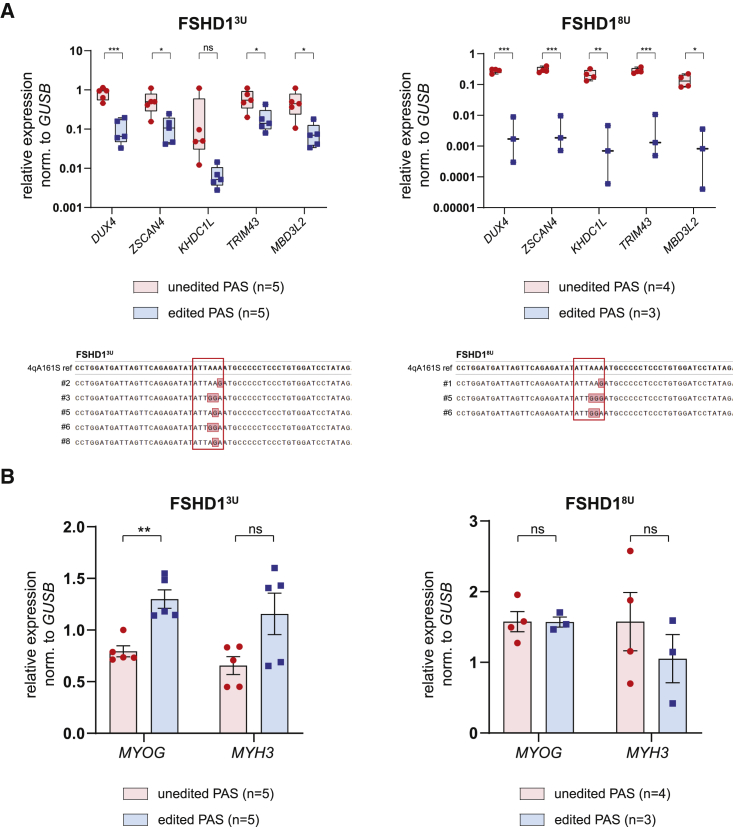
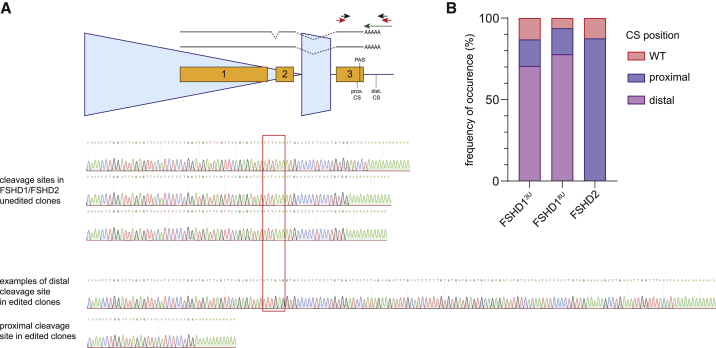
Facioscapulohumeral muscular dystrophy (FSHD) is caused by chromatin relaxation of the D4Z4 repeat resulting in misexpression of the D4Z4-encoded gene in skeletal muscle. One of the key genetic requirements for the stable production of full-length mRNA in skeletal muscle is a functional polyadenylation signal (ATTAAA) in exon three of that is used in somatic cells. Base editors hold great promise to treat DNA lesions underlying genetic diseases through their ability to carry out specific and rapid nucleotide mutagenesis even in postmitotic cells such as skeletal muscle. In this study, we present a simple and straightforward strategy for mutagenesis of the somatic polyadenylation signal by adenine base editing in immortalized myoblasts derived from independent FSHD-affected individuals. We show that mutating this critical -regulatory element results in downregulation of mRNA and its direct transcriptional target genes. Our findings identify the somatic polyadenylation signal as a therapeutic target and represent the first step toward clinical application of the CRISPR-Cas9 base editing platform for FSHD gene therapy.
面肩肱型肌营养不良症(FSHD)是由D4Z4重复序列的染色质松弛引起的,导致D4Z4编码基因在骨骼肌中错误表达。在骨骼肌中稳定产生全长mRNA的关键遗传要求之一是该基因外显子三中的功能性聚腺苷酸化信号(ATTAAA),该信号在体细胞中使用。碱基编辑器有望通过其在有丝分裂后细胞(如骨骼肌)中进行特异性和快速核苷酸诱变的能力来治疗遗传疾病的潜在DNA损伤。在本研究中,我们提出了一种简单直接的策略,通过腺嘌呤碱基编辑对来自独立FSHD患者的永生化成肌细胞中的体细胞聚腺苷酸化信号进行诱变。我们表明,突变这个关键的调控元件会导致mRNA及其直接转录靶基因的下调。我们的研究结果确定了体细胞聚腺苷酸化信号为治疗靶点,并代表了CRISPR-Cas9碱基编辑平台用于FSHD基因治疗临床应用的第一步。