Malloy Philip, Dr Neumann Donald, Leung Anne, Kipp Kristof
Department of Physical Therapy, Arcadia University, Glenside, PA, United States.
Department of Orthopaedic Surgery, Rush University Medical Center, Chicago, IL, United States.
Front Surg. 2021 Aug 17;8:614329. doi: 10.3389/fsurg.2021.614329. eCollection 2021.
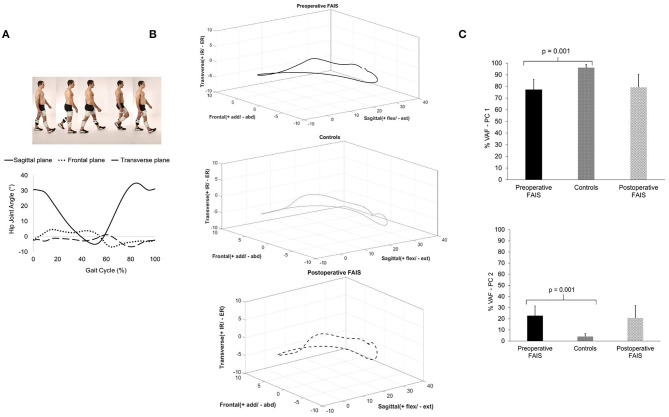
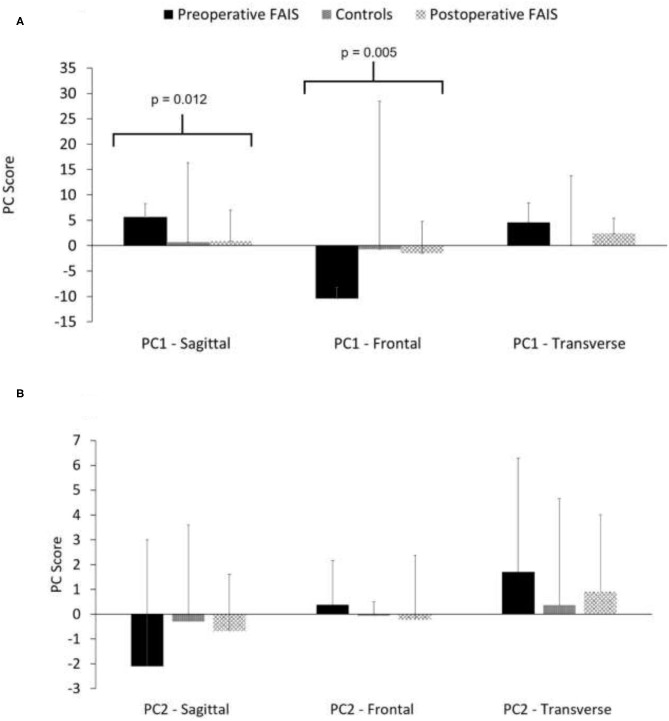
The primary aim of this study was to determine if the three-dimensional (3D) hip joint motion coordination during gait changes after arthroscopic surgery for femoroacetabular impingement syndrome (FAIS). Three-dimensional hip joint kinematic data were collected with a 12-camera motion capture system. Five trials of level walking were collected preoperatively (PRE) and at 1-year postoperatively (POST) in 8 patients diagnosed with FAIS and at a single time point in 8 healthy controls. Planar covariation analysis was performed to quantify the 3D hip joint motion coordination strategy during gait. Independent sample's -test were used to determine differences between the FAIS group at the preoperative time point (PRE) and healthy controls. Paired samples -tests were used to determine differences between the PRE and POST time points within the FAIS group. The %VAF by PC 1 for the FAIS group at the PRE time point was significantly less than that of healthy controls (PRE: 77.2 ± 8.7% vs. Control: 96.1 ± 2.8%; = 0.0001), and the % VAF of the second PC (PC2) was significantly greater [PRE: 22.8 (8.7)%; Control: 3.9 (2.8)%; = 0.0001]. No differences in %VAF were found between the PRE and POST time points within the FAIS group for PC1 [PRE: 77.2 (8.7)% vs. POST: 79.3 (11.1)%; = 0.472] or PC2 [PRE: 22.7 (8.7)%; POST: 20.7 (11.1)%; = 0.472]. Significant differences in the plane specific contribution to the 3D motion coordination strategy were found between the FAIS patients at the PRE and POST time points for the sagittal plane [PRE: 5.6 (2.7) vs. POST: 0.91 (6.1); = 0.012] and frontal plane [PRE: -10.4 (2.2) and -1.5 (6.3); = 0.005]. Patients with FAIS demonstrated a more complex coordination strategy of 3D hip joint motion than controls and this strategy remains unchanged after hip arthroscopic surgery despite changes in the plane specific contribution to this strategy. These findings indicate that motor control impairments in FAIS patients do exist and seem to persist for at least 1 year after hip arthroscopic surgery.
本研究的主要目的是确定股骨髋臼撞击综合征(FAIS)关节镜手术后步态期间三维(3D)髋关节运动协调性是否发生变化。使用12台摄像机的运动捕捉系统收集三维髋关节运动学数据。在8例诊断为FAIS的患者术前(PRE)和术后1年(POST)收集了5次平地行走试验数据,并在8例健康对照者的单一时间点收集了数据。进行平面协变分析以量化步态期间的三维髋关节运动协调策略。使用独立样本t检验确定FAIS组术前时间点(PRE)与健康对照者之间的差异。使用配对样本t检验确定FAIS组内PRE和POST时间点之间的差异。FAIS组在PRE时间点PC1的%VAF显著低于健康对照者(PRE:77.2±8.7% vs. 对照组:96.1±2.8%;P = 0.0001),第二主成分(PC2)的%VAF显著更高[PRE:22.8(8.7)%;对照组:3.9(2.8)%;P = 0.0001]。FAIS组内PRE和POST时间点之间,PC1的%VAF无差异[PRE:77.2(8.7)% vs. POST:79.3(11.1)%;P = 0.472]或PC2的%VAF无差异[PRE:22.7(8.7)%;POST:20.7(11.1)%;P = 0.472]。在矢状面[PRE:5.6(2.7) vs. POST:0.91(6.1);P = 0.012]和额状面[PRE:-10.4(2.2)和-1.5(6.3);P = 0.005]上,FAIS患者在PRE和POST时间点对三维运动协调策略的平面特定贡献存在显著差异。FAIS患者表现出比对照组更复杂的三维髋关节运动协调策略,并且尽管该策略的平面特定贡献发生了变化,但在髋关节镜手术后该策略仍保持不变。这些发现表明,FAIS患者确实存在运动控制障碍,并且在髋关节镜手术后似乎至少持续1年。