Ahad Abdul, Chahar Puneet, Haque Ekramul, Bey Afshan, Jain Meena, Raja Waseem
Department of Dentistry, Medini Rai Medical College, Palamu, Jharkhand, India.
Department of Public Health Dentistry, Maulana Azad Institute of Dental Sciences, New Delhi, India.
J Educ Health Promot. 2021 Jul 30;10:266. doi: 10.4103/jehp.jehp_1475_20. eCollection 2021.
The objective was to assess the prevalence and the associated demographic factors of stress, anxiety, and depression among undergraduate (UG) Indian dental students and determine whether the pattern is different in government-run institutions and those managed by private authorities.
A cross-sectional study was conducted among dental UG students from five dental colleges. Snowball sampling was used to approach 776 potential participants, resulting in a complete response from 507 students. The questionnaire consisted of demographic data; year of study; type of college; accommodation; and Depression, Anxiety, and Stress Scale (DASS)-42. Descriptive data and inferential statistics were obtained. Chi-square test was applied for categorical data to test for significance, and higher analysis was done using multiple linear regression.
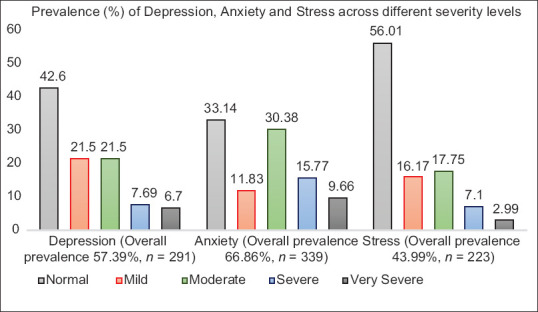
Females and males comprised 71.8% ( = 364) and 28.2% ( = 143) of the study population, respectively. The prevalence of anxiety was highest (66.86%, n = 339), followed by depression (57.39%, n = 291) and stress (43.99%, n = 223). In terms of severity also, anxiety was the most prevalent condition as more than one-fourth of the students presented with severe and very severe scores in this aspect (25.43%, n = 129) compared to depression (14.39%, n = 73) and stress (10.09%, n = 51). Regression analysis revealed age as a strong positive predictor for all the three conditions, while staying in the hostel was a positive predictor for anxiety and stress. Being female was also an independent predictor for the high prevalence of stress.
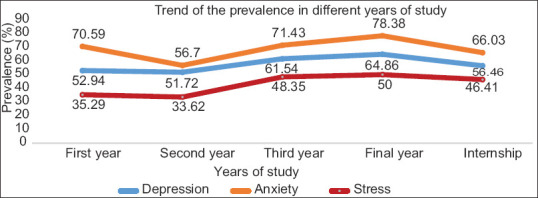
Stress, anxiety, and depression are highly prevalent among Indian dental students. Clinical students and interns have a higher prevalence of stress than preclinical students. Age, being female, and staying in the hostel are positive predictors for the severity of stress. There is no significant difference between government and private colleges, regarding the prevalence of any psychological condition.
目的是评估印度牙科本科学生中压力、焦虑和抑郁的患病率及其相关人口统计学因素,并确定在政府运营机构和私立机构中这种模式是否存在差异。
对五所牙科学院的牙科本科学生进行了一项横断面研究。采用雪球抽样法接触776名潜在参与者,最终507名学生给出了完整回复。问卷包括人口统计学数据、学习年份、学院类型、住宿情况以及抑郁、焦虑和压力量表(DASS)-42。获取了描述性数据和推断性统计数据。对分类数据应用卡方检验以检验显著性,并使用多元线性回归进行进一步分析。
女性和男性分别占研究人群的71.8%(n = 364)和28.2%(n = 143)。焦虑患病率最高(66.86%,n = 339),其次是抑郁(57.39%,n = 291)和压力(43.99%,n = 223)。在严重程度方面,焦虑也是最普遍的情况,超过四分之一的学生在这方面表现出严重和非常严重的得分(25.43%,n = 129),相比之下抑郁为(14.39%,n = 73),压力为(10.09%,n = 51)。回归分析显示年龄是所有这三种情况的强正向预测因素,而住在宿舍是焦虑和压力的正向预测因素。女性也是压力高患病率的独立预测因素。
压力、焦虑和抑郁在印度牙科学生中非常普遍。临床学生和实习生的压力患病率高于临床前学生。年龄、女性身份和住在宿舍是压力严重程度的正向预测因素。政府学院和私立学院在任何心理状况的患病率方面没有显著差异。