de Korte Johannus Q, Bongers Coen C W G, Hopman Maria T E, Teunissen Lennart P J, Jansen Kaspar M B, Kingma Boris R M, Ballak Sam B, Maase Kamiel, Moen Maarten H, van Dijk Jan-Willem, Daanen Hein A M, Eijsvogels Thijs M H
Department of Physiology, Radboud University Medical Center, Radboud Institute for Health Sciences, Nijmegen, The Netherlands.
Faculty of Health Sciences, Thermal Ergonomics Laboratory, The University of Sydney, Sydney, Australia.
Temperature (Austin). 2021 Jun 2;8(3):209-222. doi: 10.1080/23328940.2021.1925618. eCollection 2021.
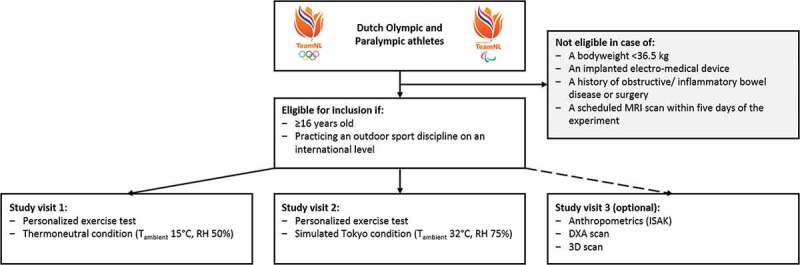
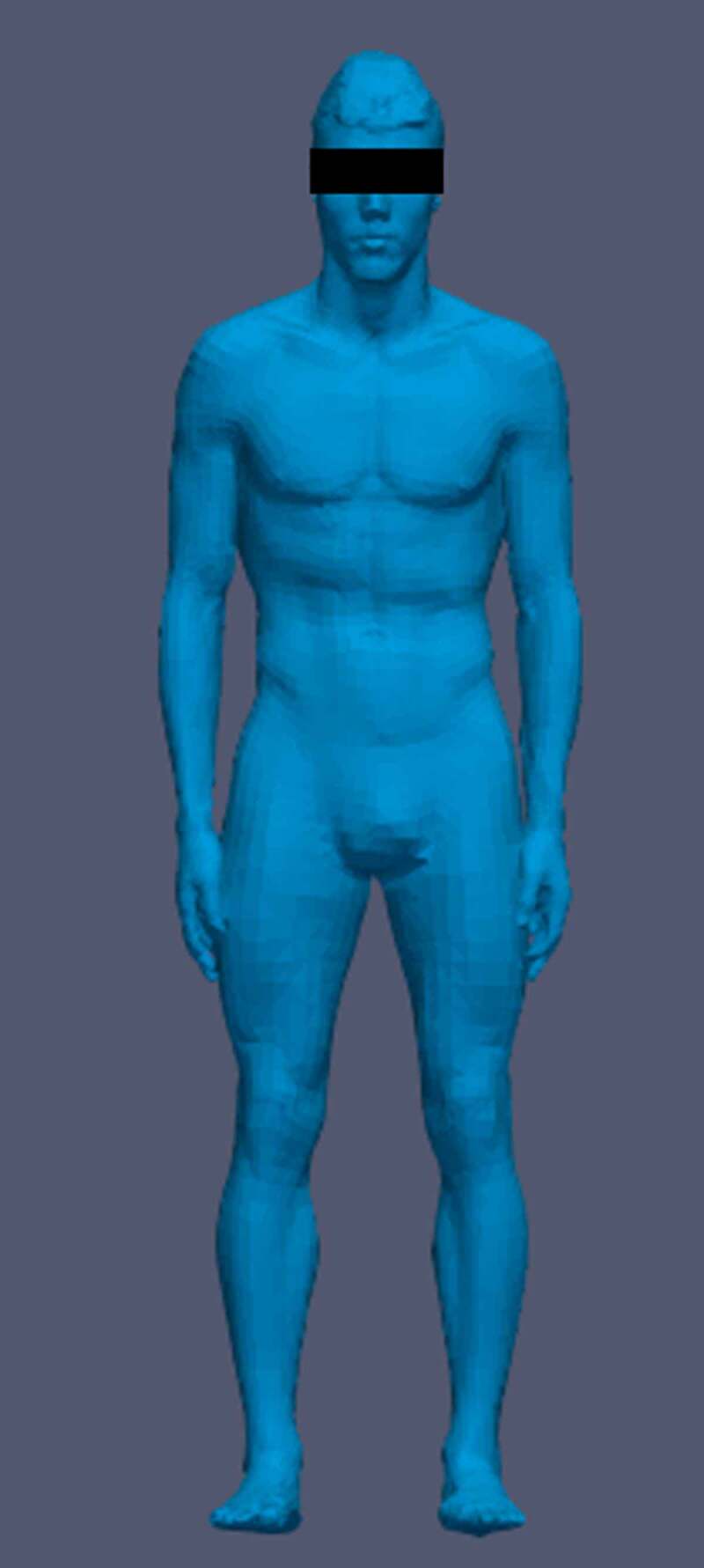
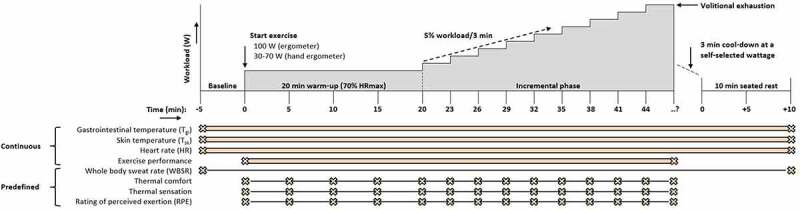
The environmental conditions during the Tokyo Olympic and Paralympic Games are expected to be challenging, which increases the risk for participating athletes to develop heat-related illnesses and experience performance loss. To allow safe and optimal exercise performance of Dutch elite athletes, the Thermo Tokyo study aimed to determine thermoregulatory responses and performance loss among elite athletes during exercise in the heat, and to identify personal, sports-related, and environmental factors that contribute to the magnitude of these outcomes. For this purpose, Dutch Olympic and Paralympic athletes performed two personalized incremental exercise tests in simulated control (15°C, relative humidity (RH) 50%) and Tokyo (32°C, RH 75%) conditions, during which exercise performance and (thermo)physiological parameters were obtained. Thereafter, athletes were invited for an additional visit to conduct anthropometric, dual-energy X-ray absorptiometry (DXA), and 3D scan measurements. Collected data also served as input for a thermophysiological computer simulation model to estimate the impact of a wider range of environmental conditions on thermoregulatory responses. Findings of this study can be used to inform elite athletes and their coaches on how heat impacts their individual (thermo)physiological responses and, based on these data, advise which personalized countermeasures (i.e. heat acclimation, cooling interventions, rehydration plan) can be taken to allow safe and maximal performance in the challenging environmental conditions of the Tokyo 2020 Olympic and Paralympic Games.
东京奥运会和残奥会期间的环境条件预计具有挑战性,这增加了参赛运动员患热相关疾病和表现下降的风险。为了让荷兰精英运动员能够安全、最佳地进行运动表现,“东京热研究”旨在确定精英运动员在高温环境下运动时的体温调节反应和表现下降情况,并识别导致这些结果严重程度的个人、运动相关和环境因素。为此,荷兰奥运会和残奥会运动员在模拟的对照条件(15°C,相对湿度(RH)50%)和东京条件(32°C,RH 75%)下进行了两次个性化的递增运动测试,在此期间获取了运动表现和(热)生理参数。此后,运动员被邀请再次前来进行人体测量、双能X线吸收法(DXA)和三维扫描测量。收集到的数据还作为热生理计算机模拟模型的输入,以估计更广泛的环境条件对体温调节反应的影响。这项研究的结果可用于告知精英运动员及其教练高温如何影响他们的个体(热)生理反应,并基于这些数据,建议采取哪些个性化的应对措施(即热适应、降温干预、补液计划),以便在2020年东京奥运会和残奥会具有挑战性的环境条件下实现安全和最佳表现。