Faculty of Behavioral and Movement Sciences, Vrije Universiteit Amsterdam, Amsterdam Movement Sciences, Amsterdam, THE NETHERLANDS.
Radboud Institute for Health Sciences, Department of Physiology, Radboud University Medical Center, Nijmegen, THE NETHERLANDS.
Med Sci Sports Exerc. 2023 Oct 1;55(10):1835-1844. doi: 10.1249/MSS.0000000000003222. Epub 2023 May 22.
This study aimed to compare the impact of hot-humid environmental conditions on performance outcomes, thermoregulatory responses, and thermal perception during exercise between elite para- and able-bodied (AB) athletes.
Twenty elite para-athletes (para-cycling and wheelchair tennis) and 20 elite AB athletes (road cycling, mountain biking, beach volleyball) performed an incremental exercise test in a temperate environment (mean ± SD, 15.2°C ± 1.2°C; relative humidity, 54% ± 7%) and a hot-humid environment (31.9°C ± 1.6°C, 72% ± 5%). Exercise tests started with a 20-min warm-up at 70% of maximal heart rate, after which power output increased by 5% every 3 min until volitional exhaustion.
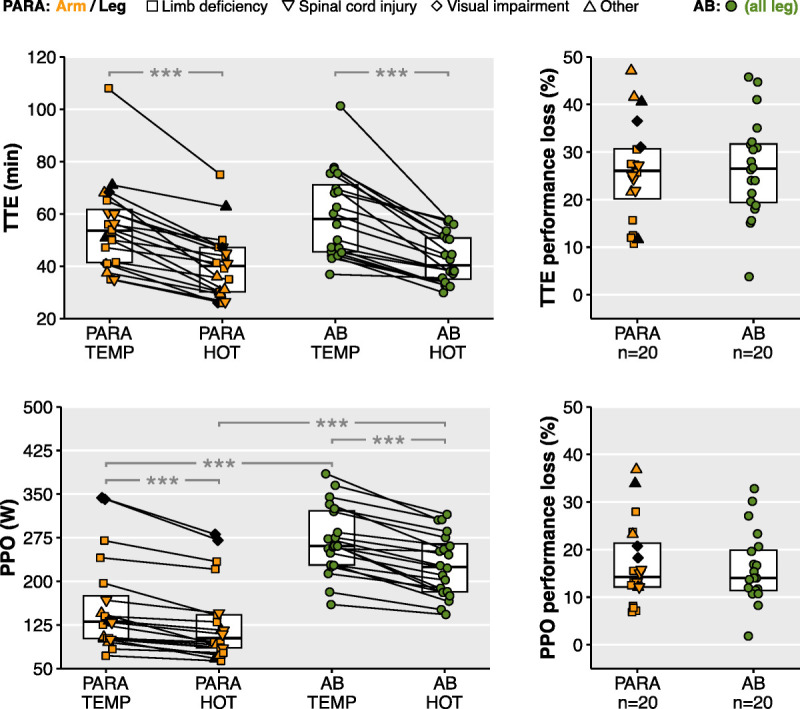
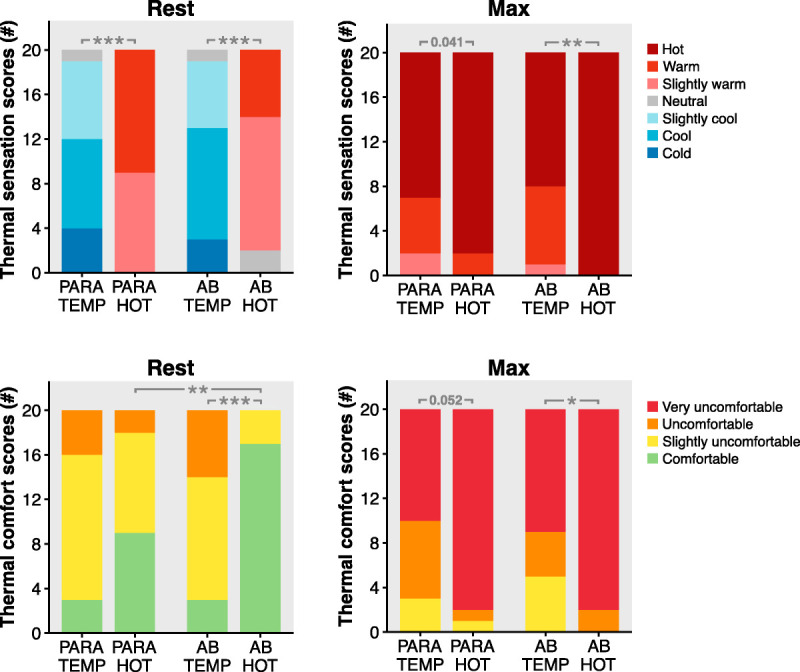
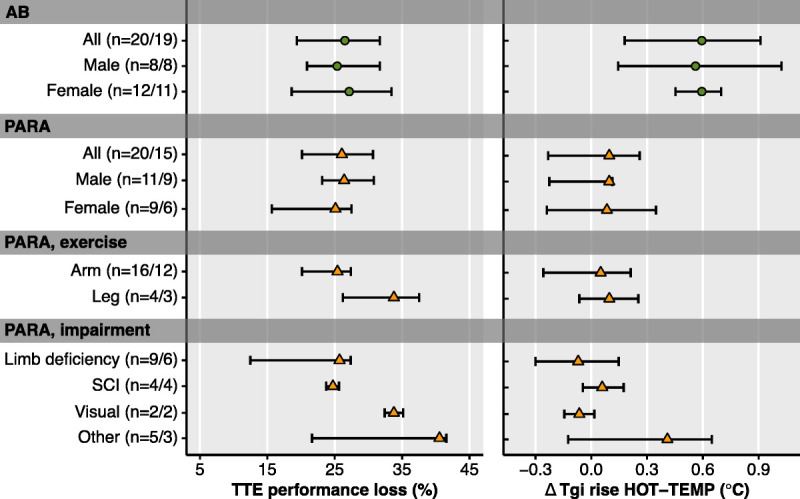
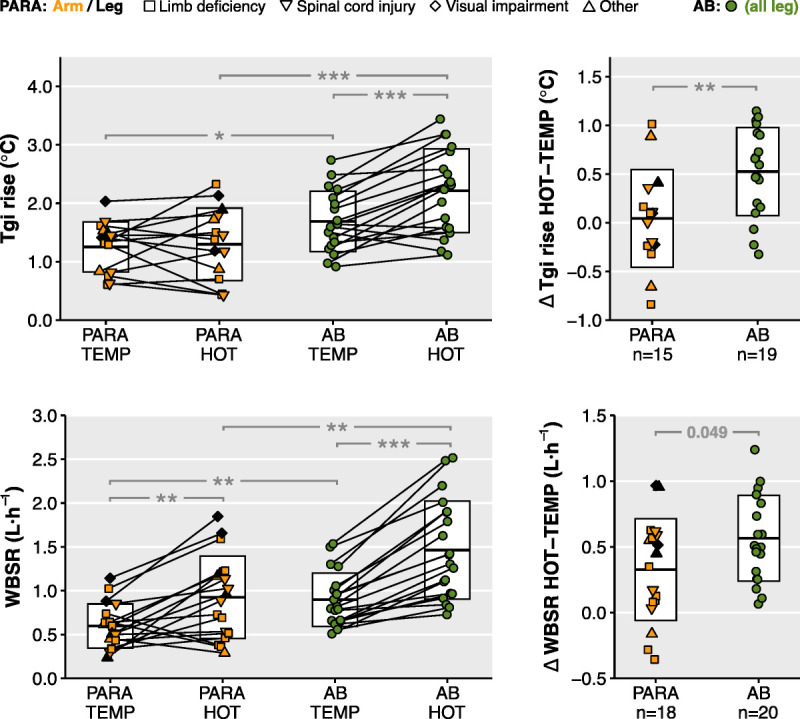
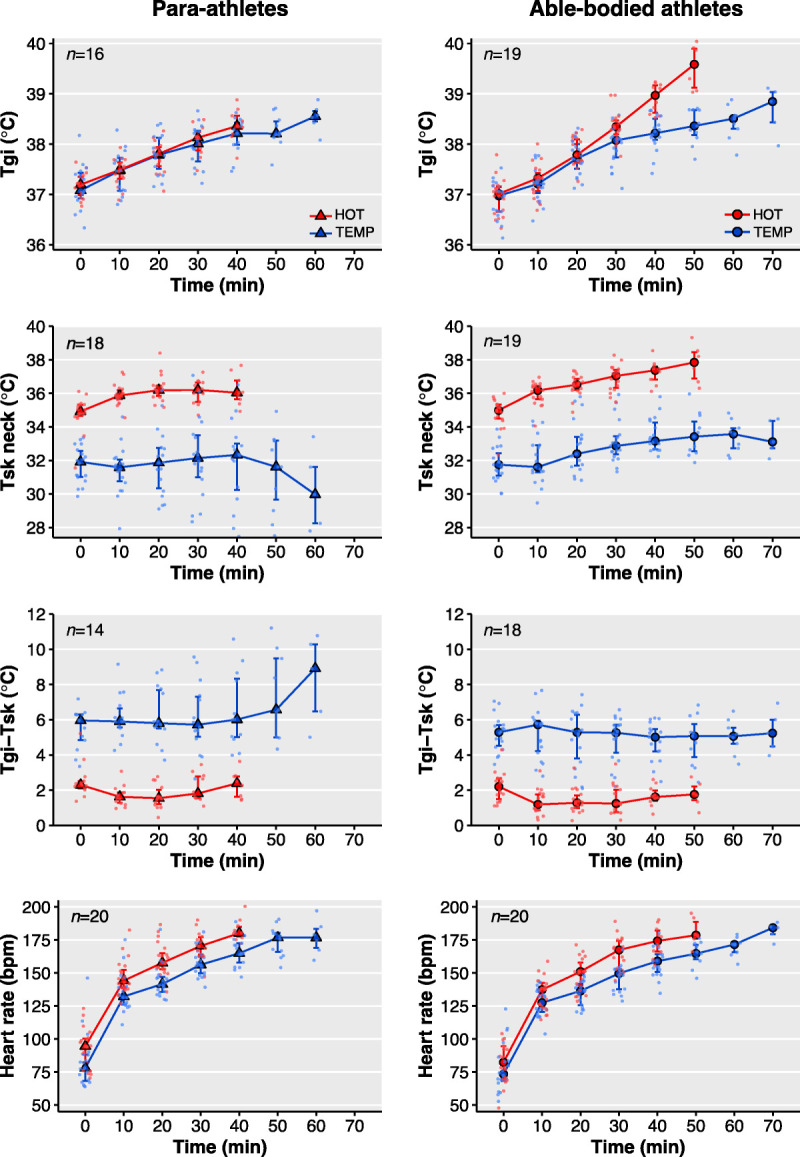
Time to exhaustion was shorter in hot-humid versus temperate conditions, with equal performance loss for para- and AB athletes (median (interquartile range), 26% (20%-31%) vs 27% (19%-32%); P = 0.80). AB athletes demonstrated larger exercise-induced increases in gastrointestinal temperature (T gi ) in hot-humid versus temperate conditions (2.2 ± 0.7 vs 1.7 ± 0.5, P < 0.001), whereas T gi responses in para-athletes were similar between conditions (1.3 ± 0.6 vs 1.3 ± 0.4, P = 0.74). Para- and AB athletes showed similar elevations in peak skin temperature ( P = 0.94), heart rate ( P = 0.67), and thermal sensation score ( P = 0.64) in hot-humid versus temperate conditions.
Elite para-athletes and AB athletes demonstrated similar performance decrements during exercise in hot-humid versus temperate conditions, whereas T gi elevations were markedly lower in para-athletes. We observed large interindividual variation within both groups, suggesting that in both para- and AB athletes, personalized heat mitigation plans should be developed based on individual thermal testing.
本研究旨在比较热湿环境对精英残障和健全运动员运动表现、体温调节反应和运动时热感觉的影响。
20 名精英残障运动员(残障自行车和轮椅网球)和 20 名精英健全运动员(公路自行车、山地自行车、沙滩排球)在温带环境(平均±标准差,15.2°C±1.2°C;相对湿度,54%±7%)和热湿环境(31.9°C±1.6°C,72%±5%)下进行递增运动测试。运动测试以 70%最大心率的 20 分钟热身开始,之后每 3 分钟功率输出增加 5%,直至力竭。
与温带环境相比,热湿环境下的运动时间更短,残障和健全运动员的运动表现下降幅度相同(中位数(四分位间距),26%(20%-31%)比 27%(19%-32%);P=0.80)。与温带环境相比,健全运动员在热湿环境下运动引起的胃肠道温度(Tgi)升高更大(2.2±0.7 比 1.7±0.5,P<0.001),而残障运动员在两种条件下的 Tgi 反应相似(1.3±0.6 比 1.3±0.4,P=0.74)。在热湿环境下,残障和健全运动员的峰值皮肤温度(P=0.94)、心率(P=0.67)和热感觉评分(P=0.64)均升高,与温带环境相似。
与温带环境相比,精英残障运动员和健全运动员在热湿环境下运动时表现出相似的下降,而残障运动员的 Tgi 升高明显较低。我们观察到两组内个体间的差异较大,这表明在残障和健全运动员中,都应根据个体的热测试制定个性化的热缓解计划。