Institute of Biology, Pedagogical University of Cracow, Podchorążych 2, 30-084, Kraków, Poland.
Department of Biotechnology and Bioinformatics, Faculty of Chemistry, Rzeszow University of Technology, Powstańców Warszawy 6, 35-959, Rzeszow, Poland.
J Appl Genet. 2022 Feb;63(1):15-33. doi: 10.1007/s13353-021-00660-1. Epub 2021 Sep 7.
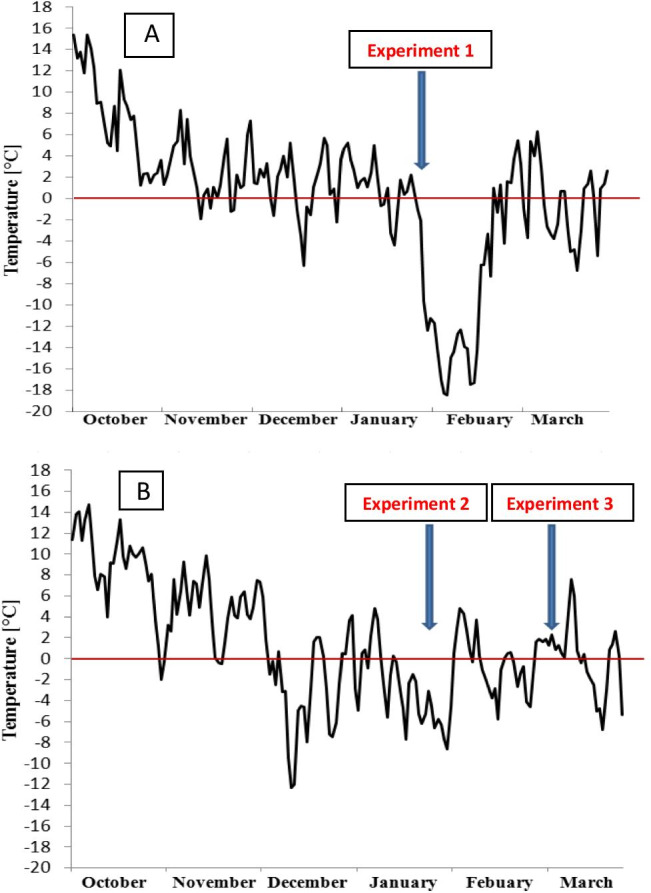
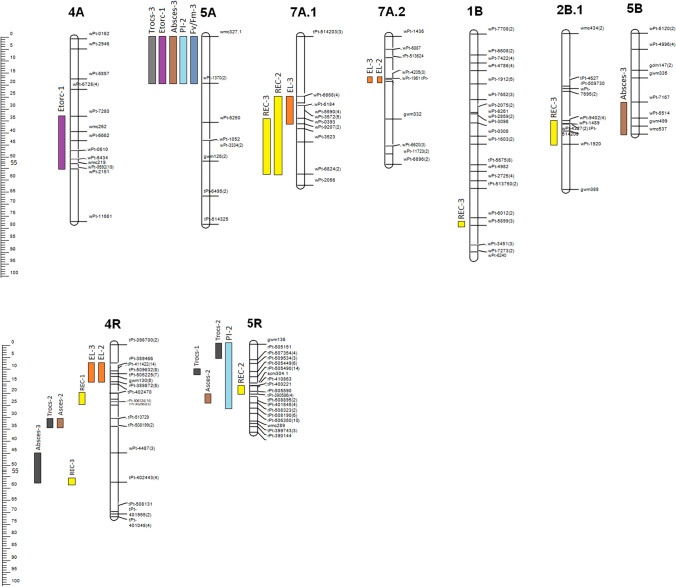
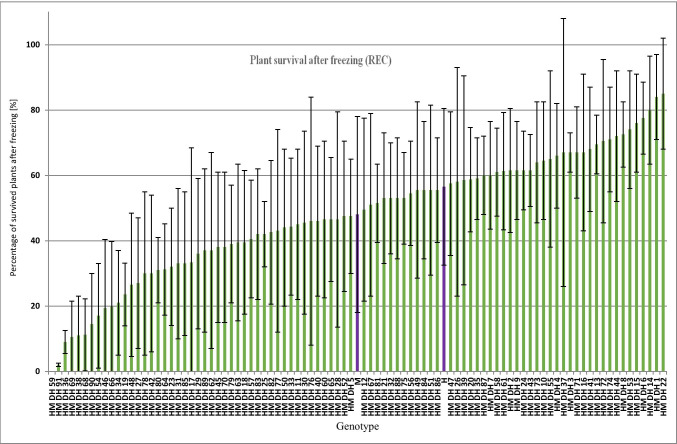
Freezing tolerance of triticale is a major trait contributing to its winter hardiness. The identification of genomic regions - quantitative trait loci (QTL) and molecular markers associated with freezing tolerance in winter hexaploid triticale - was the aim of this study. For that purpose, a new genetic linkage map was developed for the population of 92 doubled haploid lines derived from 'Hewo' × 'Magnat' F hybrid. Those lines, together with parents were subjected to freezing tolerance test three times during two winter seasons. Plants were grown and cold-hardened under natural fall/winter conditions and then subjected to freezing in controlled conditions. Freezing tolerance was assessed as the plants recovery (REC), the electrolyte leakage (EL) from leaves and chlorophyll fluorescence parameters (JIP) after freezing. Three consistent QTL for several fluorescence parameters, electrolyte leakage, and the percentage of the survived plants were identified with composite interval mapping (CIM) and single marker analysis (SMA). The first locus Qfr.hm-7A.1 explained 9% of variation of both electrolyte leakage and plants recovery after freezing. Two QTL explaining up to 12% of variation in plants recovery and shared by selected chlorophyll fluorescence parameters were found on 4R and 5R chromosomes. Finally, main locus Qchl.hm-5A.1 was detected for chlorophyll fluorescence parameters that explained up to 19.6% of phenotypic variation. The co-located QTL on chromosomes 7A.1, 4R and 5R, clearly indicated physiological and genetic relationship of the plant survival after freezing with the ability to maintain optimal photochemical activity of the photosystem II and preservation of the cell membranes integrity. The genes located in silico within the identified QTL include those encoding BTR1-like protein, transmembrane helix proteins like potassium channel, and phosphoric ester hydrolase involved in response to osmotic stress as well as proteins involved in the regulation of the gene expression, chloroplast RNA processing, and pyrimidine salvage pathway. Additionally, our results confirm that the JIP test is a valuable tool to evaluate freezing tolerance of triticale under unstable winter environments.
冬性是普通小麦与黑麦远缘杂交种——小黑麦的主要抗寒特性之一。本研究旨在鉴定与小黑麦冬性相关的基因组区域——数量性状位点(QTL)和分子标记。为此,我们以‘Hewo’בMagnat’ F1 杂种衍生的 92 个加倍单倍体(DH)系群体为材料,构建了新的遗传连锁图谱。利用该图谱,在两个冬季,对包含亲本在内的 92 个 DH 系进行了 3 次抗寒性鉴定。在自然的秋季/冬季条件下,将植株种植并进行低温驯化,然后在受控条件下进行冷冻处理。利用植株的恢复能力(REC)、叶片电解质渗出率(EL)和叶绿素荧光参数(JIP)评估抗寒性。利用复合区间作图(CIM)和单标记分析(SMA)共鉴定到与多个荧光参数、电解质渗出率和存活率相关的 3 个稳定的 QTL。第一个 QTL 位点 Qfr.hm-7A.1 可解释电解质渗出率和冷冻后植株存活率变异的 9%。在 4R 和 5R 染色体上,还发现了 2 个解释高达 12%的植株存活率的 QTL,且与选定的叶绿素荧光参数共享。最后,鉴定到一个主效 QTL Qchl.hm-5A.1,可解释高达 19.6%的叶绿素荧光参数表型变异。7A.1、4R 和 5R 染色体上的共定位 QTL 清楚地表明,植物在冷冻后的存活率与保持最佳光合系统 II 光化学活性以及维持细胞膜完整性的能力之间存在生理和遗传关系。在鉴定的 QTL 内,通过计算机预测到的基因包括编码 BTR1 样蛋白的基因、钾通道跨膜螺旋蛋白的基因以及参与渗透胁迫反应的磷酸酯水解酶的基因,以及参与基因表达调控、叶绿体 RNA 加工和嘧啶 salvage 途径的基因。此外,我们的研究结果证实,JIP 测试是评估不稳定冬季环境中小黑麦抗寒性的一种有价值的工具。