Department of Otolaryngology-Head and Neck Surgery, Gunma University Graduate School of Medicine, 3-39-22 Showa-machi, Maebashi, Gunma, 371-8511, Japan.
Division of Integrated Oncology Research, Gunma University Initiative for Advanced Research, 3-39-22 Showa-machi, Maebashi, Gunma, 371-8511, Japan.
Sci Rep. 2021 Sep 7;11(1):17789. doi: 10.1038/s41598-021-97292-6.
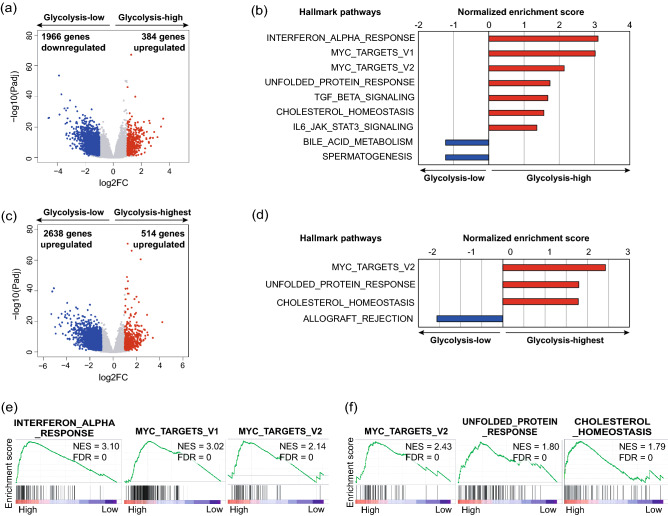
Altered metabolism is an emerging hallmark of cancer. Cancer cells preferentially utilize glycolysis for energy production, termed "aerobic glycolysis." In this study, we performed a comprehensive analysis of the glycolytic activity in head and neck squamous cell carcinoma (HNSCC) using data obtained from The Cancer Genome Atlas database. We first divided 520 patients with HNSCC into four groups based on the mRNA expression of 16 glycolysis-related genes. The upregulated glycolytic activity positively correlated with human papillomavirus-negative tumor type, advanced T factor, and unfavorable prognosis. The gene set enrichment analysis revealed upregulation of several hallmark pathways, including interferon-alpha response, myc targets, unfolded protein response, transforming growth factor-β signaling, cholesterol homeostasis, and interleukin 6-Janus kinase-signal transducer and activator of transcription 3 signaling, in the glycolysis-upregulated groups. Immune cell enrichment analysis revealed decreased infiltration of T cells, dendritic cells, and B cells in the glycolysis-upregulated groups, suggesting impaired tumor antigen presentation, T cell activation, and antibody production in the TME. Moreover, the expression profile of immune-related genes indicated increased immune evasion in the glycolysis-upregulated tumors. Collectively, these findings suggest that transcriptome analysis of glycolytic activity of tumors has the potential as a biomarker for tumor progression and immunological status in patients with HNSCC.
代谢改变是癌症的一个新兴标志。癌细胞优先利用糖酵解来产生能量,称为“有氧糖酵解”。在这项研究中,我们使用从癌症基因组图谱数据库中获得的数据,对 520 名头颈部鳞状细胞癌(HNSCC)患者的糖酵解活性进行了全面分析。我们首先根据 16 个与糖酵解相关基因的 mRNA 表达将 520 名 HNSCC 患者分为四组。上调的糖酵解活性与 HPV 阴性肿瘤类型、晚期 T 因子和不良预后呈正相关。基因集富集分析显示,上调的标志性通路包括干扰素-α反应、myc 靶点、未折叠蛋白反应、转化生长因子-β信号、胆固醇稳态和白细胞介素 6-Janus 激酶-信号转导和转录激活因子 3 信号通路,在糖酵解上调的组中。免疫细胞富集分析显示,糖酵解上调组中 T 细胞、树突状细胞和 B 细胞的浸润减少,提示 TME 中肿瘤抗原呈递、T 细胞激活和抗体产生受损。此外,免疫相关基因的表达谱表明糖酵解上调肿瘤的免疫逃逸增加。总之,这些发现表明肿瘤糖酵解活性的转录组分析有可能成为 HNSCC 患者肿瘤进展和免疫状态的生物标志物。