Human Reproduction Unit, Cruces University Hospital, Barakaldo 48903, Spain.
Human Reproduction Unit, San Pedro Hospital, Logroño 26006, Spain.
Asian J Androl. 2022 Mar-Apr;24(2):139-146. doi: 10.4103/aja202150.
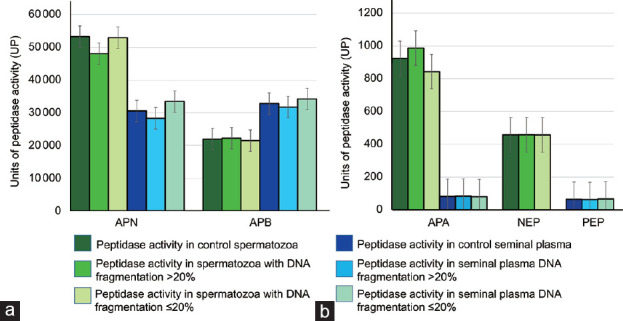
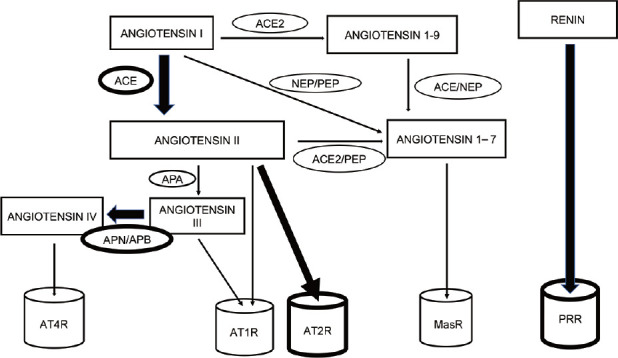
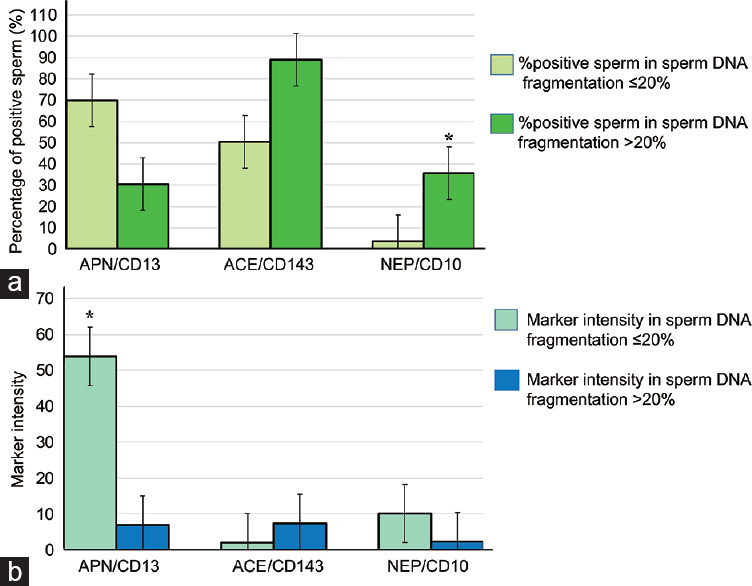
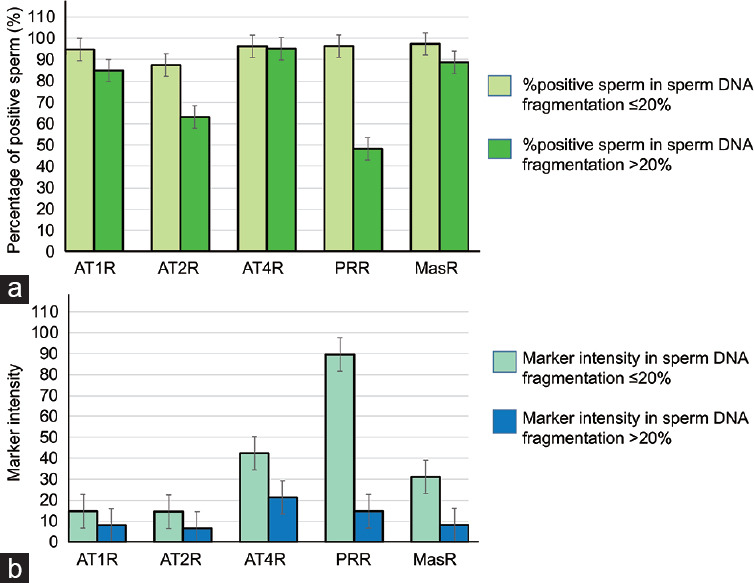
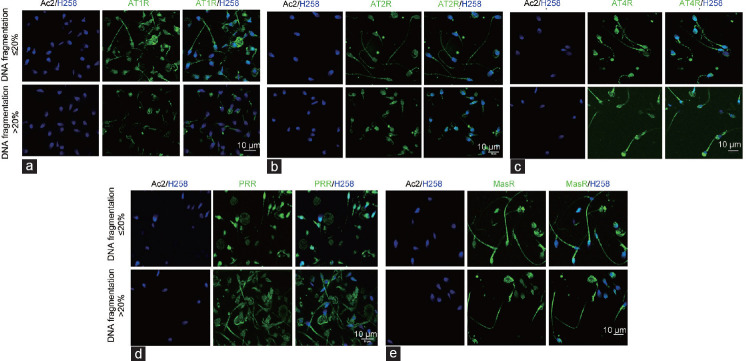
The renin angiotensin system (RAS) appears to influence male fertility at multiple levels. In this work, we analyzed the relationship between the RAS and DNA integrity. Fifty male volunteers were divided into two groups (25 each): control (DNA fragmentation ≤20%) and pathological (DNA fragmentation >20%) cases. Activities of five peptidases controlling RAS were measured fluorometrically: prolyl endopeptidase (which converts angiotensin [A] I and A II to A 1-7), neutral endopeptidase (NEP/CD10: A I to A 1-7), aminopeptidase N (APN/CD13: A III to A IV), aminopeptidase A (A II to A III) and aminopeptidase B (A III to A IV). Angiotensin-converting enzyme (A I to A II), APN/CD13 and NEP/CD10 were also assessed by semiquantitative cytometry and quantitative flow cytometry assays, as were the receptors of all RAS components: A II receptor type 1 (AT1R), A II receptor type 2 (AT2R), A IV receptor (AT4R or insulin-regulated aminopeptidase [IRAP]), (pro)renin receptor (PRR) and A 1-7 receptor or Mas receptor (MasR) None of the enzymes that regulate levels of RAS components, except for APN/CD13 (decrease in fragmented cells), showed significant differences between both groups. Micrographs of RAS receptors revealed no significant differences in immunolabeling patterns between normozoospermic and fragmented cells. Labeling of AT1R (94.3% normozoospermic vs 84.1% fragmented), AT4R (96.2% vs 95.3%) and MasR (97.4% vs 87.2%) was similar between the groups. AT2R (87.4% normozoospermic vs 63.1% fragmented) and PRR (96.4% vs 48.2%) were higher in non-fragmented spermatozoa. These findings suggest that fragmented DNA spermatozoa have a lower capacity to respond to bioactive RAS peptides.
肾素血管紧张素系统(RAS)似乎在多个层面上影响男性生育能力。在这项工作中,我们分析了 RAS 与 DNA 完整性之间的关系。将 50 名男性志愿者分为两组(每组 25 名):对照组(DNA 碎片化率≤20%)和病理性组(DNA 碎片化率>20%)。荧光法测量了控制 RAS 的五种肽酶的活性:脯氨酰内肽酶(将血管紧张素[AI]和 AII 转化为 A1-7)、中性内肽酶(NEP/CD10:AI 转化为 A1-7)、氨肽酶 N(APN/CD13:AIII 至 AIV)、氨肽酶 A(AII 转化为 AIII)和氨肽酶 B(AIII 转化为 AIV)。血管紧张素转换酶(AI 转化为 AII)、APN/CD13 和 NEP/CD10 也通过半定量细胞计数和定量流式细胞术进行了评估,以及所有 RAS 成分的受体:AII 受体 1 型(AT1R)、AII 受体 2 型(AT2R)、AIV 受体(AT4R 或胰岛素调节氨肽酶[IRAP])、(前)肾素受体(PRR)和 A1-7 受体或 Mas 受体(MasR)。除 APN/CD13(碎片化细胞减少)外,调节 RAS 成分水平的酶均未显示两组之间存在显著差异。RAS 受体的显微镜照片显示,正常精子和碎片化细胞之间的免疫标记模式没有明显差异。AT1R(94.3%正常精子对 84.1%碎片化)、AT4R(96.2%对 95.3%)和 MasR(97.4%对 87.2%)的标记在两组之间相似。AT2R(87.4%正常精子对 63.1%碎片化)和 PRR(96.4%对 48.2%)在非碎片化精子中更高。这些发现表明,碎片化的 DNA 精子对生物活性 RAS 肽的反应能力较低。