KG Jebsen Coeliac Disease Research Centre, University of Oslo, Oslo, 0372, Norway.
Institute of Clinical Medicine, University of Oslo, Oslo, 0450, Norway.
Adv Sci (Weinh). 2021 Nov;8(21):e2102778. doi: 10.1002/advs.202102778. Epub 2021 Sep 8.
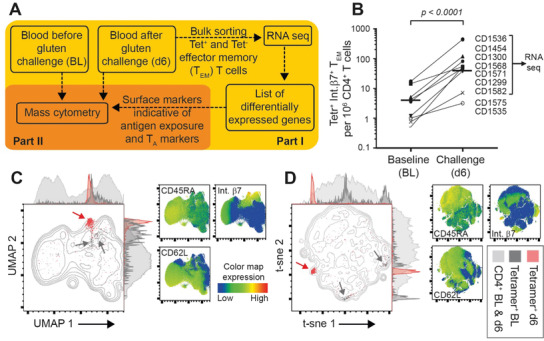
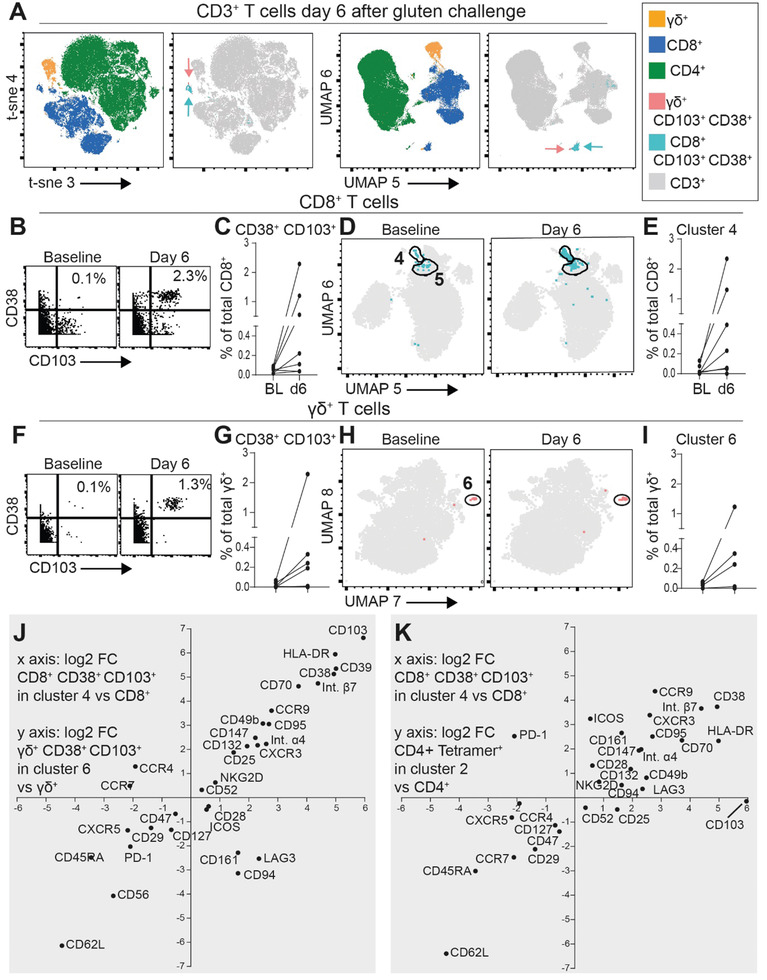
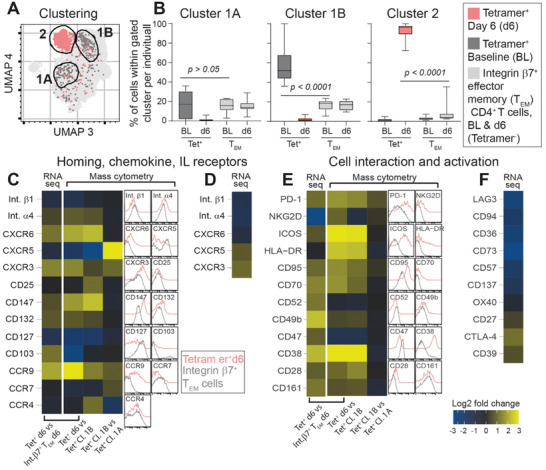
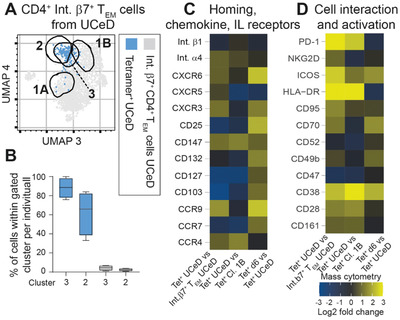
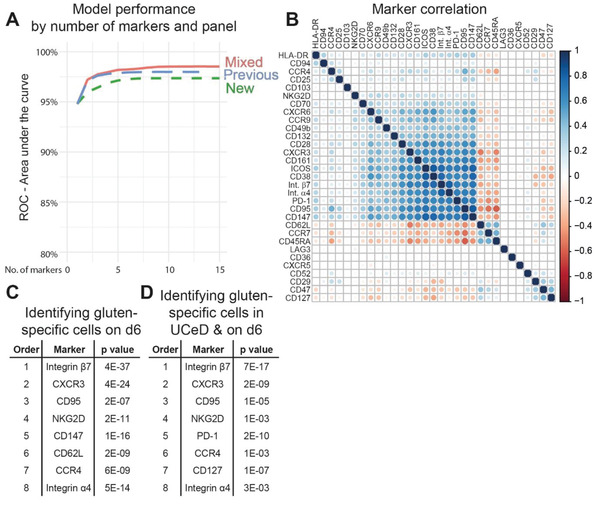
Gluten-specific CD4 T cells being drivers of celiac disease (CeD) are obvious targets for immunotherapy. Little is known about how cell markers harnessed for T-cell-directed therapy can change with time and upon activation in CeD and other autoimmune conditions. In-depth characterization of gluten-specific CD4 T cells and CeD-associated (CD38 and CD103 ) CD8 and γδ T cells in blood of treated CeD patients undergoing a 3 day gluten challenge is reported. The phenotypic profile of gluten-specific cells changes profoundly with gluten exposure and the cells adopt the profile of gluten-specific cells in untreated disease (CD147 , CD70 , programmed cell death protein 1 (PD-1) , inducible T-cell costimulator (ICOS) , CD28 , CD95 , CD38 , and CD161 ), yet with some markers being unique for day 6 cells (C-X-C chemokine receptor type 6 (CXCR6), CD132, and CD147) and with integrin α4β7, C-C motif chemokine receptor 9 (CCR9), and CXCR3 being expressed stably at baseline and day 6. Among gluten-specific CD4 T cells, 52% are CXCR5 at baseline, perhaps indicative of germinal-center reactions, while on day 6 all are CXCR5 . Strikingly, the phenotypic profile of gluten-specific CD4 T cells on day 6 largely overlaps with that of CeD-associated (CD38 and CD103 ) CD8 and γδ T cells. The antigen-induced shift in phenotype of CD4 T cells being shared with other disease-associated T cells is relevant for development of T-cell-directed therapies.
针对乳糜泻(CeD)的谷蛋白特异性 CD4 T 细胞是免疫治疗的明显靶点。然而,对于用于 T 细胞定向治疗的细胞标志物如何随时间和 CeD 及其他自身免疫性疾病中的激活而变化,我们知之甚少。本文报道了经治疗的 CeD 患者在接受为期 3 天的谷蛋白挑战时,血液中谷蛋白特异性 CD4 T 细胞和 CeD 相关(CD38 和 CD103)CD8 和 γδ T 细胞的深入特征。谷蛋白暴露后,谷蛋白特异性细胞的表型特征发生了深刻变化,并且这些细胞呈现出未经治疗疾病中谷蛋白特异性细胞的特征(CD147、CD70、程序性细胞死亡蛋白 1(PD-1)、诱导型 T 细胞共刺激分子(ICOS)、CD28、CD95、CD38 和 CD161),但有一些标志物仅存在于第 6 天的细胞中(C-X-C 趋化因子受体类型 6(CXCR6)、CD132 和 CD147),整合素 α4β7、C-C 基序趋化因子受体 9(CCR9)和 CXCR3 在基线和第 6 天稳定表达。在谷蛋白特异性 CD4 T 细胞中,有 52%在基线时为 CXCR5,这可能表明发生了生发中心反应,而在第 6 天时所有细胞均为 CXCR5。引人注目的是,第 6 天谷蛋白特异性 CD4 T 细胞的表型特征与 CeD 相关(CD38 和 CD103)CD8 和 γδ T 细胞的表型特征大部分重叠。与其他疾病相关 T 细胞共享 CD4 T 细胞的抗原诱导表型转变对于开发 T 细胞定向治疗具有重要意义。