Lymphoma Program, Abramson Cancer Center.
Institute for Immunology, and.
Blood. 2022 Feb 17;139(7):1026-1038. doi: 10.1182/blood.2021012634.
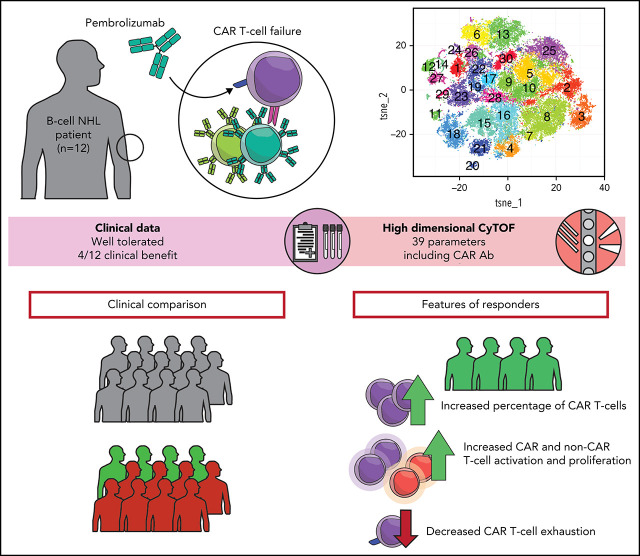
CD19-directed chimeric antigen receptor-modified (CAR T) T cells achieve durable remissions in about 30% to 40% of relapsed/refractory large B-cell lymphomas. T-cell exhaustion and/or an immunosuppressive tumor microenvironment may contribute to CAR T-cell failure. Pembrolizumab, an anti-PD1 immune checkpoint inhibitor, may reverse T-cell exhaustion after CAR T-cell therapy. We treated 12 patients with B-cell lymphomas who were either refractory to (n = 9) or relapsed after (n = 3) CD19-directed CAR T-cell (4-1BB-costimulated) therapy with pembrolizumab 200 mg IV every 3 weeks. Median time from CAR T-cell infusion to first pembrolizumab dose was 3.3 months (range, 0.4-42.8 months). Pembrolizumab was well tolerated, and the only grade ≥3 adverse events related to pembrolizumab were neutropenia (n = 3; 25%). Best overall response rate after pembrolizumab was 25% (3 of 12 patients; 1 complete response; 2 partial responses). One (8%) patient had stable disease; thus, 4 of 12 (33%) patients had clinical benefit. After pembrolizumab, 4 patients with clinical benefit had an increase in percentage of CAR T cells by mass cytometry by time of flight (CyTOF); 3 of 4 of these patients also had increases in CAR19 transgene levels by quantitative polymerase chain reaction. Deep immune profiling using CyTOF revealed increased CAR T-cell activation and proliferation and less T-cell exhaustion in clinical responders. Together, PD1 blockade with pembrolizumab after CD19-directed CAR T-cell therapy appears safe and may achieve clinical responses in some patients with B-cell lymphomas refractory to or relapsed after CAR T-cell therapy. This trial was registered at www.clinicaltrials.gove as #NCT02650999.
CD19 定向嵌合抗原受体修饰 (CAR T) T 细胞在约 30%至 40%的复发/难治性大 B 细胞淋巴瘤中实现持久缓解。T 细胞衰竭和/或免疫抑制性肿瘤微环境可能导致 CAR T 细胞失效。Pembrolizumab,一种抗 PD1 免疫检查点抑制剂,可能在 CAR T 细胞治疗后逆转 T 细胞衰竭。我们用 Pembrolizumab(200mg IV 每 3 周一次)治疗了 12 例 B 细胞淋巴瘤患者,这些患者要么对 CD19 定向 CAR T 细胞(4-1BB 共刺激)治疗(n=9)有反应,要么在 CAR T 细胞治疗后复发(n=3)。从 CAR T 细胞输注到首次 Pembrolizumab 剂量的中位时间为 3.3 个月(范围,0.4-42.8 个月)。Pembrolizumab 耐受性良好,唯一与 Pembrolizumab 相关的 3 级以上不良事件为中性粒细胞减少症(n=3;25%)。Pembrolizumab 后的最佳总体缓解率为 25%(12 例患者中有 3 例;1 例完全缓解,2 例部分缓解)。1 例(8%)患者疾病稳定;因此,12 例中有 4 例(33%)患者有临床获益。在 Pembrolizumab 治疗后,4 例有临床获益的患者通过飞行时间(CyTOF)的质谱流式细胞术检测到 CAR T 细胞的百分比增加;其中 4 例中有 3 例通过定量聚合酶链反应检测到 CAR19 转基因水平升高。使用 CyTOF 进行的深度免疫分析显示,在临床应答者中,CAR T 细胞的激活和增殖增加,而 T 细胞衰竭减少。总之,在 CD19 定向 CAR T 细胞治疗后使用 Pembrolizumab 进行 PD1 阻断似乎是安全的,并可能在一些对 CAR T 细胞治疗有反应或复发的 B 细胞淋巴瘤患者中实现临床缓解。该试验在 www.clinicaltrials.gov 上注册,编号为 #NCT02650999。