Department of Thoracic Surgery, Shanghai Pulmonary Hospital, School of Medicine, Tongji University, Shanghai, 200433, P. R. China.
Sun Yat-sen University Cancer Center, State Key Laboratory of Oncology in South China, Collaborative Innovation Center for Cancer Medicine, Guangzhou, 510060, P. R. China.
BMC Cancer. 2021 Sep 9;21(1):1009. doi: 10.1186/s12885-021-08741-4.
This study aimed to investigate the incidence and long-term survival outcomes of occult lung cancer between 2004 and 2015.
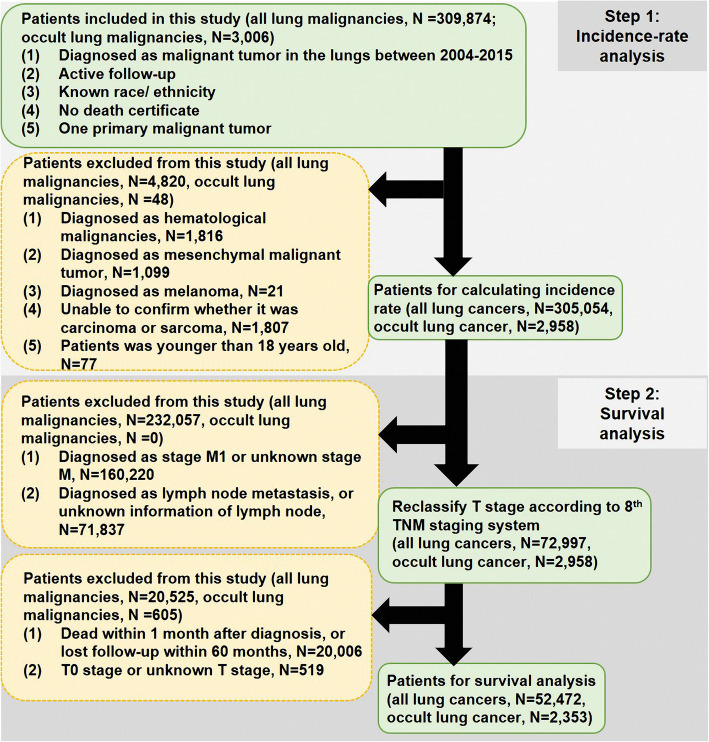
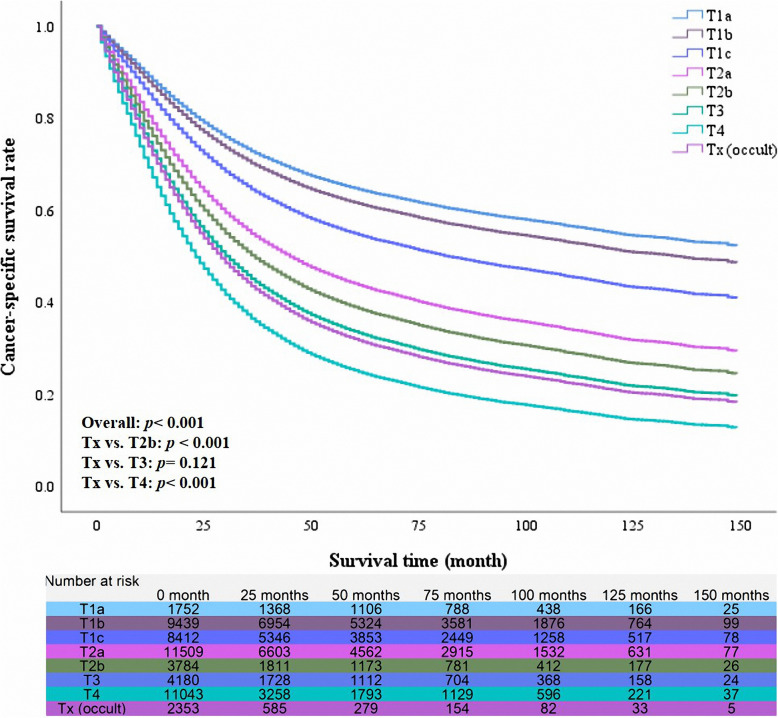
A total of 2958 patients were diagnosed with occult lung cancer in the 305,054 patients with lung cancer. The entire cohort was used to calculate the crude incidence rate. Eligible 52,472 patients (T1-xN0M0, including 2353 occult lung cancers) were selected from the entire cohort to perform survival analyses after translating T classification according to the 8th TNM staging system. Cancer-specific survival curves for different T classifications were presented.
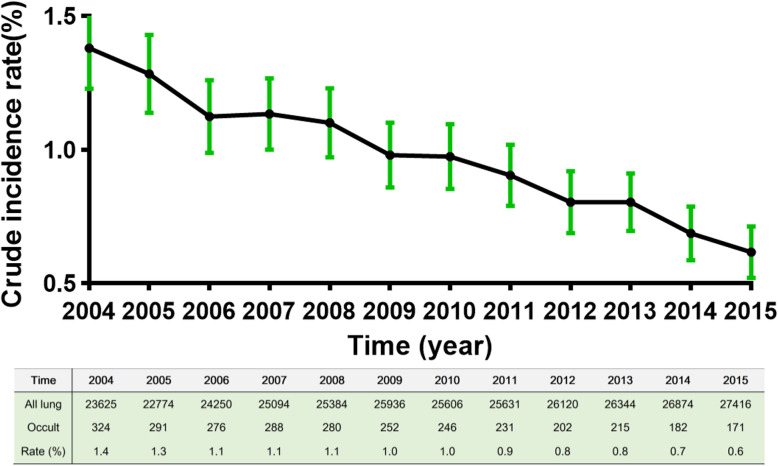
The crude incidence rate of occult lung cancer was 1.00 per 100 patients, and it was reduced between 2004 and 2015 [1.4 per 100 persons in 2004; 0.6 per 100 persons in 2015; adjusted risk ratio = 0.437, 95% confidence interval (CI) 0.363-0.527]. In the survival analysis, there were 2206 death events in the 2353 occult lung cancers. The results of the multivariable analysis revealed that the prognoses with occult lung cancer were similar to patients with stage T3N0M0 (adjusted hazard ratio = 1.054, 95% CI 0.986-1.127, p = 0.121). Adjusted survival curves presented the same results. In addition, adjusted for other confounders, female, age ≤ 72 years, surgical treatment, radiotherapy, adenocarcinoma, and non-squamous and non-adenocarcinoma non-small cell carcinoma were independent protective prognostic factors (all p < 0.05).
Occult lung cancer was uncommon. However, the cancer-specific survival of occult lung cancer was poor, therefore, we should put the assessment of its prognoses on the agenda. Timely surgical treatment and radiotherapy could improve survival outcomes for those patients. Besides, we still need more research to confirm those findings.
本研究旨在探讨 2004 年至 2015 年间隐匿性肺癌的发病率和长期生存结局。
在 305054 例肺癌患者中,共有 2958 例被诊断为隐匿性肺癌。整个队列用于计算粗发病率。从整个队列中选择符合条件的 52472 例患者(T1-xN0M0,包括 2353 例隐匿性肺癌),根据第 8 版 TNM 分期系统翻译 T 分类后进行生存分析。呈现了不同 T 分类的癌症特异性生存曲线。
隐匿性肺癌的粗发病率为 1.00/100 例,2004 年至 2015 年间有所下降[2004 年每 100 人 1.4 例;2015 年每 100 人 0.6 例;调整风险比=0.437,95%置信区间(CI)0.363-0.527]。在生存分析中,2353 例隐匿性肺癌中有 2206 例死亡事件。多变量分析结果显示,隐匿性肺癌的预后与 T3N0M0 期患者相似(调整后的危险比=1.054,95%CI 0.986-1.127,p=0.121)。调整后的生存曲线呈现相同的结果。此外,调整其他混杂因素后,女性、年龄≤72 岁、手术治疗、放疗、腺癌、非鳞状非腺癌非小细胞癌是独立的预后保护因素(均 p<0.05)。
隐匿性肺癌并不常见。然而,隐匿性肺癌的癌症特异性生存率较差,因此,我们应将其预后评估提上日程。及时的手术治疗和放疗可以改善患者的生存结果。此外,我们仍需要更多的研究来证实这些发现。