He Siyi, Li He, Cao Maomao, Sun Dianqin, Yang Fan, Yan Xinxin, Zhang Shaoli, He Yutong, Du Lingbin, Sun Xibin, Wang Ning, Zhang Min, Wei Kuangrong, Lei Lin, Xia Changfa, Peng Ji, Chen Wanqing
Office of Cancer Screening, National Cancer Center/National Clinical Research Center for Cancer/Cancer Hospital, Chinese Academy of Medical Sciences and Peking Union Medical College/Chinese Academy of Medical Sciences Key Laboratory for National Cancer Big Data Analysis and Implement, Beijing, China.
Cancer Institute, the Fourth Hospital of Hebei Medical University/the Tumor Hospital of Hebei Province, Shijiazhuang, China.
Transl Lung Cancer Res. 2022 Aug;11(8):1591-1605. doi: 10.21037/tlcr-22-240.
Representative prognostic data by clinical characteristics for lung cancer is not yet available in China. This study aimed to calculate the survival of lung cancer patients with different pathological evaluations, explore their predictive effects and provide information for prognosis improvement.
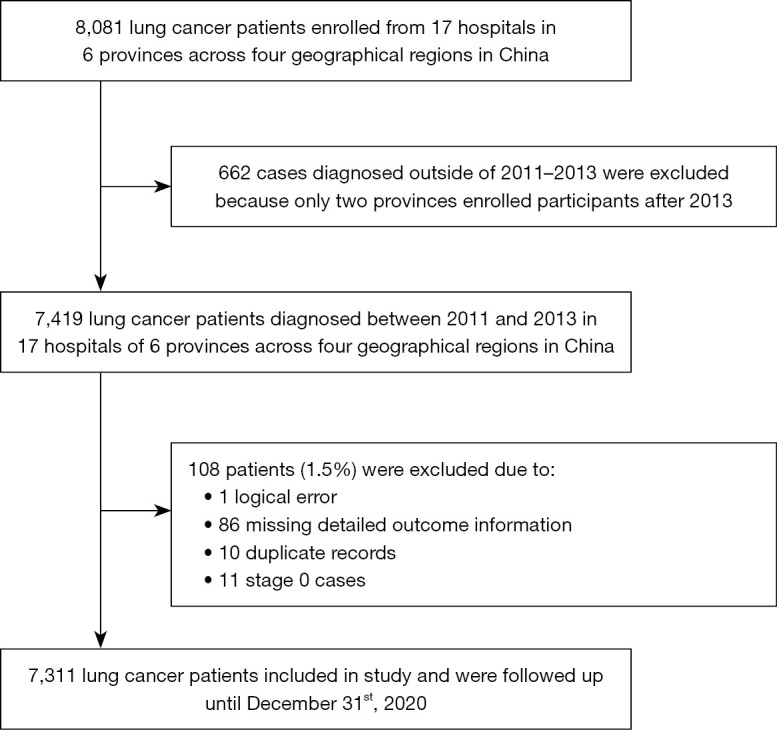
In this multicenter cohort study, primary lung cancer patients diagnosed in 17 hospitals at three distinct levels in China between 2011-2013 were enrolled and followed up till 2020. Overall survival and lung cancer specific survival were calculated by Kaplan-Meier method. Cox proportional hazards model was applied to assess the effects of predictors of lung cancer survival.
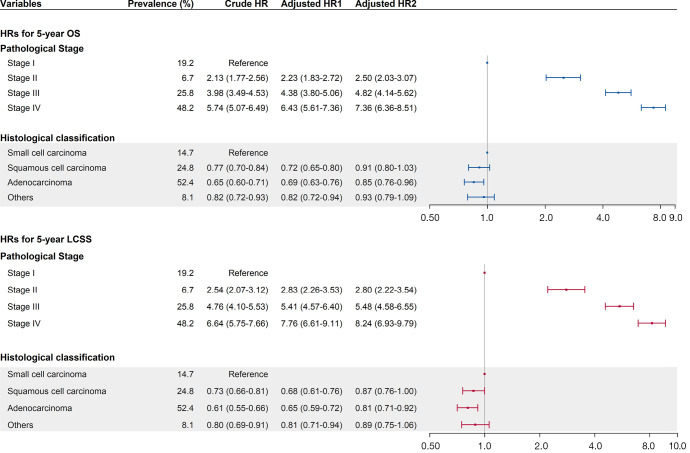
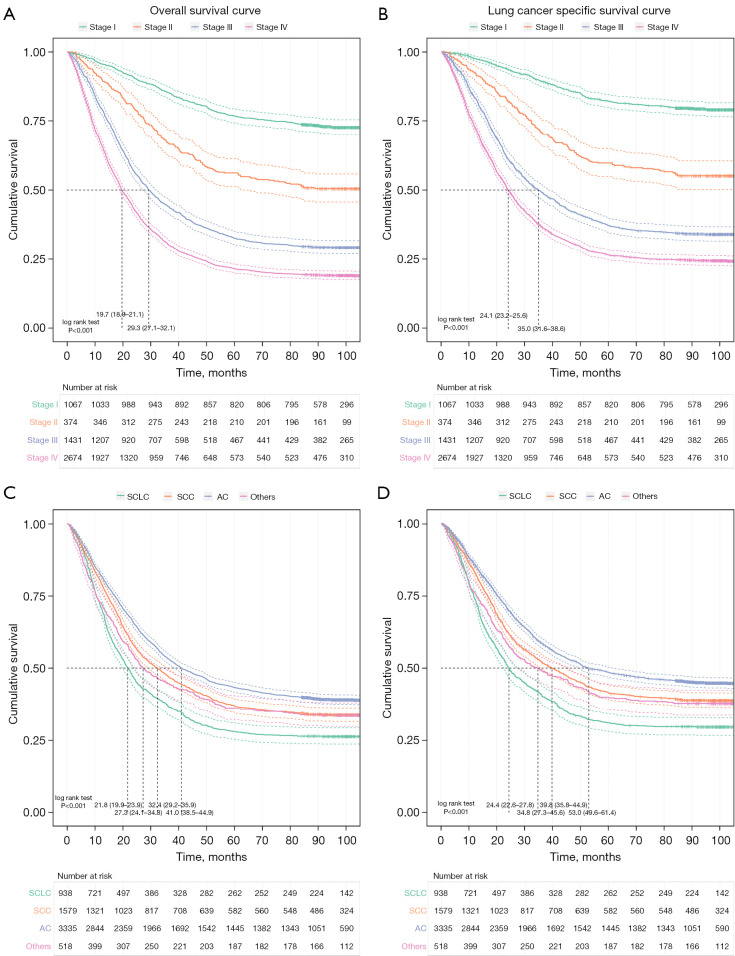
Of all the 7,311 patients, the 5-year overall and lung cancer specific survival rates were 37.0% and 41.6%, respectively. For lung cancer patients at stages I, II, III, and IV, the 5-year overall survival rates were 76.9%, 56.1%, 32.6%, and 21.4%, respectively; the lung cancer specific survival rates were 82.3%, 59.7%, 37.2%, and 26.4%, respectively. Differences of survival for each stage remained significant between histological classifications (P<0.01). The 5-year overall survival rates for patients with squamous cell carcinoma, adenocarcinoma (AC), and small cell carcinoma were 36.9%, 43.3% and 27.9%, respectively; the corresponding disease-specific rates were 41.5%, 48.6% and 31.0%, respectively. Such differences were non-statistically significant at advanced stages (P=0.09). After multivariate adjustments, stage and classification remained independent predictors for the survival of lung cancer.
The prognosis of lung cancer varied with the pathological stages and histological classifications, and had room for improvement. Stage was the strongest predictor, so efforts on early detection and treatment are needed.
中国尚未有基于临床特征的肺癌代表性预后数据。本研究旨在计算不同病理评估的肺癌患者生存率,探索其预测作用,并为改善预后提供信息。
在这项多中心队列研究中,纳入了2011年至2013年在中国三个不同级别17家医院诊断的原发性肺癌患者,并随访至2020年。采用Kaplan-Meier法计算总生存率和肺癌特异性生存率。应用Cox比例风险模型评估肺癌生存预测因素的作用。
在所有7311例患者中,5年总生存率和肺癌特异性生存率分别为37.0%和41.6%。对于I、II、III和IV期肺癌患者,5年总生存率分别为76.9%、56.1%、32.6%和21.4%;肺癌特异性生存率分别为82.3%、59.7%、37.2%和26.4%。各期生存差异在组织学分类之间仍具有显著性(P<0.01)。鳞状细胞癌、腺癌(AC)和小细胞癌患者的5年总生存率分别为36.9%、43.3%和27.9%;相应的疾病特异性生存率分别为41.5%、48.6%和31.0%。在晚期阶段,这种差异无统计学意义(P=0.09)。多因素调整后,分期和分类仍然是肺癌生存的独立预测因素。
肺癌预后随病理分期和组织学分类而异,且有改善空间。分期是最强的预测因素,因此需要努力进行早期检测和治疗。