RIKEN Center for Brain Science, Laboratory for the Neural Circuitry of Learning and Memory, 2-1 Hirosawa, Wako-shi, Saitama, 351-0198, Japan.
Department of Life Sciences, Graduate School of Arts and Sciences, University of Tokyo, 3-8-1 Komaba, Meguro-ku, Tokyo, 153-8902, Japan.
Mol Brain. 2021 Sep 8;14(1):136. doi: 10.1186/s13041-021-00844-0.
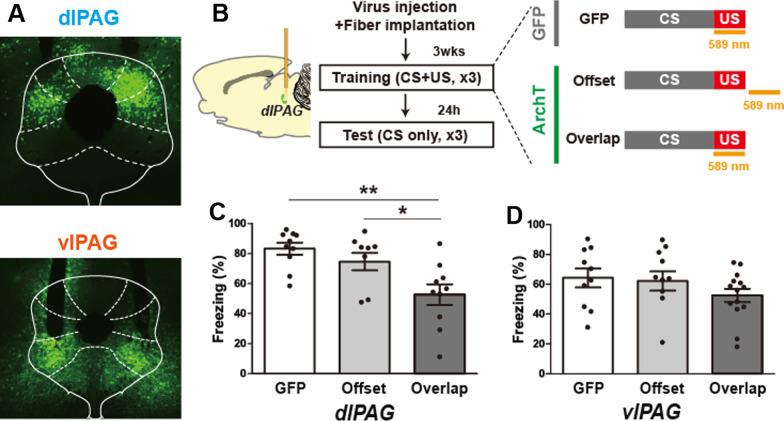
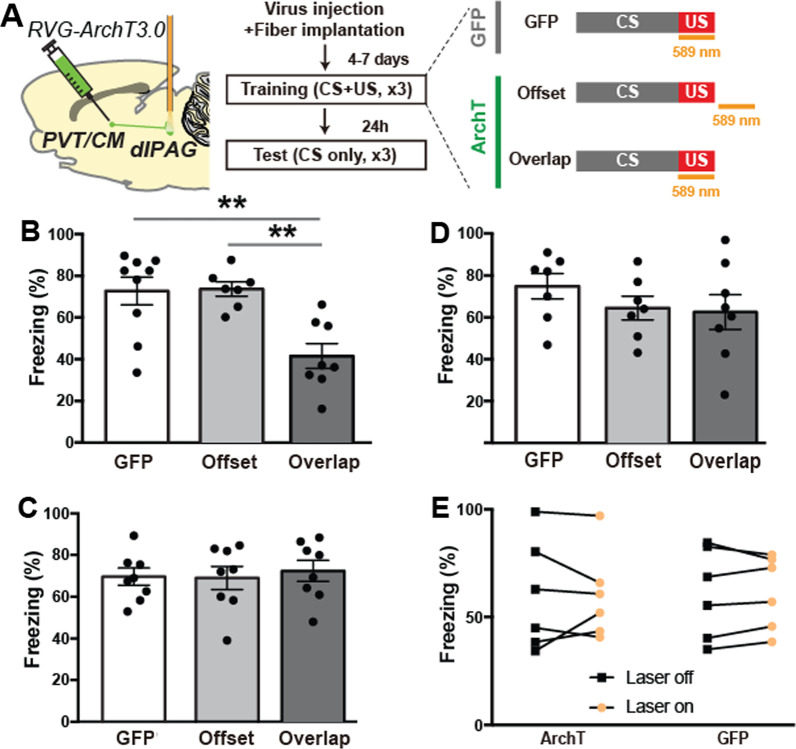
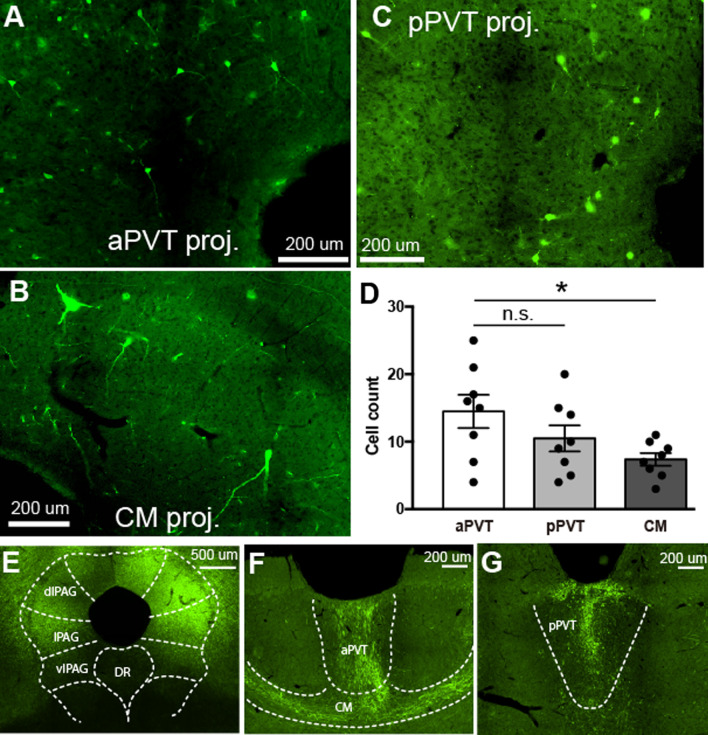
Innately aversive experiences produce rapid defensive responses and powerful emotional memories. The midbrain periaqueductal gray (PAG) drives defensive behaviors through projections to brainstem motor control centers, but the PAG has also been implicated in aversive learning, receives information from aversive-signaling sensory systems and sends ascending projections to the thalamus as well as other forebrain structures which could control learning and memory. Here we sought to identify PAG subregions and cell types which instruct memory formation in response to aversive events. We found that optogenetic inhibition of neurons in the dorsolateral subregion of the PAG (dlPAG), but not the ventrolateral PAG (vlPAG), during an aversive event reduced memory formation. Furthermore, inhibition of a specific population of thalamus projecting dlPAG neurons projecting to the anterior paraventricular thalamus (aPVT) reduced aversive learning, but had no effect on the expression of previously learned defensive behaviors. By contrast, inactivation of dlPAG neurons which project to the posterior PVT (pPVT) or centromedial intralaminar thalamic nucleus (CM) had no effect on learning. These results reveal specific subregions and cell types within PAG responsible for its learning related functions.
先天厌恶体验会产生快速的防御反应和强烈的情绪记忆。中脑导水管周围灰质(PAG)通过投射到脑干运动控制中心来驱动防御行为,但 PAG 也与厌恶学习有关,它接收来自厌恶信号感觉系统的信息,并向上投射到丘脑以及其他前脑结构,这些结构可以控制学习和记忆。在这里,我们试图确定 PAG 的亚区和细胞类型,这些亚区和细胞类型在应对厌恶事件时指导记忆形成。我们发现,在厌恶事件期间,光遗传学抑制 PAG 背外侧亚区(dlPAG)的神经元,但不是腹外侧 PAG(vlPAG),会减少记忆形成。此外,抑制投射到前室旁丘脑(aPVT)的特定丘脑投射 dlPAG 神经元群体会减少厌恶学习,但对先前习得的防御行为的表达没有影响。相比之下,抑制投射到后室旁丘脑(pPVT)或中央中脑内丘脑核(CM)的 dlPAG 神经元对学习没有影响。这些结果揭示了 PAG 中负责其学习相关功能的特定亚区和细胞类型。