Psychology Department, University of California Los Angeles, Los Angeles, California, USA.
Nat Neurosci. 2010 Aug;13(8):979-86. doi: 10.1038/nn.2594. Epub 2010 Jul 4.
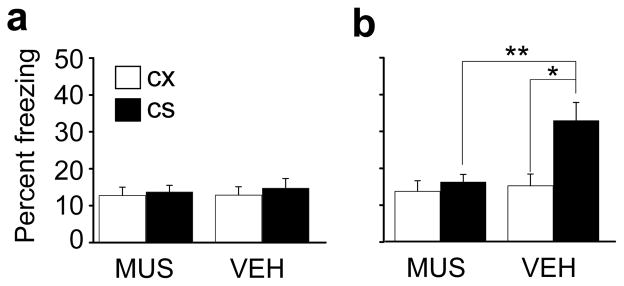
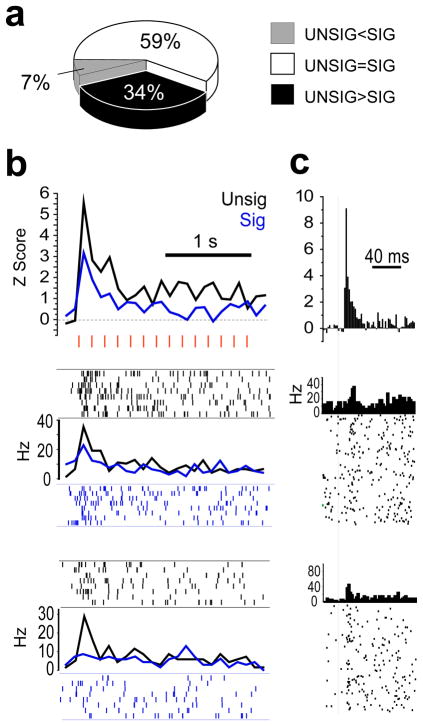
A form of aversively motivated learning called fear conditioning occurs when a neutral conditioned stimulus is paired with an aversive unconditioned stimulus (UCS). UCS-evoked depolarization of amygdala neurons may instruct Hebbian plasticity that stores memories of the conditioned stimulus-unconditioned stimulus association, but the origin of UCS inputs to the amygdala is unknown. Theory and evidence suggest that instructive UCS inputs to the amygdala will be inhibited when the UCS is expected, but this has not been found during fear conditioning. We investigated neural pathways that relay information about the UCS to the amygdala by recording neurons in the amygdala and periaqueductal gray (PAG) of rats during fear conditioning. UCS-evoked responses in both amygdala and PAG were inhibited by expectation. Pharmacological inactivation of the PAG attenuated UCS-evoked responses in the amygdala and impaired acquisition of fear conditioning, indicating that PAG may be an important part of the pathway that relays instructive signals to the amygdala.
一种称为恐惧条件反射的厌恶动机学习形式发生在中性条件刺激与厌恶无条件刺激 (UCS) 配对时。UCS 诱发的杏仁核神经元去极化可能指导赫布氏可塑性,存储条件刺激-无条件刺激关联的记忆,但 UCS 输入到杏仁核的起源尚不清楚。理论和证据表明,当 UCS 被预期时,对杏仁核的有指导意义的 UCS 输入将被抑制,但在恐惧条件反射中尚未发现这一点。我们通过在恐惧条件反射期间记录大鼠杏仁核和导水管周围灰质 (PAG) 的神经元,研究了将 UCS 信息传递到杏仁核的神经通路。UCS 诱发的杏仁核和 PAG 的反应均被预期抑制。PAG 的药理学失活减弱了杏仁核中 UCS 诱发的反应,并损害了恐惧条件反射的获得,表明 PAG 可能是将有指导意义的信号传递到杏仁核的通路的重要组成部分。