Cardiothoracic Surgery, Leiden University Medical Center, Leiden, The Netherlands.
Cardiothoracic Surgery, Amsterdam UMC Locatie AMC, Amsterdam, The Netherlands.
Open Heart. 2021 Sep;8(2). doi: 10.1136/openhrt-2021-001772.
Bicuspid aortic valve (BAV) has been associated with less atherosclerosis as compared with tricuspid aortic valve (TAV) patients. It, however, remains unclear whether this reflects the older age of TAV patients and/or accumulation of atherosclerotic risk factors or that the BAV phenotype is atheroprotective. Therefore, we compared the atherosclerotic disease burden of BAV and TAV patients, with that of the general (age-matched) population.
The prevalence of coronary artery disease (CAD) and CAD risk factors in BAV and TAV patients who underwent aortic valve surgery were compared with the Dutch general practitioners registry data. BAV (n=454) and TAV (n=1101) patients were divided into four groups: BAV with aortic valve stenosis (BAV-AoS), BAV with aortic valve regurgitation (BAV-AR), TAV with AoS (TAV-AoS) and TAV with AR (TAV-AR). The atherosclerotic disease burden of each group was compared with that of the corresponding age cohort for the general population.
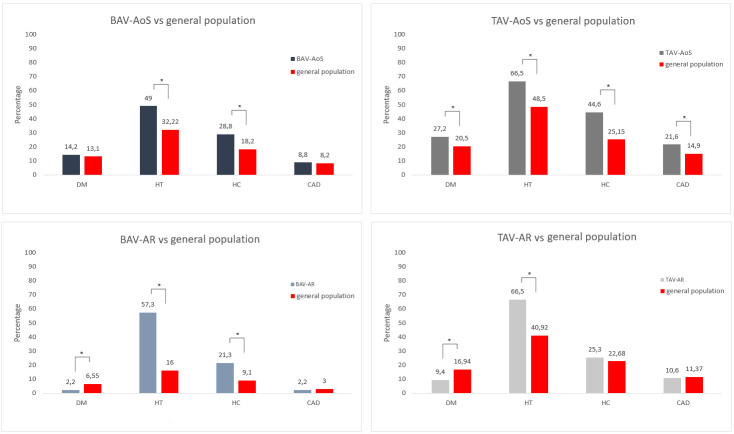
CAD risk factors hypertension and hypercholesterolaemia were more prevalent in the surgery groups than the age-matched general population (all p<0.001). All BAVs (BAV-AoS and BAV-AR) and TAV-AR had a similar incidence of CAD history as compared to the age-matched general populations (p=0.689, p=0.325 and p=0.617 respectively), whereas TAV-AoS had a higher incidence (21.6% versus 14.9% in the age-matched general population, p<0.001).
Stenotic TAV disease is part of the atherosclerotic disease spectrum, while regurgitant TAV and all BAVs are not. Although the prevalence of cardiovascular risk factors is higher in all BAV patients, the prevalence of CAD is similar to the general population.
与三尖瓣主动脉瓣(TAV)患者相比,二叶式主动脉瓣(BAV)患者的动脉粥样硬化程度较低。然而,目前尚不清楚这是反映 TAV 患者年龄较大和/或动脉粥样硬化危险因素的积累,还是 BAV 表型具有抗动脉粥样硬化作用。因此,我们比较了 BAV 和 TAV 患者的动脉粥样硬化疾病负担与普通人群(年龄匹配)的动脉粥样硬化疾病负担。
比较了接受主动脉瓣手术的 BAV 和 TAV 患者的冠心病(CAD)患病率和 CAD 危险因素,并与荷兰全科医生登记处的数据进行了比较。将 BAV(n=454)和 TAV(n=1101)患者分为四组:BAV 伴主动脉瓣狭窄(BAV-AoS)、BAV 伴主动脉瓣反流(BAV-AR)、TAV 伴 AoS(TAV-AoS)和 TAV 伴 AR(TAV-AR)。比较每组的动脉粥样硬化疾病负担与相应年龄组的普通人群。
与年龄匹配的普通人群相比,手术组的 CAD 危险因素高血压和高胆固醇血症更为普遍(均 p<0.001)。与年龄匹配的普通人群相比,所有 BAV(BAV-AoS 和 BAV-AR)和 TAV-AR 的 CAD 病史发生率相似(p=0.689,p=0.325 和 p=0.617),而 TAV-AoS 的发生率较高(21.6%比年龄匹配的普通人群中的 14.9%,p<0.001)。
狭窄性 TAV 疾病是动脉粥样硬化疾病谱的一部分,而反流性 TAV 和所有 BAV 则不是。尽管所有 BAV 患者的心血管危险因素患病率较高,但 CAD 的患病率与普通人群相似。