European Research Executive Agency, Place Charles Rogier 16, 1210 Bruxelles, Belgium.
Laboratory of Food Chemistry and Technology, School of Chemical Engineering, National Technical University of Athens, Iron Politechniou 9, 15780 Athens, Greece.
Molecules. 2021 Sep 6;26(17):5405. doi: 10.3390/molecules26175405.
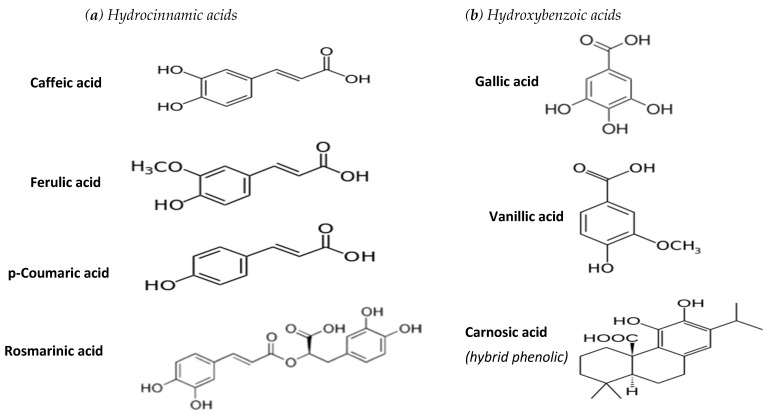
Phenolic acids comprise a class of phytochemical compounds that can be extracted from various plant sources and are well known for their antioxidant and anti-inflammatory properties. A few of the most common naturally occurring phenolic acids (i.e., caffeic, carnosic, ferulic, gallic, p-coumaric, rosmarinic, vanillic) have been identified as ingredients of edible botanicals (thyme, oregano, rosemary, sage, mint, etc.). Over the last decade, clinical research has focused on a number of in vitro (in human cells) and in vivo (animal) studies aimed at exploring the health protective effects of phenolic acids against the most severe human diseases. In this review paper, the authors first report on the main structural features of phenolic acids, their most important natural sources and their extraction techniques. Subsequently, the main target of this analysis is to provide an overview of the most recent clinical studies on phenolic acids that investigate their health effects against a range of severe pathologic conditions (e.g., cancer, cardiovascular diseases, hepatotoxicity, neurotoxicity, and viral infections-including coronaviruses-based ones).
酚酸是一类植物化学物质,可以从各种植物源中提取,因其具有抗氧化和抗炎特性而广为人知。一些最常见的天然酚酸(如咖啡酸、迷迭香酸、阿魏酸、没食子酸、对香豆酸、鼠尾草酸、香草酸)已被确定为食用植物(百里香、牛至、迷迭香、鼠尾草、薄荷等)的成分。在过去的十年中,临床研究集中在许多体外(在人类细胞中)和体内(动物)研究上,旨在探索酚酸对人类最严重疾病的健康保护作用。在这篇综述论文中,作者首先报告了酚酸的主要结构特征、它们最重要的天然来源和提取技术。随后,本次分析的主要目标是概述最近关于酚酸的临床研究,这些研究调查了它们对一系列严重病理状况(如癌症、心血管疾病、肝毒性、神经毒性和病毒性感染——包括基于冠状病毒的感染)的健康影响。