Silva Henrique, Lopes Nuno Miguel F
CBIOS - Universidade Lusófona's Research Center for Biosciences and Health Technologies, Lisboa, Portugal.
Department of Pharmacological Sciences, Faculty of Pharmacy, Universidade de Lisboa, Lisbon, Portugal.
Front Physiol. 2020 Nov 27;11:595516. doi: 10.3389/fphys.2020.595516. eCollection 2020.
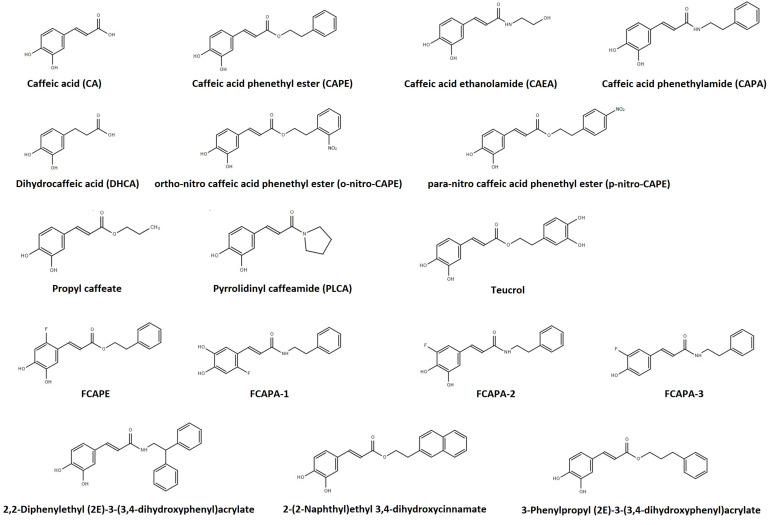
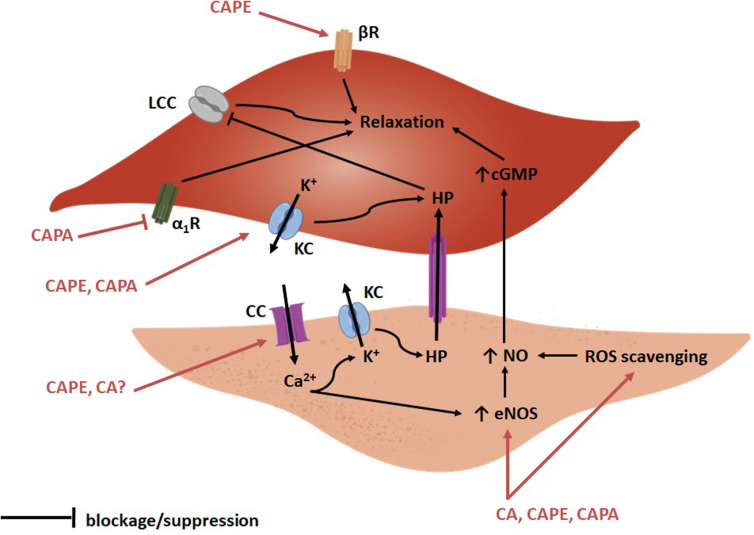
Caffeic acid (CA) and its phenethyl ester (CAPE) are naturally occurring hydroxycinnamic acids with an interesting array of biological activities; e.g., antioxidant, anti-inflammatory, antimicrobial and cytostatic. More recently, several synthetic analogs have also shown similar properties, and some with the advantage of added stability. The actions of these compounds on the cardiovascular system have not been thoroughly explored despite presenting an interesting potential. Indeed the mechanisms underlying the vascular effects of these compounds particularly need clarifying. The aim of this paper is to provide a comprehensive and up-to-date review on current knowledge about CA and its derivatives in the cardiovascular system. Caffeic acid, CAPE and the synthetic caffeic acid phenethyl amide (CAPA) exhibit vasorelaxant activity by acting on the endothelial and vascular smooth muscle cells. Vasorelaxant mechanisms include the increased endothelial NO secretion, modulation of calcium and potassium channels, and modulation of adrenergic receptors. Together with a negative chronotropic effect, vasorelaxant activity contributes to lower blood pressure, as several preclinical studies show. Their antioxidant, anti-inflammatory and anti-angiogenic properties contribute to an important anti-atherosclerotic effect, and protect tissues against ischemia/reperfusion injuries and the cellular dysfunction caused by different physico-chemical agents. There is an obvious shortage of studies to further explore these compounds' potential in vascular physiology. Nevertheless, their favorable pharmacokinetic profile and overall lack of toxicity make these compounds suitable for clinical studies.
咖啡酸(CA)及其苯乙酯(CAPE)是天然存在的羟基肉桂酸,具有一系列有趣的生物活性,例如抗氧化、抗炎、抗菌和抑制细胞生长。最近,几种合成类似物也显示出类似的性质,有些还具有稳定性增强的优点。尽管这些化合物具有有趣的潜力,但其对心血管系统的作用尚未得到充分探索。实际上,这些化合物血管效应的潜在机制尤其需要阐明。本文的目的是对目前关于CA及其衍生物在心血管系统中的知识提供全面且最新的综述。咖啡酸、CAPE和合成的咖啡酸苯乙酰胺(CAPA)通过作用于内皮细胞和血管平滑肌细胞表现出血管舒张活性。血管舒张机制包括增加内皮一氧化氮分泌、调节钙通道和钾通道以及调节肾上腺素能受体。正如一些临床前研究所示,血管舒张活性与负性变时作用一起有助于降低血压。它们的抗氧化、抗炎和抗血管生成特性有助于产生重要的抗动脉粥样硬化作用,并保护组织免受缺血/再灌注损伤以及不同物理化学因子引起的细胞功能障碍。目前明显缺乏进一步探索这些化合物在血管生理学中潜力的研究。然而,它们良好的药代动力学特征以及总体上缺乏毒性使得这些化合物适合进行临床研究。