Office of the Executive Director, Centre for Injury Prevention and Research Bangladesh (CIPRB), Dhaka 1206, Bangladesh.
College of Nursing, Midwifery and Healthcare, University of West London, London W5 5RF, UK.
Int J Environ Res Public Health. 2021 Sep 2;18(17):9259. doi: 10.3390/ijerph18179259.
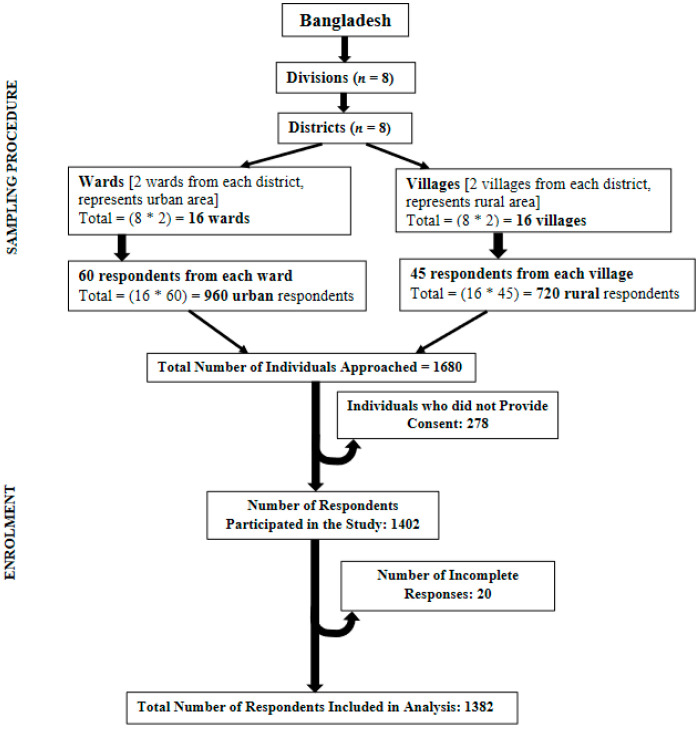
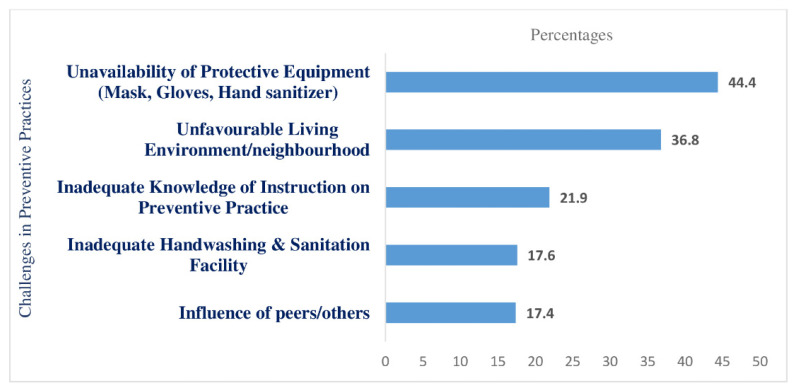
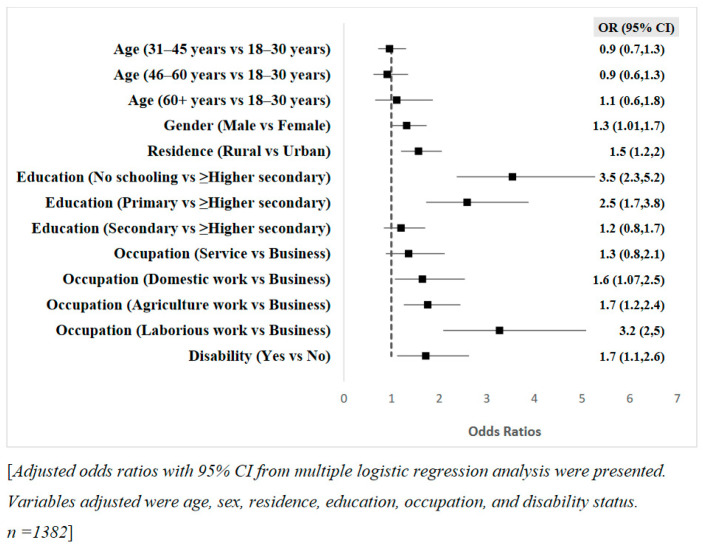
Bangladesh recently experienced a COVID-19 second wave, resulting in the highest number of new cases and deaths in a single day. This study aims to identify the challenges for COVID-19 preventive practices and risk communications and associated factors among Bangladeshi adults. A cross-sectional survey was conducted between December 2020 and January 2021 involving 1382 Bangladeshi adults (aged ≥ 18-years) in randomly selected urban and rural areas from all eight divisions in Bangladesh. Descriptive data analysis was conducted to highlight the challenges for preventive practices and risk communications for COVID-19. Multiple logistic regression analysis was used to determine the sociodemographic groups vulnerable to these challenges. Lack of availability of protective equipment (44.4%), crowded living situations/workspaces (36.8%), inadequate information on the proper use of protective measures (21.9%), inadequate handwashing and sanitation facilities (17.6%), and negative influences on family/friends (17.4%) were identified as barriers to COVID-19 preventive practices. It was also found that males (OR = 1.3, 95% CI = 1.01, 1.7), rural residents (OR = 1.5, 95% CI = 1.2, 2), respondents with a low level of education: no schooling vs. ≥higher secondary (OR = 3.5, 95% CI = 2.3, 5.2), primary vs. ≥higher secondary (OR = 2.5, 95% CI = 1.7, 3.8), respondents engaged in agricultural (OR = 1.7, 95% CI = 1.2, 2.4), laboring (OR = 3.2, 95% CI = 2, 5), and domestic works (OR = 1.6, 95% CI = 1.07, 2.5), and people with disabilities (OR = 1.7, 95% CI = 1.1, 2.6) were all likely to have difficulty in practicing effective COVID-19 protective behaviors. Respondents' education and occupation were significant predictors of inadequate understanding of COVID-19 risk communications and was identified as a problem among 17.4% of the respondents. A substantial percentage of Bangladeshi adults have difficulty practising COVID-19 protective behaviours and have poor comprehension of risk communications, particularly in rural areas and among those with low education. This research can aid policymakers in developing tailored COVID-19 risk communications and mitigation strategies to help prevent future waves of the pandemic.
孟加拉国最近经历了 COVID-19 的第二波疫情,单日新增病例和死亡人数均创历史新高。本研究旨在确定孟加拉国成年人 COVID-19 预防措施和风险沟通方面的挑战,以及相关因素。2020 年 12 月至 2021 年 1 月期间,在孟加拉国所有 8 个行政区的城市和农村地区,采用整群随机抽样方法,对 1382 名年龄≥18 岁的孟加拉国成年人进行了横断面调查。采用描述性数据分析方法突出 COVID-19 预防措施和风险沟通方面的挑战。采用多因素逻辑回归分析确定易受这些挑战影响的社会人口学群体。缺乏防护设备(44.4%)、居住/工作空间拥挤(36.8%)、缺乏关于正确使用防护措施的信息(21.9%)、缺乏洗手和卫生设施(17.6%)以及家庭/朋友的负面影响(17.4%)被认为是 COVID-19 预防措施的障碍。研究还发现,男性(OR=1.3,95%CI=1.01,1.7)、农村居民(OR=1.5,95%CI=1.2,2)、受教育程度低的人:未受教育与≥高中(OR=3.5,95%CI=2.3,5.2)、小学与≥高中(OR=2.5,95%CI=1.7,3.8)、从事农业(OR=1.7,95%CI=1.2,2.4)、体力劳动(OR=3.2,95%CI=2,5)和家政工作(OR=1.6,95%CI=1.07,2.5)以及残疾人(OR=1.7,95%CI=1.1,2.6)都不太可能有效地实施 COVID-19 保护行为。受访者的教育和职业是对 COVID-19 风险沟通理解不足的重要预测因素,17.4%的受访者认为这是一个问题。相当一部分孟加拉国成年人在实施 COVID-19 保护行为方面存在困难,对风险沟通的理解也较差,尤其是在农村地区和受教育程度较低的人群中。本研究可以帮助政策制定者制定有针对性的 COVID-19 风险沟通和缓解策略,以帮助预防未来的疫情浪潮。